Department of Anatomy and Cellular Biology, Tufts University School of Medicine, Boston, MA 02111, USA.
Environ Health Perspect. 2013 Sep;121(9):1040-6. doi: 10.1289/ehp.1306734. Epub 2013 Jul 23.
Environmental exposure to bisphenol A (BPA) affects mammary gland development in rodents and primates. Prenatal exposure to environmentally relevant doses of BPA increased the number of intraductal hyperplasias and ductal carcinomas in situ by 50 days of age in Wistar-Furth rats.
We aimed to determine whether BPA exposure of dams during gestation only or throughout lactation affects the incidence of mammary gland neoplasia in female offspring.
We treated pregnant Sprague-Dawley rats with BPA at 0, 0.25, 2.5, 25, or 250 μg BPA/kg BW/day from gestational day (GD) 9 to birth and from GD9 to postnatal day (PND) 21. Mammary glands from BPA-exposed offspring were examined at four time points for preneoplastic and neoplastic lesions. To assess circulating BPA levels, we exposed pregnant rats to vehicle or 250 μg BPA/kg BW/day during gestation only or during gestation/lactation and analyzed sera from dams, fetuses, and nursing pups for total and unconjugated BPA.
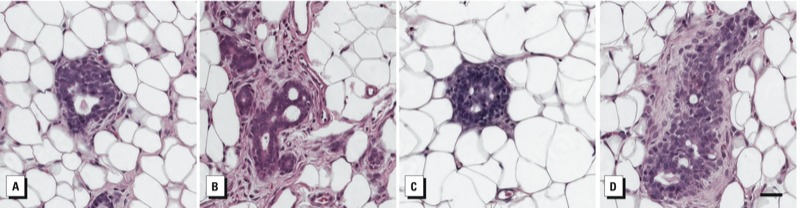
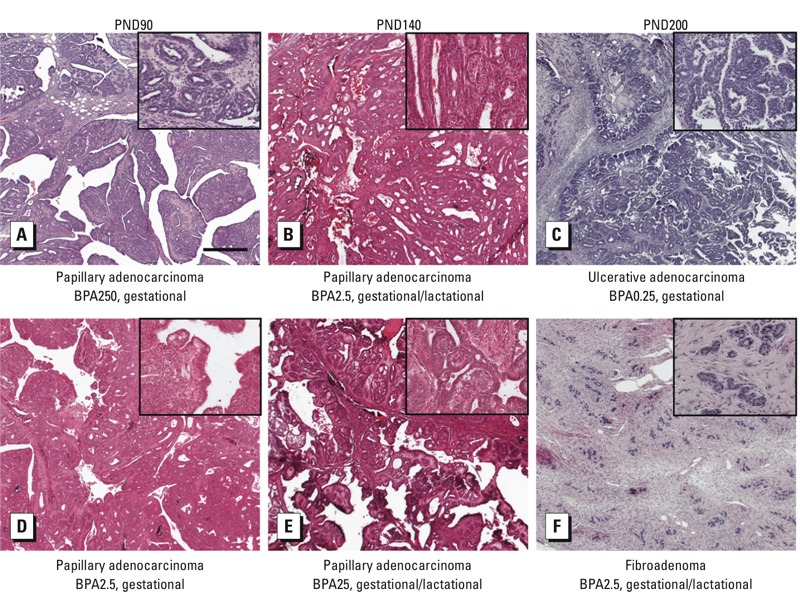
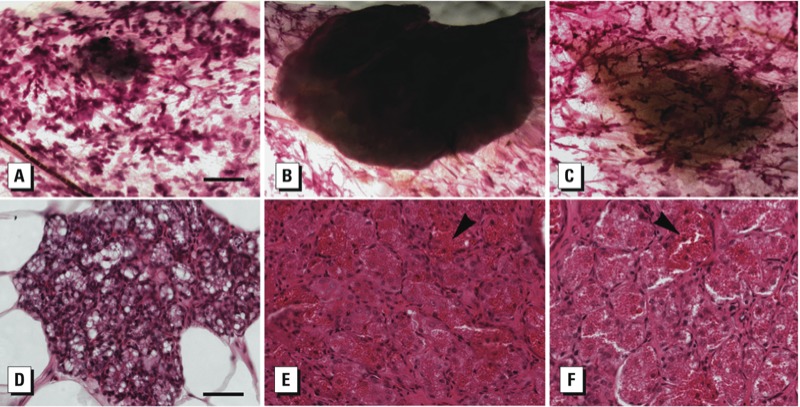
Total and unconjugated BPA were detected in sera from 100% of dams and fetuses and 33% of pups exposed to 250 μg BPA/kg BW/day. Unconjugated BPA levels in exposed dams and fetuses (gestational) and in exposed dams and pups (gestational/lactational) were within levels found in humans. Preneoplastic lesions developed in BPA-exposed female offspring across all doses as early as PND50. Unexpectedly, mammary gland adenocarcinomas developed in BPA-exposed offspring by PND90.
Our findings suggest that developmental exposure to environmentally relevant levels of BPA during gestation and lactation induces mammary gland neoplasms in the absence of any additional carcinogenic treatment. Thus, BPA may act as a complete mammary gland carcinogen.
环境暴露于双酚 A(BPA)会影响啮齿动物和灵长类动物的乳腺发育。在 Wistar-Furth 大鼠中,妊娠期间暴露于环境相关剂量的 BPA 会使乳腺管内增生和原位导管癌的数量在 50 天大时增加 50%。
我们旨在确定母体在妊娠期间或整个哺乳期暴露于 BPA 是否会影响雌性后代乳腺肿瘤的发生率。
我们用 BPA 处理妊娠 Sprague-Dawley 大鼠,剂量分别为 0、0.25、2.5、25 或 250μg BPA/kg BW/天,从妊娠第 9 天(GD)至出生,以及从 GD9 至产后第 21 天(PND)。用 BPA 处理的雌性后代的乳腺在四个时间点检查,以评估其是否有前肿瘤和肿瘤病变。为了评估循环 BPA 水平,我们在妊娠期间仅用 250μg BPA/kg BW/天或在妊娠/哺乳期用 250μg BPA/kg BW/天暴露于怀孕的大鼠,并分析母体、胎儿和哺乳期幼崽的血清中的总 BPA 和非共轭 BPA。
暴露于 250μg BPA/kg BW/天的母体、胎儿和 33%的幼崽血清中检测到总 BPA 和非共轭 BPA。暴露于 250μg BPA/kg BW/天的母体和胎儿(妊娠)以及暴露于 250μg BPA/kg BW/天的母体和幼崽(妊娠/哺乳期)的非共轭 BPA 水平在人类发现的水平范围内。在所有剂量下,BPA 暴露的雌性后代在 PND50 时就已出现前肿瘤病变。出乎意料的是,BPA 暴露的后代在 PND90 时出现了乳腺腺癌。
我们的研究结果表明,在妊娠和哺乳期暴露于环境相关水平的 BPA 会诱导乳腺肿瘤的发生,而无需任何其他致癌处理。因此,BPA 可能是一种完整的乳腺致癌剂。