Bacterial Foodborne Pathogens and Mycology Research Unit, USDA-ARS-NCAUR, 1815 N. University St., Peoria, IL 61604, USA.
Toxins (Basel). 2013 Jul 19;5(7):1299-313. doi: 10.3390/toxins5071299.
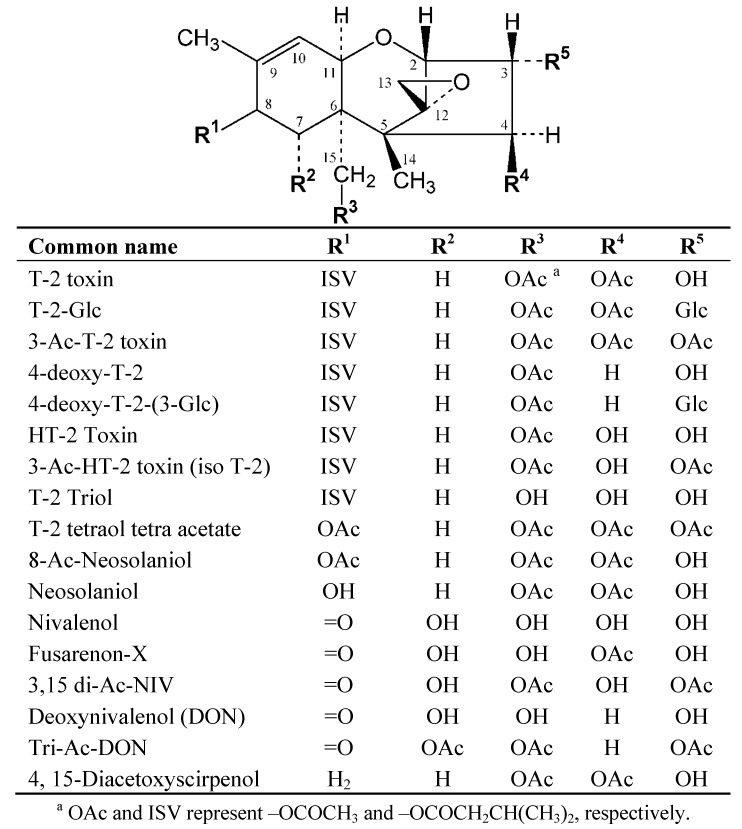
The interactions between fungi and plants can yield metabolites that are toxic in animal systems. Certain fungi are known to produce sesquiterpenoid trichothecenes, such as T-2 toxin, that are biotransformed by several mechanisms including glucosylation. The glucosylated forms have been found in grain and are of interest as potential reservoirs of T-2 toxin that are not detected by many analytical methods. Hence the glucosides of trichothecenes are often termed "masked" mycotoxins. The glucoside of T-2 toxin (T2-Glc) was linked to keyhole limpet hemocyanin and used to produce antibodies in mice. Ten monoclonal antibody (Mab)-producing hybridoma cell lines were developed. The Mabs were used in immunoassays to detect T2-Glc and T-2 toxin, with midpoints of inhibition curves (IC50s) in the low ng/mL range. Most of the Mabs demonstrated good cross-reactivity to T-2 toxin, with lower recognition of HT-2 toxin. One of the clones (2-13) was further characterized with in-depth cross-reactivity and solvent tolerance studies. Results suggest Mab 2-13 will be useful for the simultaneous detection of T-2 toxin and T2-Glc.
真菌与植物的相互作用会产生在动物系统中有毒的代谢物。某些真菌已知会产生倍半萜烯曲古霉素,如 T-2 毒素,它通过几种机制被生物转化,包括葡糖苷化。葡糖苷化形式已在谷物中被发现,并且作为 T-2 毒素的潜在储库引起关注,许多分析方法都无法检测到。因此,曲古霉素的糖苷常被称为“掩盖”的霉菌毒素。T-2 毒素的糖苷(T2-Glc)与贻贝血红蛋白连接,并用于在小鼠中产生抗体。开发了 10 株产生单克隆抗体 (Mab) 的杂交瘤细胞系。这些 Mab 被用于免疫测定法来检测 T2-Glc 和 T-2 毒素,抑制曲线的中点 (IC50) 在低 ng/mL 范围内。大多数 Mab 对 T-2 毒素表现出良好的交叉反应性,对 HT-2 毒素的识别较低。其中一个克隆(2-13)进一步进行了深入的交叉反应性和溶剂耐受性研究。结果表明,Mab 2-13 将有助于同时检测 T-2 毒素和 T2-Glc。