Department of Psychiatry, Vanderbilt University, Nashville, Tennessee; Department of Psychiatry, University of Szeged, 6725 Szeged, Hungary.
Department of Psychiatry, Vanderbilt University, Nashville, Tennessee; Vanderbilt Kennedy Center for Research on Human Development, Vanderbilt University, Nashville, Tennessee; Department of Psychiatry, University of Szeged, 6725 Szeged, Hungary.
Biol Psychiatry. 2014 Feb 15;75(4):316-23. doi: 10.1016/j.biopsych.2013.06.010. Epub 2013 Jul 25.
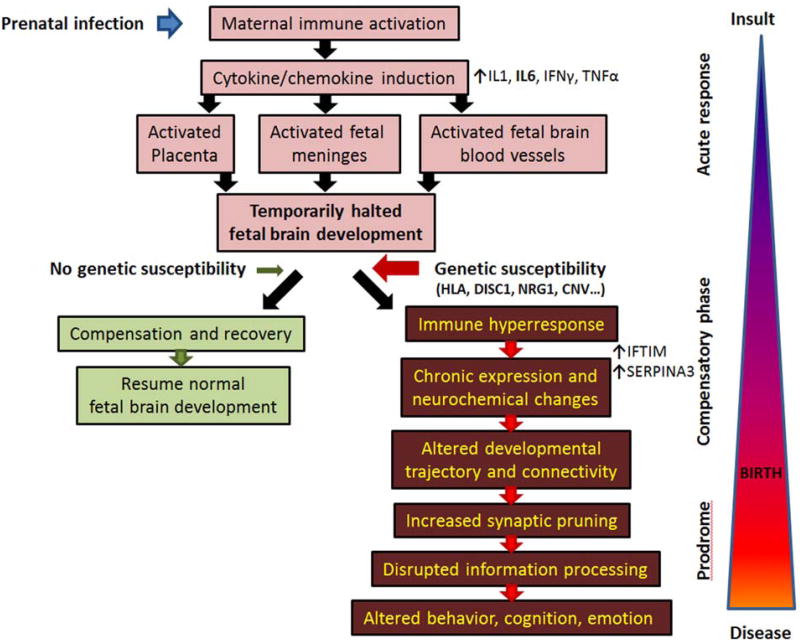
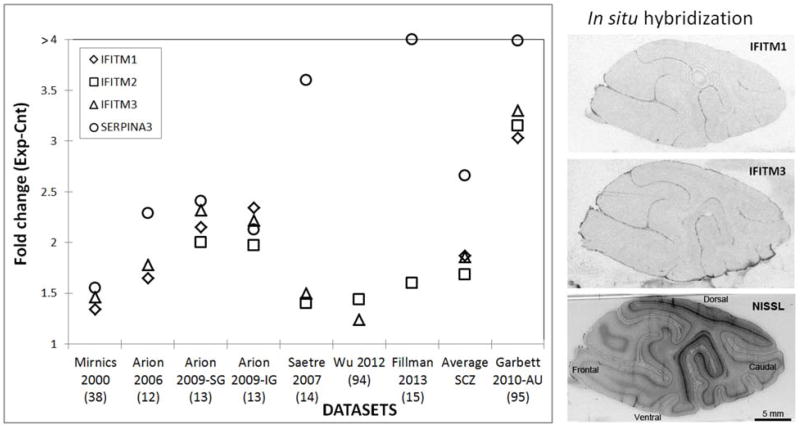
Epidemiological, genetic, transcriptome, postmortem, peripheral biomarker, and therapeutic studies of schizophrenia all point to a dysregulation of both innate and adaptive immune systems in the disease, and it is likely that these immune changes actively contribute to disease symptoms. Gene expression disturbances in the brain of subjects with schizophrenia show complex, region-specific changes with consistently replicated and potentially interdependent induction of serpin peptidase inhibitor, clade A member 3 (SERPINA3) and interferon inducible transmembrane protein (IFITM) family transcripts in the prefrontal cortex. Recent data suggest that IFITM3 expression is a critical mediator of maternal immune activation. Because the IFITM gene family is primarily expressed in the endothelial cells and meninges, and because the meninges play a critical role in interneuron development, we suggest that these two non-neuronal cell populations might play an important role in the disease pathophysiology. Finally, we propose that IFITM3 in particular might be a novel, appealing, knowledge-based drug target for treatment of schizophrenia.
精神分裂症的流行病学、遗传学、转录组学、尸检、外周生物标志物和治疗研究都指向疾病中先天和适应性免疫系统的失调,并且这些免疫变化很可能积极促成疾病症状。精神分裂症患者大脑中的基因表达紊乱表现出复杂的、具有区域特异性的变化,在前额叶皮层中始终一致地复制并可能相互依存地诱导丝氨酸蛋白酶抑制剂、A 族成员 3(SERPINA3)和干扰素诱导跨膜蛋白(IFITM)家族转录物。最近的数据表明,IFITM3 表达是母体免疫激活的关键介质。由于 IFITM 基因家族主要在血管内皮细胞和脑膜中表达,并且脑膜在中间神经元发育中起关键作用,因此我们提出这两个非神经元细胞群体可能在疾病发病机制中发挥重要作用。最后,我们提出 IFITM3 特别是一个新的、有吸引力的、基于知识的治疗精神分裂症的药物靶点。