Department of Psychology, University of New Hampshire, Durham, NH 03824, USA.
Curr Biol. 2013 Aug 19;23(16):1536-40. doi: 10.1016/j.cub.2013.06.030. Epub 2013 Jul 25.
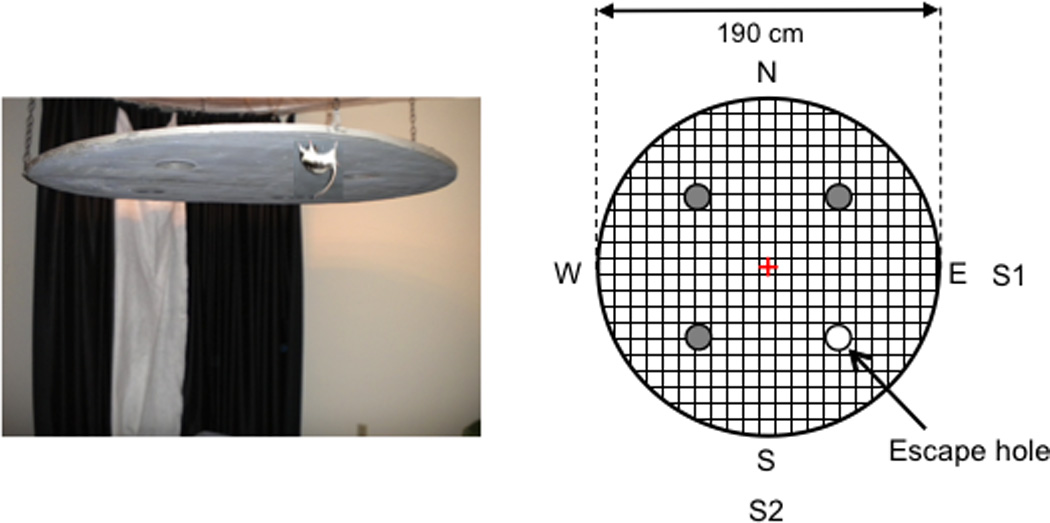
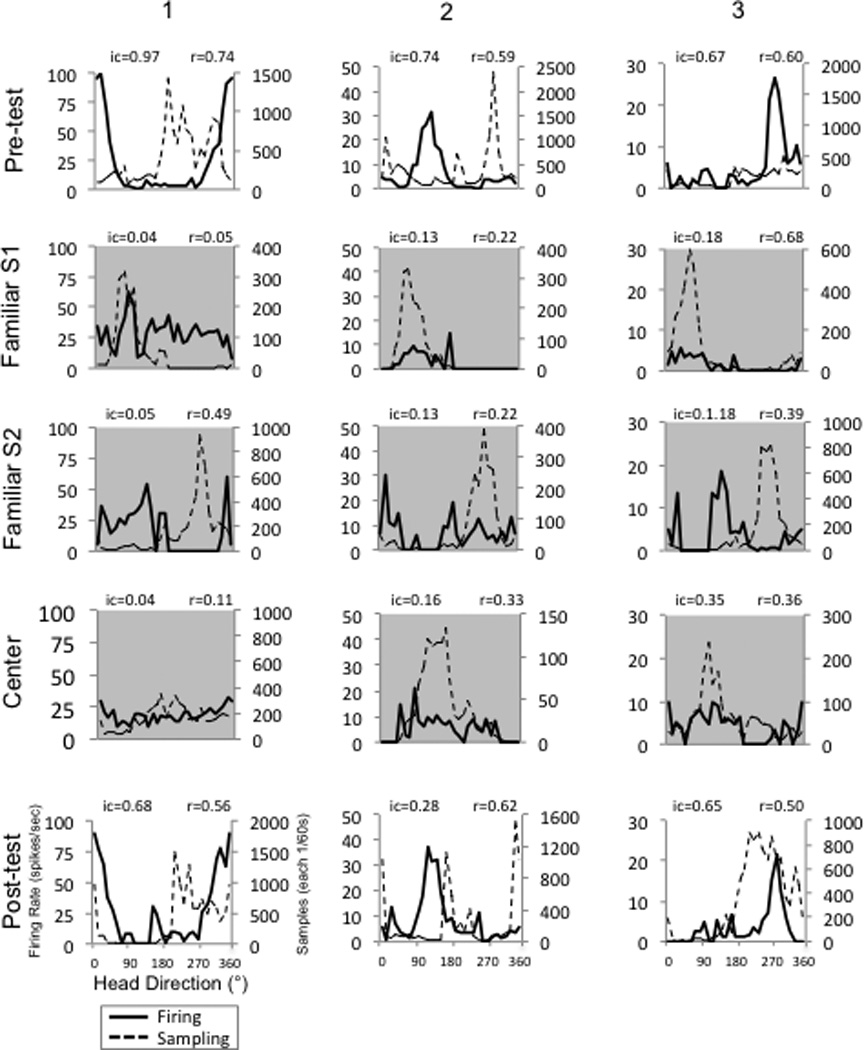
Head-direction (HD) cells fire as a function of an animal's directional heading in the horizontal plane during two-dimensional navigational tasks [1]. The information from HD cells is used with place and grid cells to form a spatial representation (cognitive map) of the environment [2, 3]. Previous studies have shown that when rats are inverted (upside down), they have difficulty learning a task that requires them to find an escape hole from one of four entry points but that they can learn it when released from one or two start points [4]. Previous reports also indicate that the HD signal is disrupted when a rat is oriented upside down [5, 6]. Here we monitored HD cell activity in the two-entry-point version of the inverted task and when the rats were released from a novel start point. We found that despite the absence of direction-specific firing in HD cells when inverted, rats could successfully navigate to the escape hole when released from one of two familiar locations by using a habit-associated directional strategy. In the continued absence of normal HD cell activity, inverted rats failed to find the escape hole when started from a novel release point. The results suggest that the HD signal is critical for accurate navigation in situations that require a flexible allocentric cognitive mapping strategy, but not for situations that utilize habit-like associative spatial learning.
头部方向 (HD) 细胞在二维导航任务中根据动物在水平面上的指向方向而发射[1]。HD 细胞的信息与位置和网格细胞一起形成环境的空间表示(认知图)[2,3]。先前的研究表明,当大鼠被倒置(上下颠倒)时,它们很难学习一项需要它们从四个入口点中的一个找到逃生孔的任务,但当从一个或两个起始点释放时,它们可以学习[4]。先前的报告还表明,当大鼠被定向倒置时,HD 信号会中断[5,6]。在这里,我们在倒置任务的双入口版本中监测了 HD 细胞的活动,以及当大鼠从一个新的起点释放时。我们发现,尽管大鼠在倒置时 HD 细胞没有方向特异性放电,但当从两个熟悉的位置之一释放时,它们可以使用与习惯相关的定向策略成功导航到逃生孔。在持续缺乏正常 HD 细胞活动的情况下,从新的释放点开始时,倒置的大鼠无法找到逃生孔。结果表明,HD 信号对于需要灵活的以客体为中心的认知映射策略的准确导航至关重要,但对于利用类似习惯的联想空间学习的情况则不重要。