Department of Neurology, The Fifth Affiliated Hospital of Zhengzhou University, Zhengzhou, 450052 Henan, China.
Brain Behav Immun. 2013 Nov;34:56-66. doi: 10.1016/j.bbi.2013.07.010. Epub 2013 Jul 24.
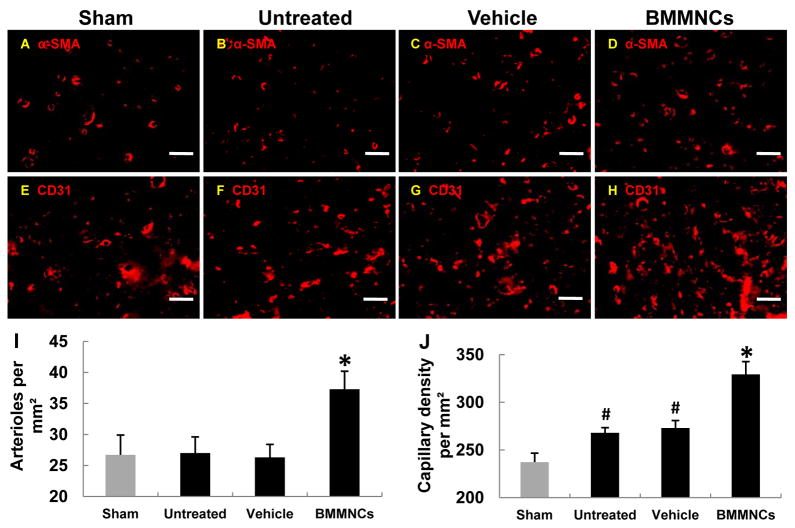
Transplanted bone marrow-derived mononuclear cells (BMMNCs) can promote arteriogenesis and angiogenesis by incorporating into vascular walls and differentiating into smooth muscle cells (SMCs) and endothelial cells (ECs). Here, we explored whether BMMNCs can enhance arteriogenesis and angiogenesis and promote long-term functional recovery in a rat model of permanent middle cerebral artery occlusion (pMCAO). Sprague-Dawley rats were injected with vehicle or 1×10(7) BMMNCs labeled with BrdU via femoral vein 24 h after induction of pMCAO. Functional deficits were assessed weekly through day 42 after pMCAO, and infarct volume was assessed on day 7. We visualized the angioarchitecture by latex perfusion on days 14 and 42. BMMNC transplantation significantly reduced infarct volume and neurologic functional deficits compared with untreated or vehicle-treated ischemic groups. In BMMNC-treated rats, BrdU-positive cells were widely distributed in the infarct boundary zone, were incorporated into vessel walls, and enhanced the growth of leptomeningeal anastomoses, the circle of Willis, and basilar arteries. BMMNCs were shown to differentiate into SMCs and ECs from day 14 after stroke and preserved vascular repair function for at least 6 weeks. Our data indicate that BMMNCs can significantly enhance arteriogenesis and angiogenesis, reduce infarct volume, and promote long-term functional recovery after pMCAO in rats.
移植的骨髓源性单核细胞(BMMNC)可以通过整合到血管壁并分化为平滑肌细胞(SMC)和内皮细胞(EC)来促进动脉生成和血管生成。在这里,我们探讨了 BMMNC 是否可以增强动脉生成和血管生成,并促进永久性大脑中动脉闭塞(pMCAO)大鼠模型中的长期功能恢复。pMCAO 诱导后 24 小时,通过股静脉向 Sprague-Dawley 大鼠注射 vehicle 或 1×10(7)标记有 BrdU 的 BMMNC。pMCAO 后第 42 天通过每天评估功能缺陷,第 7 天评估梗塞体积。我们在第 14 天和第 42 天通过乳胶灌注可视化血管结构。与未治疗或 vehicle 治疗的缺血组相比,BMMNC 移植显著减少了梗塞体积和神经功能缺陷。在 BMMNC 治疗的大鼠中,BrdU 阳性细胞广泛分布在梗塞边界区,整合到血管壁中,并增强了软脑膜吻合、Willis 环和基底动脉的生长。从卒中后第 14 天开始,BMMNC 分化为 SMC 和 EC,并至少 6 周保持血管修复功能。我们的数据表明,BMMNC 可以显著增强动脉生成和血管生成,减少梗塞体积,并促进大鼠 pMCAO 后的长期功能恢复。