Duke University Medical Center, Department of Psychiatry and Behavioral Sciences, Durham, North Carolina, United States of America.
PLoS One. 2013 Jul 24;8(7):e68717. doi: 10.1371/journal.pone.0068717. Print 2013.
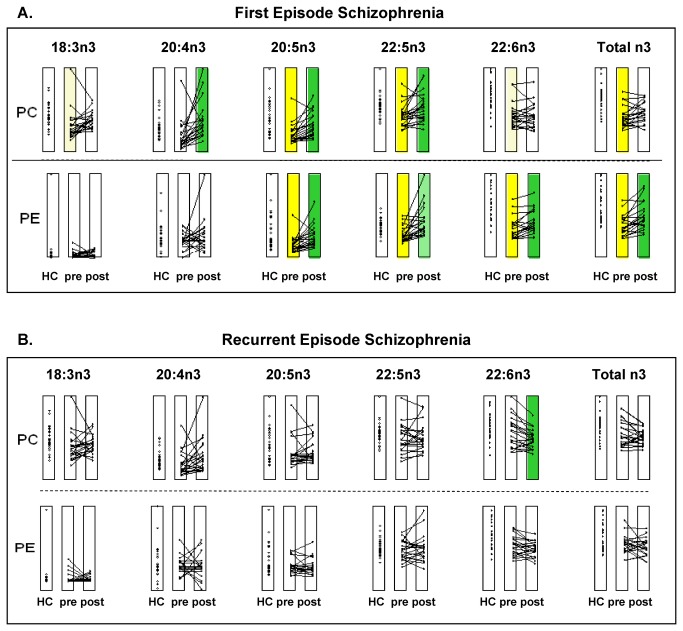
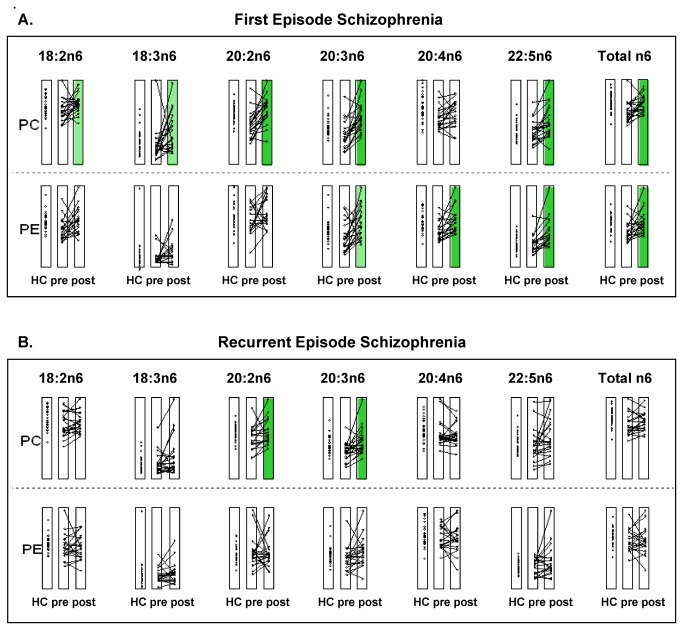
There is a critical need for mapping early metabolic changes in schizophrenia to capture failures in regulation of biochemical pathways and networks. This information could provide valuable insights about disease mechanisms, trajectory of disease progression, and diagnostic biomarkers. We used a lipidomics platform to measure individual lipid species in 20 drug-naïve patients with a first episode of schizophrenia (FE group), 20 patients with chronic schizophrenia that had not adhered to prescribed medications (RE group), and 29 race-matched control subjects without schizophrenia. Lipid metabolic profiles were evaluated and compared between study groups and within groups before and after treatment with atypical antipsychotics, risperidone and aripiprazole. Finally, we mapped lipid profiles to n3 and n6 fatty acid synthesis pathways to elucidate which enzymes might be affected by disease and treatment. Compared to controls, the FE group showed significant down-regulation of several n3 polyunsaturated fatty acids (PUFAs), including 20:5n3, 22:5n3, and 22:6n3 within the phosphatidylcholine and phosphatidylethanolamine lipid classes. Differences between FE and controls were only observed in the n3 class PUFAs; no differences where noted in n6 class PUFAs. The RE group was not significantly different from controls, although some compositional differences within PUFAs were noted. Drug treatment was able to correct the aberrant PUFA levels noted in FE patients, but changes in re patients were not corrective. Treatment caused increases in both n3 and n6 class lipids. These results supported the hypothesis that phospholipid n3 fatty acid deficits are present early in the course of schizophrenia and tend not to persist throughout its course. These changes in lipid metabolism could indicate a metabolic vulnerability in patients with schizophrenia that occurs early in development of the disease.
目前迫切需要绘制精神分裂症早期代谢变化图谱,以捕捉生化途径和网络调节失败的情况。这些信息可以提供关于疾病机制、疾病进展轨迹和诊断生物标志物的宝贵见解。我们使用脂质组学平台测量了 20 名首次出现精神分裂症(FE 组)的未经药物治疗的患者、20 名未遵医嘱服用抗精神病药物的慢性精神分裂症患者(RE 组)和 29 名种族匹配的无精神分裂症对照者的个体脂质种类。评估了脂质代谢谱,并在接受非典型抗精神病药物、利培酮和阿立哌唑治疗前后对研究组和组内的代谢谱进行了比较。最后,我们将脂质谱映射到 n3 和 n6 脂肪酸合成途径,以阐明哪些酶可能受到疾病和治疗的影响。与对照组相比,FE 组几种 n3 多不饱和脂肪酸(PUFA),包括磷脂酰胆碱和磷脂酰乙醇胺类中的 20:5n3、22:5n3 和 22:6n3,表达显著下调。FE 组与对照组之间仅观察到 n3 类 PUFAs 的差异;n6 类 PUFAs 无差异。RE 组与对照组无显著差异,尽管注意到 PUFAs 内有一些成分差异。药物治疗能够纠正 FE 患者中异常的 PUFA 水平,但对 re 患者的变化没有纠正作用。治疗导致 n3 和 n6 类脂质均增加。这些结果支持了这样一种假说,即在精神分裂症病程早期存在磷脂 n3 脂肪酸缺乏,并且在整个病程中不太可能持续存在。脂质代谢的这些变化可能表明精神分裂症患者存在代谢脆弱性,这种脆弱性在疾病发展早期就已经存在。