Barasa Anders, Schaufelberger Maria, Lappas Georgios, Swedberg Karl, Dellborg Mikael, Rosengren Annika
Department of Molecular and Clinical Medicine, Institute of Medicine/Cardiology, Sahlgrenska Academy, University of Gothenburg, Östra, Gothenburg SE-416 85, Sweden.
Eur Heart J. 2014 Jan;35(1):25-32. doi: 10.1093/eurheartj/eht278. Epub 2013 Jul 29.
To describe trends in incidence and case fatality among younger (18-54 years) and older (55-84 years) Swedish patients with heart failure (HF).
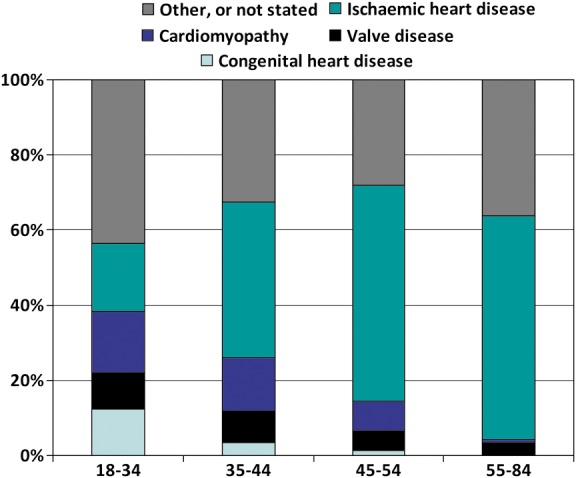
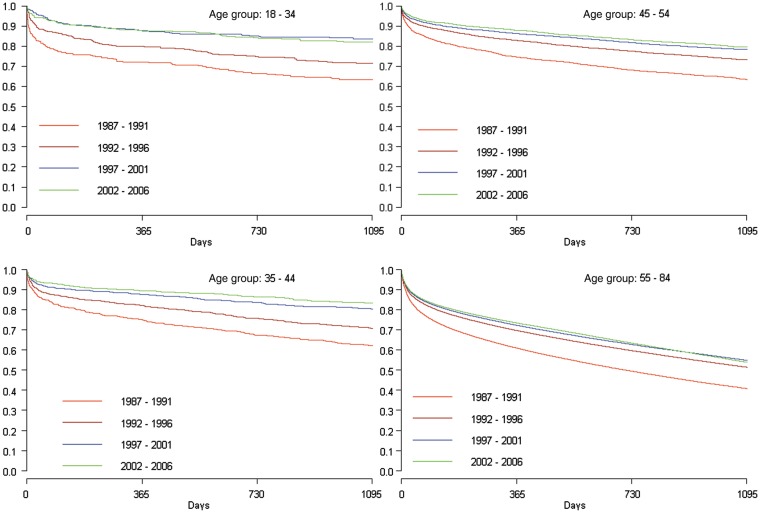
Through linking the Swedish national hospital discharge and the cause-specific death registries, we identified patients aged 18-84 years that were discharged 1987-2006 with a diagnosis of HF. Age-specific mean incidence rates per 100 000 person-years were calculated in four 5-year periods. Kaplan-Meier survival curves were plotted up to 3 years. From 1987 to 2006, there were 443 995 HF hospitalizations among adults 18-84 years. Of these, 4660 (1.0%) and 13 507 (3.0%) occurred in people aged 18-44 and 45-54 years (31.6% women), respectively. From the first to the last 5-year period, HF incidence increased by 50 and 43%, among people aged 18-34 and 35-44 years, respectively. Among people ≥45 years, incidence peaked in the mid-1990s and then decreased. Heart failure in the presence of cardiomyopathy increased more than two-fold among all age groups. Case fatality decreased for all age groups until 2001, after which no further significant decrease <55 years was observed.
Increasing HF hospitalization in young adults in Sweden opposes the general trend seen in older patients, a finding which may reflect true epidemiological changes. Cardiomyopathy accounted for a substantial part of this increase. High case fatality and lack of further case fatality reduction after 2001 are causes for concern.
描述瑞典年轻(18 - 54岁)和年长(55 - 84岁)心力衰竭(HF)患者的发病率和病死率趋势。
通过关联瑞典国家医院出院记录和特定病因死亡登记处,我们确定了1987 - 2006年期间出院诊断为HF的18 - 84岁患者。计算了四个5年期间每10万人年的年龄特异性平均发病率。绘制了长达3年的Kaplan - Meier生存曲线。1987年至2006年,18 - 84岁成年人中有443995例HF住院病例。其中,18 - 44岁人群中有4660例(1.0%),45 - 54岁人群中有13507例(3.0%)(女性占31.6%)。从第一个到最后一个5年期间,18 - 34岁和35 - 44岁人群的HF发病率分别增加了50%和43%。在45岁及以上人群中,发病率在20世纪90年代中期达到峰值,然后下降。所有年龄组中心肌病导致的心力衰竭增加了两倍多。2001年之前所有年龄组的病死率均下降,之后55岁以下人群未观察到进一步显著下降。
瑞典年轻成年人中HF住院率上升与老年患者的总体趋势相反,这一发现可能反映了真实的流行病学变化。心肌病是这一增长的重要原因。高病死率以及2001年后病死率未进一步降低令人担忧。