Holly Jeff M P, Zeng Li, Perks Claire M
School of Clinical Science, Faculty of Medicine, University of Bristol, Learning and Research Building, Southmead Hospital, Bristol, BS10 5NB, UK,
Cancer Metastasis Rev. 2013 Dec;32(3-4):673-705. doi: 10.1007/s10555-013-9445-5.
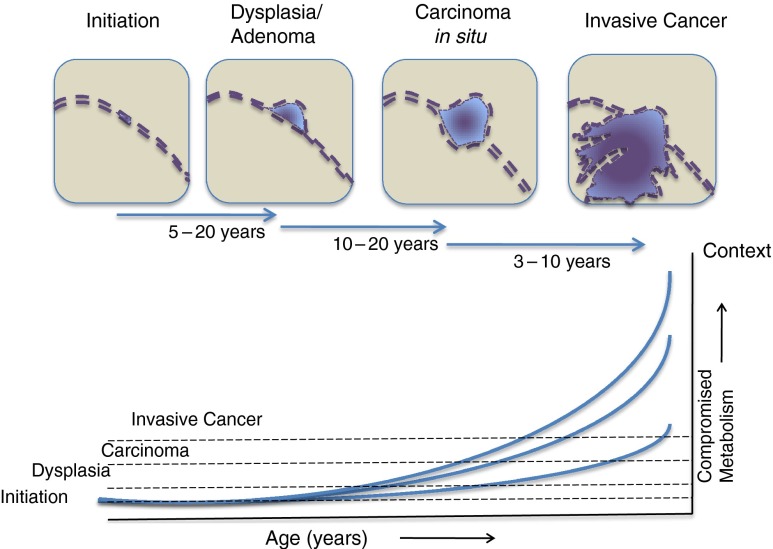
The age-related epithelial cancers of the breast, colorectum and prostate are the most prevalent and are increasing in our aging populations. Epithelial cells turnover rapidly and mutations naturally accumulate throughout life. Most epithelial cancers arise from this normal mutation rate. All elderly individuals will harbour many cells with the requisite mutations and most will develop occult neoplastic lesions. Although essential for initiation, these mutations are not sufficient for the progression of cancer to a life-threatening disease. This progression appears to be dependent on context: the tissue ecosystem within individuals and lifestyle exposures across populations of individuals. Together, this implies that the seeds may be plentiful but they only germinate in the right soil. The incidence of these cancers is much lower in Eastern countries but is increasing with Westernisation and increases more acutely in migrants to the West. A Western lifestyle is strongly associated with perturbed metabolism, as evidenced by the epidemics of obesity and diabetes: this may also provide the setting enabling the progression of epithelial cancers. Epidemiology has indicated that metabolic biomarkers are prospectively associated with cancer incidence and prognosis. Furthermore, within cancer research, there has been a rediscovery that a switch in cell metabolism is critical for cancer progression but this is set within the metabolic status of the host. The seed may only germinate if the soil is fertile. This perspective brings together the different avenues of investigation implicating the role that metabolism may play within the context of post-genomic concepts of cancer.
与年龄相关的乳腺癌、结直肠癌和前列腺癌等上皮性癌症最为常见,且在老龄化人群中呈上升趋势。上皮细胞更新迅速,一生中自然会积累突变。大多数上皮性癌症源于这种正常的突变率。所有老年人都会携带许多具有必要突变的细胞,大多数人会发展出隐匿性肿瘤病变。虽然这些突变对于癌症的起始至关重要,但并不足以使癌症发展为危及生命的疾病。这种进展似乎取决于环境:个体内部的组织生态系统以及个体群体中的生活方式暴露。综上所述,这意味着种子可能很多,但只有在合适的土壤中才会发芽。这些癌症在东方国家的发病率要低得多,但随着西方化进程而上升,并且在移民到西方的人群中上升更为急剧。西方生活方式与代谢紊乱密切相关,肥胖和糖尿病的流行就是证明:这也可能为上皮性癌症的进展提供条件。流行病学表明,代谢生物标志物与癌症发病率和预后呈前瞻性关联。此外,在癌症研究领域,人们重新发现细胞代谢的转变对于癌症进展至关重要,但这是在宿主的代谢状态背景下发生的。只有土壤肥沃,种子才可能发芽。这一观点汇集了不同的研究途径,暗示了代谢在癌症后基因组概念背景下可能发挥的作用。