Department of Statistics, Chicago University Chicago, IL, USA ; Department of Computer Science, Chicago University Chicago, IL, USA.
Front Hum Neurosci. 2013 Jul 30;7:408. doi: 10.3389/fnhum.2013.00408. eCollection 2013.
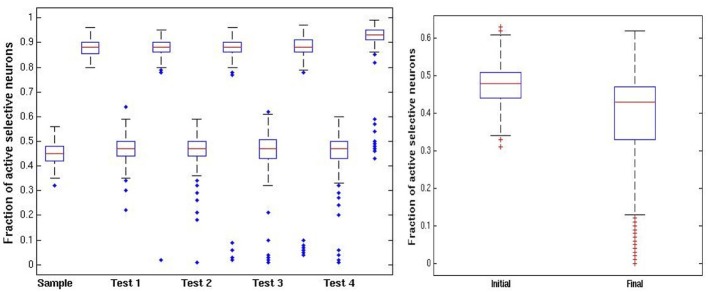
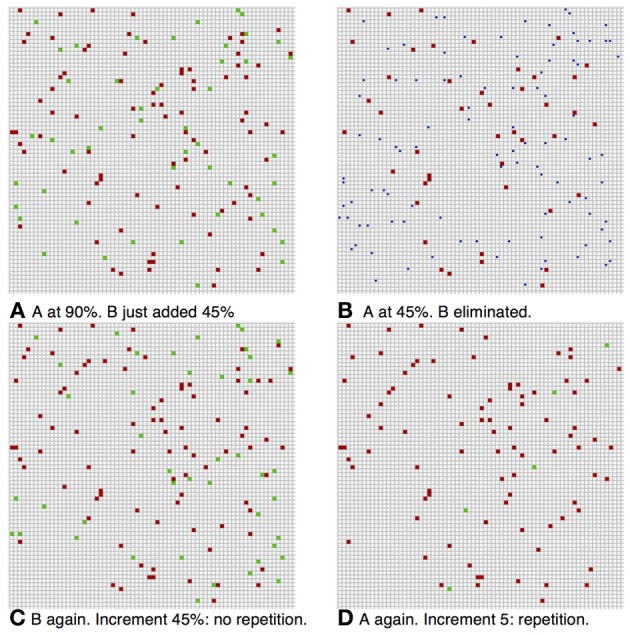
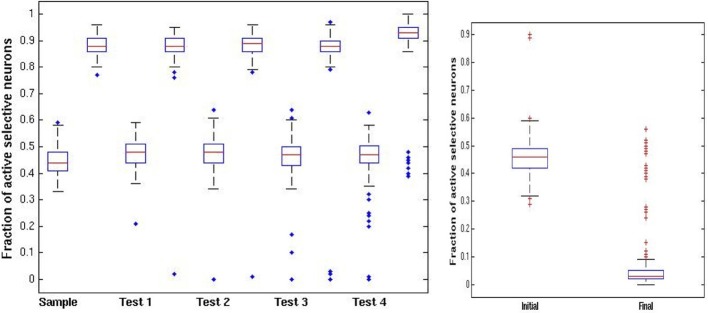
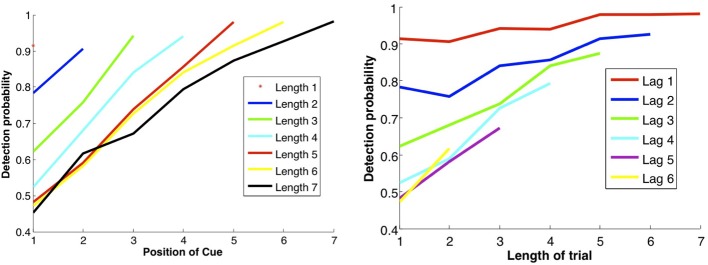
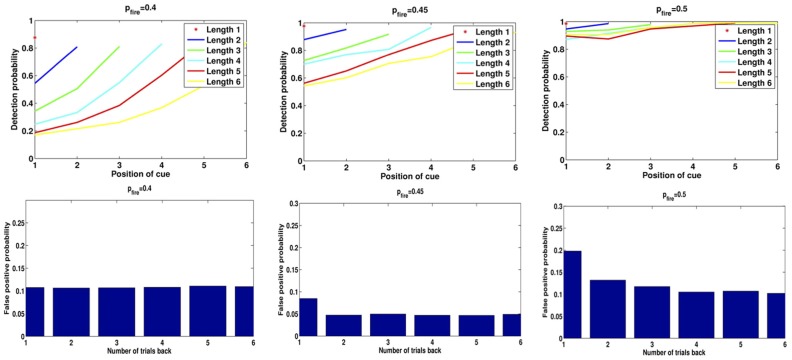
Delay match to sample (DMS) experiments provide an important link between the theory of recurrent network models and behavior and neural recordings. We define a simple recurrent network of binary neurons with stochastic neural dynamics and Hebbian synaptic learning. Most DMS experiments involve heavily learned images, and in this setting we propose a readout mechanism for match occurrence based on a smaller increment in overall network activity when the matched pattern is already in working memory, and a reset mechanism to clear memory from stimuli of previous trials using random network activity. Simulations show that this model accounts for a wide range of variations on the original DMS tasks, including ABBA tasks with distractors, and more general repetition detection tasks with both learned and novel images. The differences in network settings required for different tasks derive from easily defined changes in the levels of noise and inhibition. The same models can also explain experiments involving repetition detection with novel images, although in this case the readout mechanism for match is based on higher overall network activity. The models give rise to interesting predictions that may be tested in neural recordings.
延迟匹配到样本 (DMS) 实验为递归网络模型的理论与行为和神经记录之间提供了重要联系。我们定义了一个具有随机神经动力学和赫布式突触学习的二进制神经元的简单递归网络。大多数 DMS 实验涉及经过大量学习的图像,在这种情况下,我们提出了一种基于匹配模式已经在工作记忆中时整体网络活动略有增加的匹配发生的读出机制,以及一种使用随机网络活动从先前试验的刺激中清除记忆的重置机制。模拟表明,该模型解释了原始 DMS 任务的广泛变化,包括带有干扰物的 ABBA 任务,以及具有学习和新图像的更一般的重复检测任务。不同任务所需的网络设置的差异源于噪声和抑制水平的易于定义的变化。相同的模型也可以解释涉及新图像的重复检测的实验,尽管在这种情况下,匹配的读出机制基于更高的整体网络活动。这些模型产生了有趣的预测,可能在神经记录中进行测试。