Yu Areum, Kim Jihye, Kwon Oran, Oh Se-Young, Kim Junghyun, Yang Yoon Jung
Department of Clinical Nutrition, Dongduk Women's University, Seoul 136-714, Korea.
Clin Nutr Res. 2013 Jul;2(2):107-14. doi: 10.7762/cnr.2013.2.2.107. Epub 2013 Jul 23.
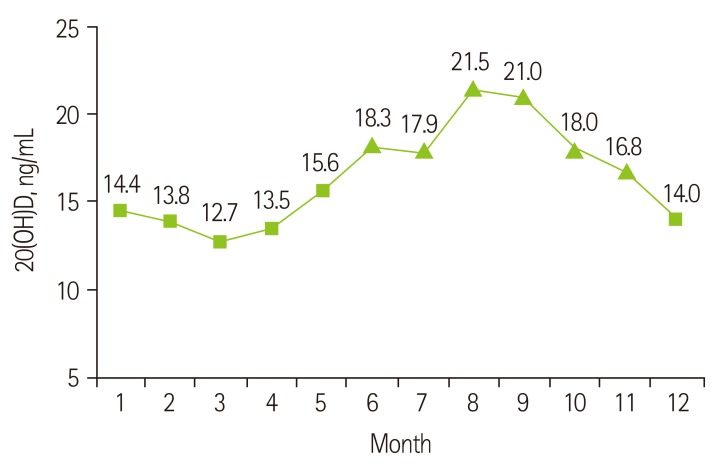
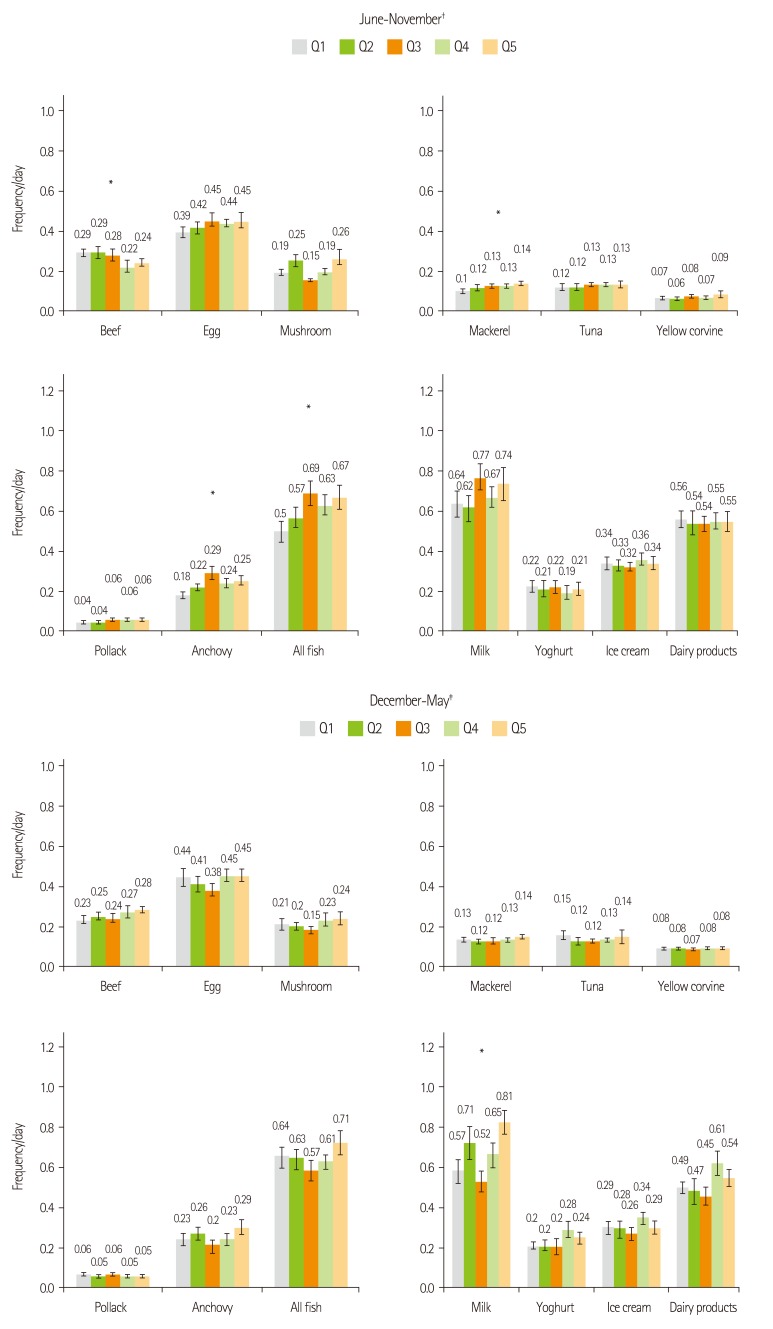
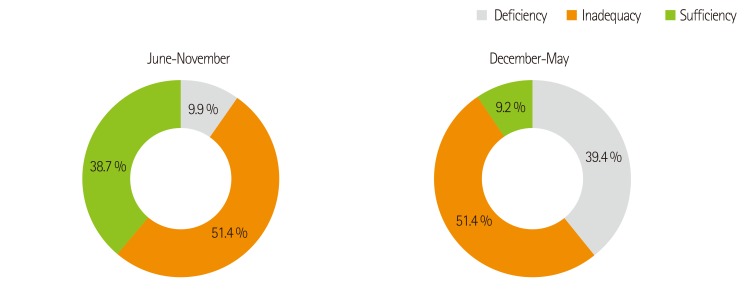
The objectives of this study were to investigate the status of vitamin D in Korean adolescents and to determine the association between serum 25-hydroxyvitamin D (25(OH)D) concentration and consumption frequencies of vitamin D food sources by season (June to November and December to May). The subjects were 1,579 adolescents aged 12-18 years participating in the 2008-2009 Korean National Health and Nutrition Examination Survey (KNHANES). Consumption frequencies of vitamin D food sources were estimated by using a qualitative food frequency questionnaire (FFQ). Thirteen food items were selected as vitamin D food sources including beef, egg, mackerel, tuna, yellow corvine, pollack, anchovy, mushroom, milk, yoghurt, ice cream, all fish and dairy products from the FFQ based on previous research. The data was analyzed using proc survey procedures. The deficiency (5.25-12 ng/mL), inadequacy (12-20 ng/mL) and sufficiency (> 20 ng/mL) proportions of serum 25(OH)D from June to November and December to May were 9.9%, 51.4%, 38.7%, and 39.4%, 51.4%, 9.2%, respectively. Mean serum 25(OH)D concentration was positively related to the consumption frequencies of mackerel, anchovy, all fish and milk. These results suggest high proportion (> 61%) of Korean adolescents were vitamin D deficiency or inadequacy, and serum 25(OH)D was associated with the consumption of vitamin D food sources including fish and milk.
本研究的目的是调查韩国青少年的维生素D状况,并确定血清25-羟基维生素D(25(OH)D)浓度与按季节(6月至11月和12月至次年5月)划分的维生素D食物来源消费频率之间的关联。研究对象为1579名12至18岁的青少年,他们参与了2008 - 2009年韩国国家健康与营养检查调查(KNHANES)。维生素D食物来源的消费频率通过使用定性食物频率问卷(FFQ)进行估算。根据先前研究,从FFQ中选择了13种食物作为维生素D食物来源,包括牛肉、鸡蛋、鲭鱼、金枪鱼、黄姑鱼、狭鳕、凤尾鱼、蘑菇、牛奶、酸奶、冰淇淋、所有鱼类和乳制品。数据使用proc survey程序进行分析。6月至11月和12月至次年5月血清25(OH)D的缺乏(5.25 - 12 ng/mL)、不足(12 - 20 ng/mL)和充足(> 20 ng/mL)比例分别为9.9%、51.4%、38.7%和39.4%、51.4%、9.2%。血清25(OH)D平均浓度与鲭鱼、凤尾鱼、所有鱼类和牛奶的消费频率呈正相关。这些结果表明,超过61%的韩国青少年存在维生素D缺乏或不足的情况,并且血清25(OH)D与包括鱼类和牛奶在内的维生素D食物来源的消费有关。