Kim Juyoung, Bea Wookyung, Lee Kiheon, Han Jongsoo, Kim Sohye, Kim Misung, Na Woori, Sohn Cheongmin
Health Promotion Center, Seoul National University of Bundang Hospital, Seongnam 463-707, Korea.
Clin Nutr Res. 2013 Jul;2(2):115-24. doi: 10.7762/cnr.2013.2.2.115. Epub 2013 Jul 23.
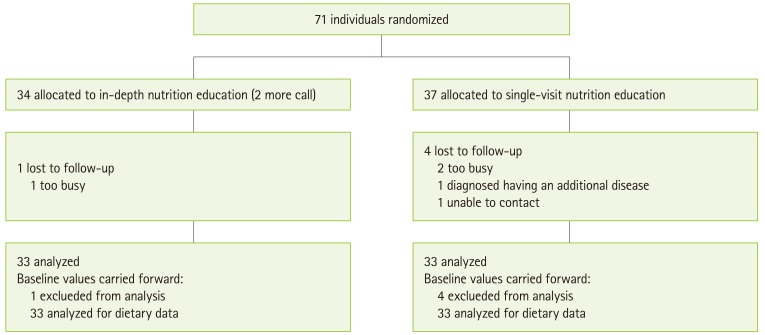
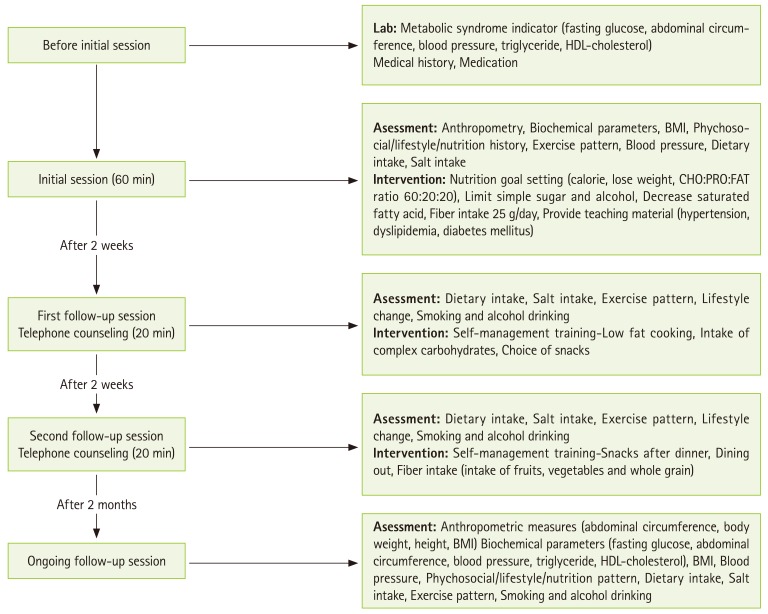
As prevalence of metabolic syndrome has rapidly increased over the past decade, lifestyle changes including dietary habits are considered as a therapeutic cornerstone for metabolic syndrome, cardiovascular complications and type 2 diabetes. We evaluated the effectiveness of a telephone-delivered nutrition education to improve metabolic parameters compared with a single-visit with a dietitian in subjects with metabolic syndrome. A total of seventy-one adults who met diagnostic criteria for the metabolic syndrome were randomly assigned to either the single-visit group or the in-depth nutrition education group during a 3-month intervention study period. The in-depth telephone-delivered nutrition education group had an initial visit with a dietitian and additional two telephone counseling during the first 4 weeks of the study periods. Sixty-six subjects completed a 3-month intervention study. The trial examined participant's anthropometric changes and dietary intakes as well as changes in the metabolic syndrome factors. At the end of the trial, the in-depth nutrition education group showed significantly higher reduction in weight, body fat and abdominal circumference compared with the other group (p < 0.05). In the in-depth nutrition groups, the prevalence of metabolic syndrome was decreased to 45.5%, while 69.7% of the subjects were metabolic syndrome patients in the single-visit group (p < 0.05). These results demonstrate that the telephone-intervention counseling is a feasible mean to deliver dietary intervention in patients with metabolic syndrome.
在过去十年中,代谢综合征的患病率迅速上升,包括饮食习惯在内的生活方式改变被视为代谢综合征、心血管并发症和2型糖尿病的治疗基石。我们评估了通过电话提供营养教育与营养师单次问诊相比,对改善代谢综合征患者代谢参数的有效性。在一项为期3个月的干预研究期间,共有71名符合代谢综合征诊断标准的成年人被随机分配到单次问诊组或深入营养教育组。深入电话营养教育组在研究期的前4周内先由营养师进行首次问诊,随后再进行两次电话咨询。66名受试者完成了为期3个月的干预研究。该试验检测了参与者的人体测量变化、饮食摄入以及代谢综合征因素的变化。试验结束时,深入营养教育组的体重、体脂肪和腹围降幅显著高于另一组(p < 0.05)。在深入营养教育组中,代谢综合征的患病率降至45.5%,而单次问诊组中69.7%的受试者为代谢综合征患者(p < 0.05)。这些结果表明,电话干预咨询是对代谢综合征患者进行饮食干预的一种可行方式。