VA San Diego Healthcare System Psychology Service (116B), 3350 La Jolla Village Drive, San Diego, CA 92126, USA;
Brain Sci. 2013 Mar 22;3(1):396-414. doi: 10.3390/brainsci3010396.
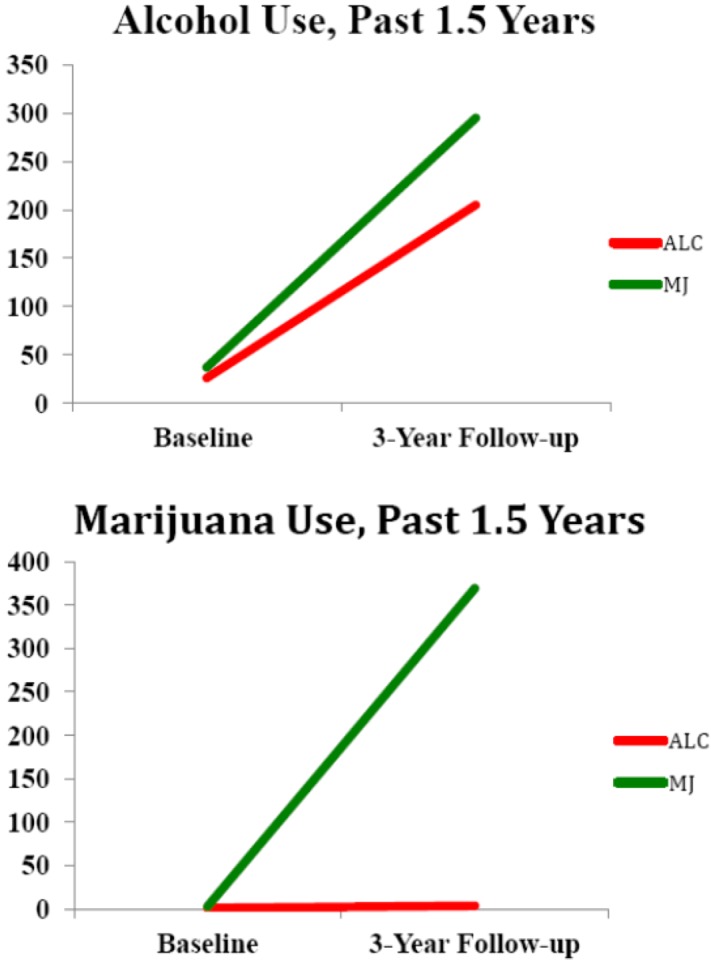
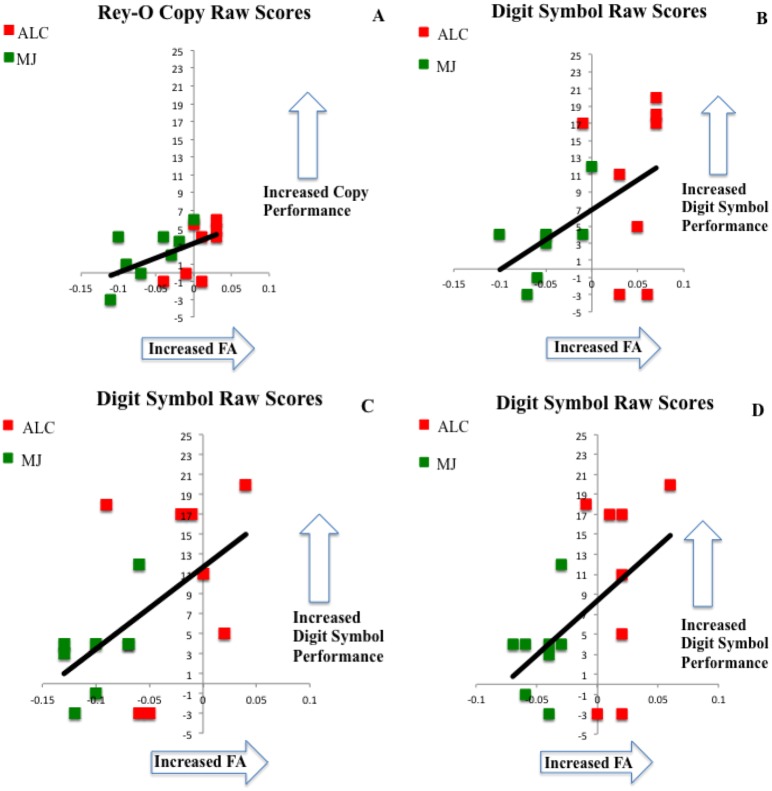
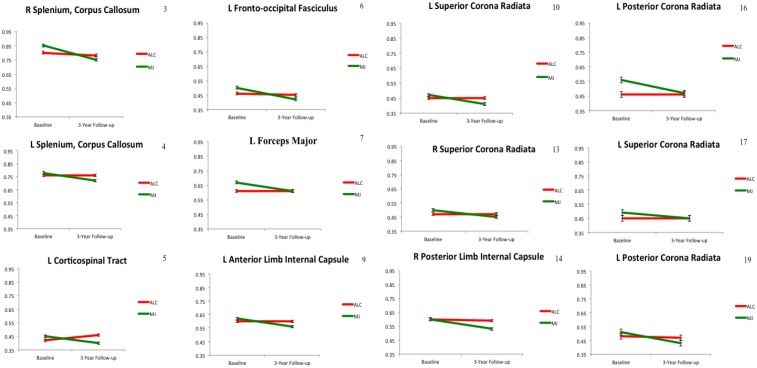
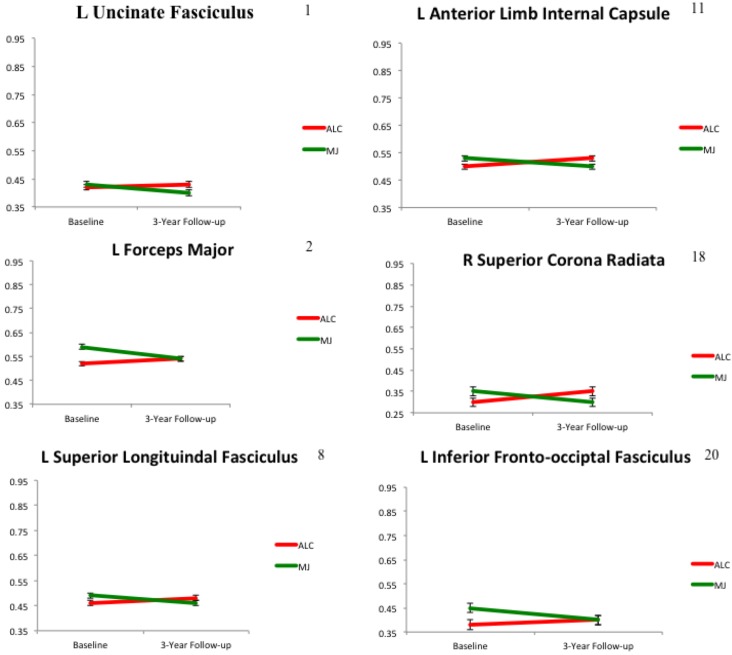
Characterizing the effects of alcohol and marijuana use on adolescent brain development is important for understanding potential alterations in neurodevelopment. Several cross sectional studies have identified group differences in white matter integrity after initiation of heavy alcohol and marijuana use, however none have explored white matter trajectories in adolescents pre- and post initiation of use, particularly for marijuana users. This study followed 16 adolescents with minimal alcohol and marijuana use at ages 16-18 over three years. At follow-up, teens were 19-22 years old; half of the participants initiated heavy alcohol use and half initiated heavy alcohol and marijuana use. Repeated-measures ANOVA revealed 20 clusters in association and projection fibers tracts (p < 0.01) in which a group by time interaction was found. Most consistently, white matter integrity (i.e., fractional anisotropy) decreased for those who initiated both heavy alcohol and marijuana use over the follow-up interval. No effect of time or change in white matter integrity was seen for those who initiated alcohol use only in the majority of clusters. In most regions, at the baseline time point, teens who would later initiate both alcohol and marijuana use demonstrated white matter integrity greater than or equal to teens that initiated alcohol use only. Findings suggest poorer tissue integrity associated with combined initiation of heavy alcohol and marijuana use in late adolescence. While OPEN ACCESS pre-existing differences may also be related to likelihood of substance use, the present data suggest an effect on tissue integrity for these teens transitioning to combined alcohol and marijuana use in later adolescence.
描述酒精和大麻使用对青少年大脑发育的影响对于理解神经发育的潜在改变很重要。一些横断面研究已经确定了在开始大量使用酒精和大麻后,白质完整性方面的群体差异,但是,没有研究探索青少年在开始使用酒精和大麻之前和之后的白质轨迹,特别是对于大麻使用者。本研究对 16 名青少年进行了为期三年的跟踪调查,这些青少年在 16-18 岁时很少使用酒精和大麻。在随访时,青少年的年龄为 19-22 岁;一半的参与者开始大量饮酒,一半开始大量饮酒和吸食大麻。重复测量方差分析显示,在关联和投射纤维束中有 20 个簇(p<0.01),其中发现了一个组间时间的相互作用。最一致的是,对于那些在随访期间同时开始大量饮酒和吸食大麻的人,白质完整性(即各向异性分数)下降。在大多数簇中,对于仅开始饮酒的人,没有时间或白质完整性变化的影响。在大多数区域,在基线时间点,后来同时开始饮酒和吸食大麻的青少年的白质完整性大于或等于仅开始饮酒的青少年。研究结果表明,在青少年晚期同时开始大量饮酒和吸食大麻与组织完整性较差有关。虽然预先存在的差异也可能与物质使用的可能性有关,但目前的数据表明,对于这些青少年来说,在青少年晚期同时开始饮酒和吸食大麻会对组织完整性产生影响。