Center for Quality Aging, Vanderbilt University School of Medicine, Nashville, TN; Department of Emergency Medicine, Vanderbilt University School of Medicine, Nashville, TN.
Department of Psychiatry, Vanderbilt University School of Medicine, Nashville, TN.
Ann Emerg Med. 2013 Nov;62(5):457-465. doi: 10.1016/j.annemergmed.2013.05.003. Epub 2013 Jul 31.
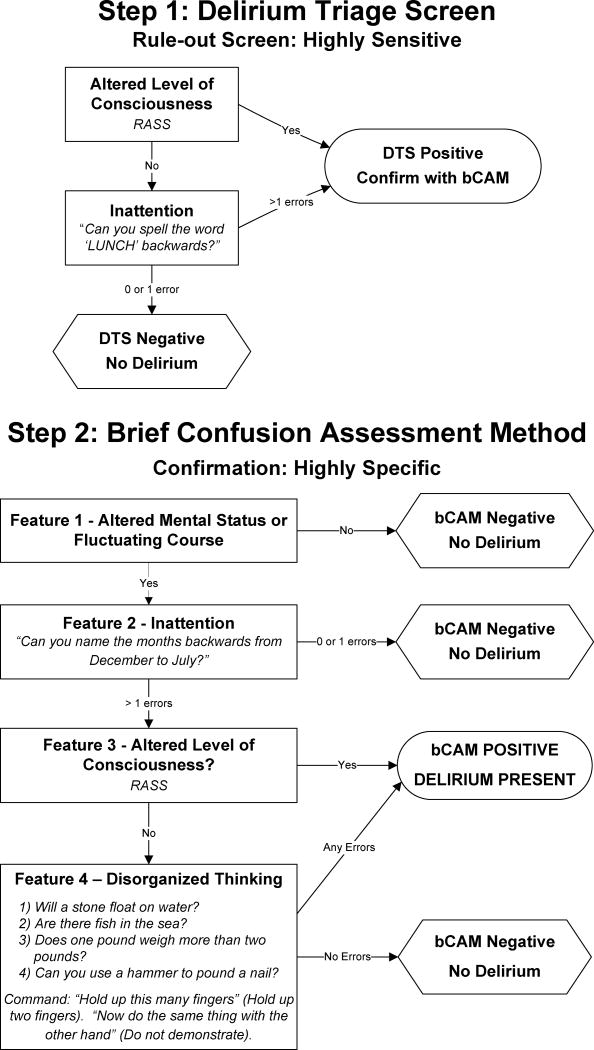
Delirium is a common form of acute brain dysfunction with prognostic significance. Health care professionals caring for older emergency department (ED) patients miss delirium in approximately 75% of cases. This error results from a lack of available measures that can be performed rapidly enough to be incorporated into clinical practice. Therefore, we developed and evaluated a novel 2-step approach to delirium surveillance for the ED.
This prospective observational study was conducted at an academic ED in patients aged 65 years or older. A research assistant and physician performed the Delirium Triage Screen (DTS), designed to be a highly sensitive rule-out test, and the Brief Confusion Assessment Method (bCAM), designed to be a highly specific rule-in test for delirium. The reference standard for delirium was a comprehensive psychiatrist assessment using Diagnostic and Statistical Manual of Mental Disorders, Fourth Edition, Text Revision criteria. All assessments were independently conducted within 3 hours of one another. Sensitivities, specificities, and likelihood ratios with their 95% confidence intervals (95% CIs) were calculated.
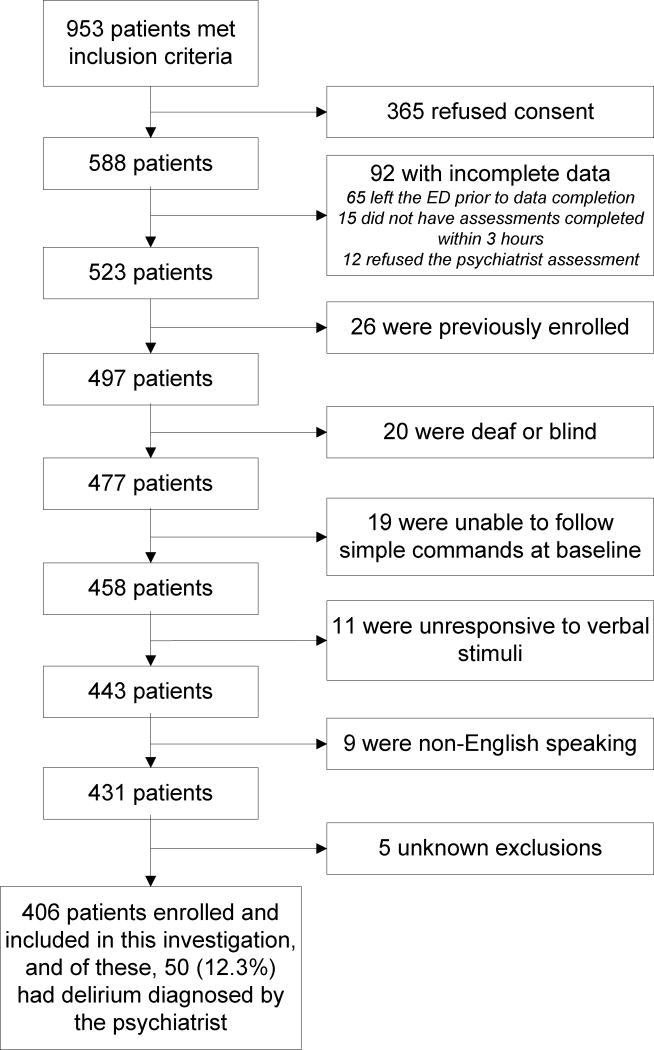
Of 406 enrolled patients, 50 (12.3%) had delirium diagnosed by the psychiatrist reference standard. The DTS was 98.0% sensitive (95% CI 89.5% to 99.5%), with an expected specificity of approximately 55% for both raters. The DTS's negative likelihood ratio was 0.04 (95% CI 0.01 to 0.25) for both raters. As the complement, the bCAM had a specificity of 95.8% (95% CI 93.2% to 97.4%) and 96.9% (95% CI 94.6% to 98.3%) and a sensitivity of 84.0% (95% CI 71.5% to 91.7%) and 78.0% (95% CI 64.8% to 87.2%) when performed by the physician and research assistant, respectively. The positive likelihood ratios for the bCAM were 19.9 (95% CI 12.0 to 33.2) and 25.2 (95% CI 13.9 to 46.0), respectively. If the research assistant DTS was followed by the physician bCAM, the sensitivity of this combination was 84.0% (95% CI 71.5% to 91.7%) and specificity was 95.8% (95% CI 93.2% to 97.4%). If the research assistant performed both the DTS and bCAM, this combination was 78.0% sensitive (95% CI 64.8% to 87.2%) and 97.2% specific (95% CI 94.9% to 98.5%). If the physician performed both the DTS and bCAM, this combination was 82.0% sensitive (95% CI 69.2% to 90.2%) and 95.8% specific (95% CI 93.2% to 97.4%).
In older ED patients, this 2-step approach (highly sensitive DTS followed by highly specific bCAM) may enable health care professionals, regardless of clinical background, to efficiently screen for delirium. Larger, multicenter trials are needed to confirm these findings and to determine the effect of these assessments on delirium recognition in the ED.
谵妄是一种常见的急性脑功能障碍形式,具有预后意义。照顾老年急诊科(ED)患者的医护人员在大约 75%的情况下会遗漏谵妄。这种错误是由于缺乏可用的措施,这些措施不能快速进行,无法纳入临床实践。因此,我们开发并评估了一种新的 ED 谵妄监测两步法。
这项前瞻性观察性研究在一家学术性 ED 进行,纳入年龄在 65 岁或以上的患者。一名研究助理和一名医生进行了 Delirium Triage Screen(DTS)检查,旨在作为一种高度敏感的排除测试,以及 Brief Confusion Assessment Method(bCAM)检查,旨在作为一种高度特异的谵妄确诊测试。使用精神障碍诊断与统计手册,第四版,修订版标准进行全面的精神病评估作为谵妄的参考标准。所有评估均在彼此 3 小时内独立进行。计算了敏感度、特异度和比值比及其 95%置信区间(95%CI)。
在 406 名入组患者中,有 50 名(12.3%)被精神病医生的参考标准诊断为谵妄。DTS 的敏感度为 98.0%(95%CI 89.5%至 99.5%),两位评估者的预期特异度约为 55%。DTS 的负似然比为 0.04(95%CI 0.01 至 0.25),两位评估者的结果一致。作为补充,bCAM 的特异性为 95.8%(95%CI 93.2%至 97.4%)和 96.9%(95%CI 94.6%至 98.3%),敏感度为 84.0%(95%CI 71.5%至 91.7%)和 78.0%(95%CI 64.8%至 87.2%),当由医生和研究助理分别进行时。bCAM 的阳性似然比分别为 19.9(95%CI 12.0 至 33.2)和 25.2(95%CI 13.9 至 46.0)。如果研究助理的 DTS 紧随医生的 bCAM 之后,这种组合的敏感度为 84.0%(95%CI 71.5%至 91.7%),特异度为 95.8%(95%CI 93.2%至 97.4%)。如果研究助理同时进行了 DTS 和 bCAM,这种组合的敏感度为 78.0%(95%CI 64.8%至 87.2%),特异度为 97.2%(95%CI 94.9%至 98.5%)。如果医生同时进行了 DTS 和 bCAM,这种组合的敏感度为 82.0%(95%CI 69.2%至 90.2%),特异度为 95.8%(95%CI 93.2%至 97.4%)。
在老年 ED 患者中,这种两步法(高度敏感的 DTS 紧随高度特异的 bCAM)可能使医护人员,无论其临床背景如何,都能够有效地对谵妄进行筛查。需要更大规模的多中心试验来证实这些发现,并确定这些评估对 ED 中谵妄识别的影响。