Botanic Gardens and Parks Authority Fraser Avenue, West Perth, Western Australia, 6005, Australia ; School of Plant Biology, University of Western Australia Nedlands, Western Australia, 6009, Australia.
Ecol Evol. 2013 Jul;3(7):2138-49. doi: 10.1002/ece3.595. Epub 2013 Jun 5.
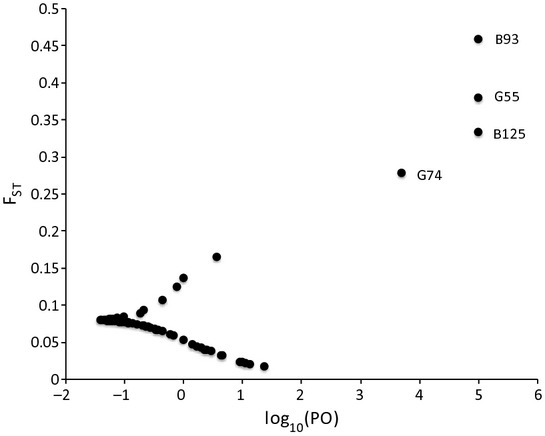
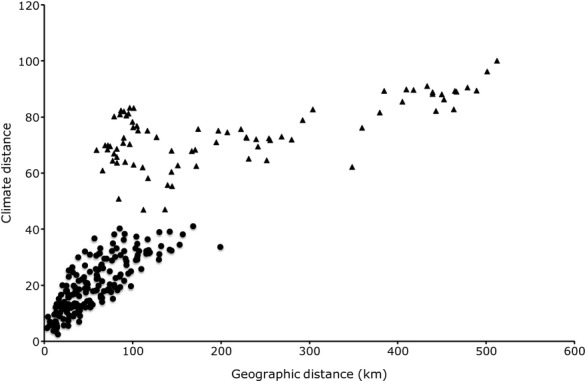
An increasingly important practical application of the analysis of spatial genetic structure within plant species is to help define the extent of local provenance seed collection zones that minimize negative impacts in ecological restoration programs. Here, we derive seed sourcing guidelines from a novel range-wide assessment of spatial genetic structure of 24 populations of Banksia menziesii (Proteaceae), a widely distributed Western Australian tree of significance in local ecological restoration programs. An analysis of molecular variance (AMOVA) of 100 amplified fragment length polymorphism (AFLP) markers revealed significant genetic differentiation among populations (ΦPT = 0.18). Pairwise population genetic dissimilarity was correlated with geographic distance, but not environmental distance derived from 15 climate variables, suggesting overall neutrality of these markers with regard to these climate variables. Nevertheless, Bayesian outlier analysis identified four markers potentially under selection, although these were not correlated with the climate variables. We calculated a global R-statistic using analysis of similarities (ANOSIM) to test the statistical significance of population differentiation and to infer a threshold seed collection zone distance of ∼60 km (all markers) and 100 km (outlier markers) when genetic distance was regressed against geographic distance. Population pairs separated by >60 km were, on average, twice as likely to be significantly genetically differentiated than population pairs separated by <60 km, suggesting that habitat-matched sites within a 30-km radius around a restoration site genetically defines a local provenance seed collection zone for B. menziesii. Our approach is a novel probability-based practical solution for the delineation of a local seed collection zone to minimize negative genetic impacts in ecological restoration.
植物种内空间遗传结构分析的一个日益重要的实际应用是帮助确定最小化生态恢复计划中负面影响的当地起源种子收集区的范围。在这里,我们从对 Banksia menziesii(Proteaceae)的 24 个种群的空间遗传结构的新型全范围评估中得出了种子来源指南,Banksia menziesii 是一种分布广泛的西澳大利亚树,在当地生态恢复计划中具有重要意义。100 个扩增片段长度多态性(AFLP)标记的分子方差分析(AMOVA)显示种群间存在显著的遗传分化(ΦPT = 0.18)。成对种群遗传不相似性与地理距离相关,但与来自 15 个气候变量的环境距离无关,表明这些标记在这些气候变量方面总体上是中性的。尽管如此,贝叶斯异常值分析确定了四个可能受到选择的标记,尽管这些标记与气候变量无关。我们使用相似性分析(ANOSIM)计算了全局 R 统计量,以检验种群分化的统计显著性,并推断当遗传距离与地理距离回归时,种子收集区的距离阈值为 60km(所有标记)和 100km(异常标记)。距离超过 60km 的种群对平均比距离小于 60km 的种群更有可能在遗传上显著分化,这表明在恢复地点周围 30km 半径内的栖息地匹配地点在遗传上定义了 B. menziesii 的本地起源种子收集区。我们的方法是一种新颖的基于概率的实用解决方案,用于划定本地种子收集区,以最小化生态恢复中的负面遗传影响。