Western EcoSystems Technology, Inc. Laramie, Wyoming, 82070.
Ecol Evol. 2013 Jul;3(7):2233-40. doi: 10.1002/ece3.617. Epub 2013 Jun 7.
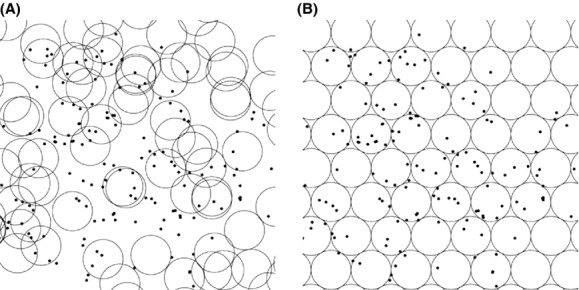
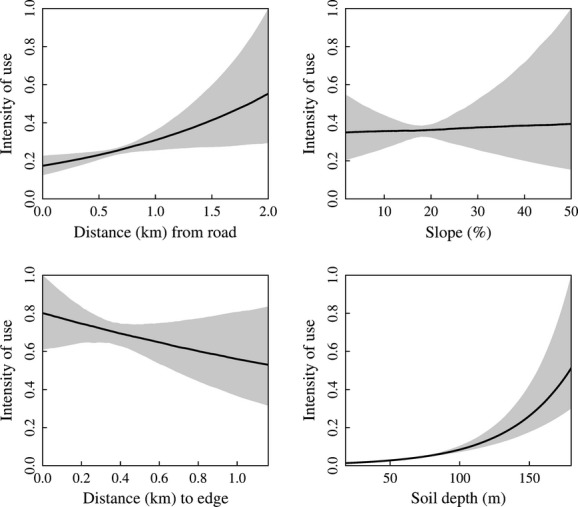
Resource selection functions (RSFs) are typically estimated by comparing covariates at a discrete set of "used" locations to those from an "available" set of locations. This RSF approach treats the response as binary and does not account for intensity of use among habitat units where locations were recorded. Advances in global positioning system (GPS) technology allow animal location data to be collected at fine spatiotemporal scales and have increased the size and correlation of data used in RSF analyses. We suggest that a more contemporary approach to analyzing such data is to model intensity of use, which can be estimated for one or more animals by relating the relative frequency of locations in a set of sampling units to the habitat characteristics of those units with count-based regression and, in particular, negative binomial (NB) regression. We demonstrate this NB RSF approach with location data collected from 10 GPS-collared Rocky Mountain elk (Cervus elaphus) in the Starkey Experimental Forest and Range enclosure. We discuss modeling assumptions and show how RSF estimation with NB regression can easily accommodate contemporary research needs, including: analysis of large GPS data sets, computational ease, accounting for among-animal variation, and interpretation of model covariates. We recommend the NB approach because of its conceptual and computational simplicity, and the fact that estimates of intensity of use are unbiased in the face of temporally correlated animal location data.
资源选择函数 (RSF) 通常通过将离散的“使用”位置的协变量与“可用”位置集的协变量进行比较来估计。这种 RSF 方法将响应视为二进制的,并且不考虑记录位置的栖息地单位中使用的强度。全球定位系统 (GPS) 技术的进步使得可以在精细的时空尺度上收集动物位置数据,并增加了 RSF 分析中使用的数据的大小和相关性。我们建议,分析此类数据的一种更现代的方法是对使用强度进行建模,可以通过将采样单元集的位置的相对频率与这些单元的栖息地特征相关联来为一个或多个动物估计使用强度,特别是基于计数的回归,特别是负二项式 (NB) 回归。我们使用在 Starkey 实验林和围场中为 10 只 GPS 项圈的落基山麋鹿 (Cervus elaphus) 收集的位置数据演示了这种 NB RSF 方法。我们讨论了建模假设,并展示了如何使用 NB 回归进行 RSF 估计,以轻松适应当代研究需求,包括:分析大型 GPS 数据集、计算简便、考虑动物间的变异性以及对模型协变量的解释。我们建议使用 NB 方法,因为它具有概念和计算上的简单性,并且在面对时间相关的动物位置数据时,使用强度的估计是无偏的。