University of Southamptom, Southampton, UK.
Arthritis Care Res (Hoboken). 2013 Dec;65(12):1976-85. doi: 10.1002/acr.22085.
To conduct a systematic review to assess the effectiveness of patient education interventions delivered or directed by health professionals for people with musculoskeletal conditions who also have lower levels of literacy.
Electronic databases were searched from 1946 to May 2012. Randomized controlled trials with primary interventions designed specifically for individuals with musculoskeletal conditions and lower levels of literacy were eligible for inclusion. The quality of the study was determined by assessing method of randomization, allocation concealment, creation and maintenance of comparable groups, blinding of patients and providers, control of confounding, and the validity and reliability of outcome measures.
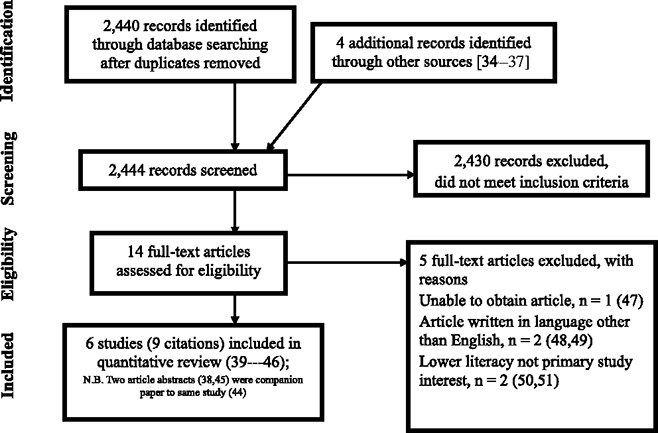
Of the 2,440 studies located using the search strategy, 6 studies met the inclusion criteria. Three public health community studies and 3 rheumatology clinic-based studies delivered educational programs to people with musculoskeletal conditions who also had lower levels of literacy. Three moderate quality studies suggest that musculoskeletal educational interventions had a small short-term effect on knowledge and 2 moderate quality studies suggest musculoskeletal interventions had a small effect on self-efficacy (although results on self-efficacy were conflicting in 1 of these studies). Only 1 moderate quality study showed a small effect on anxiety and 1 on self-perceived health and well-being in people with lower literacy.
High quality evidence is lacking on the effectiveness of musculoskeletal education interventions for people with lower literacy levels. Research programs that test the effectiveness of patient education interventions for arthritis must recruit and engage people with lower levels of literacy.
系统评价卫生专业人员为患有肌肉骨骼疾病且文化程度较低的患者提供或指导的患者教育干预措施的效果。
从 1946 年至 2012 年 5 月对电子数据库进行了检索。符合纳入标准的随机对照试验具有针对肌肉骨骼疾病和较低文化程度个体设计的主要干预措施。通过评估随机分组方法、分配隐匿、可比组的创建和维持、患者和提供者的盲法、混杂因素的控制以及结果测量的有效性和可靠性来确定研究的质量。
使用搜索策略共找到 2440 项研究,其中 6 项研究符合纳入标准。3 项公共卫生社区研究和 3 项风湿病诊所为患有肌肉骨骼疾病且文化程度较低的患者提供了教育计划。3 项中等质量的研究表明,肌肉骨骼教育干预措施对知识有短期的小影响,2 项中等质量的研究表明肌肉骨骼干预措施对自我效能有小的影响(尽管其中 1 项研究的自我效能结果存在矛盾)。仅有 1 项中等质量的研究显示对焦虑症和对较低文化程度者的自我感知健康和幸福感有较小的影响。
缺乏针对文化程度较低人群的肌肉骨骼教育干预效果的高质量证据。测试关节炎患者教育干预效果的研究计划必须招募和吸引文化程度较低的人群。