Disease Dynamics Unit, Department of Veterinary Medicine, University of Cambridge, Cambridge CB3 0ES, UK.
J Evol Biol. 2013 Sep;26(9):2021-30. doi: 10.1111/jeb.12209. Epub 2013 Aug 9.
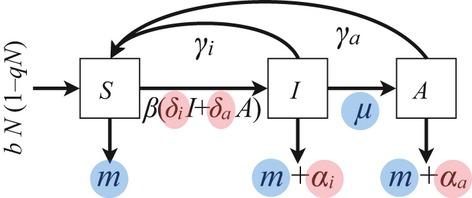
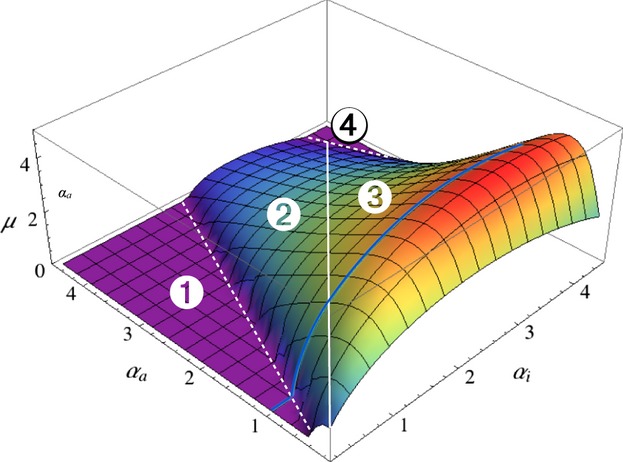
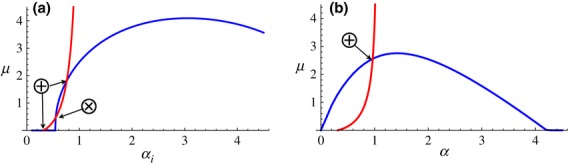
According to the Red Queen hypothesis, hosts and pathogens are engaged in an escalating coevolutionary arms race between resistance and virulence. However, the vast majority of symbionts colonize their hosts' mucosal compartments without triggering any immune response, resulting in durable commensal associations. Here, I propose a simple extension of previous mathematical models for antagonistic coevolution in which the host can mount a delayed immune response; in response, the symbiont can change its virulence following this activation. Even though the levels of virulence in both phases are assumed to be genetically determined, this simple form of plasticity can select for commensal associations. In particular, coevolution can result in hosts that do not activate their immune response, thus preventing phenotypically plastic pathogens from switching to a higher virulence level. I argue that, from the host's point of view, this state is analogous to the mafia behaviour previously described in avian brood parasites. More importantly, this study provides a new hypothesis for the maintenance of a commensal relationship through antagonistic coevolution.
根据红皇后假说,宿主和病原体之间在抗性和毒力之间进行着不断升级的协同进化军备竞赛。然而,绝大多数共生体在定植宿主黏膜隔室时不会引发任何免疫反应,从而形成持久的共生关系。在这里,我提出了一个简单的扩展,即在以前的拮抗共生进化数学模型中,宿主可以进行延迟的免疫反应;作为回应,共生体可以在这种激活后改变其毒力。尽管两个阶段的毒力水平都假定是由遗传决定的,但这种简单的可塑性形式可以选择共生关系。特别是,协同进化可以导致宿主不激活其免疫反应,从而防止表型可塑性病原体切换到更高的毒力水平。我认为,从宿主的角度来看,这种状态类似于先前在鸟类寄生雏鸟中描述的黑手党行为。更重要的是,这项研究为通过拮抗协同进化维持共生关系提供了一个新的假说。