Health Sciences Post-Graduate Program, Natal, RN, Brazil.
BMC Pregnancy Childbirth. 2013 Aug 8;13:159. doi: 10.1186/1471-2393-13-159.
Preeclampsia is a disease with great variability in incidence across the world. The mortality is higher in lower income countries, where it is the leading cause of maternal mortality. This study aimed to determine the frequency of and risk factors for preeclampsia in a low income population from an urban area of Brazil.
A prospective case control study of 242 women of which 30 developed preeclampsia, 4 had gestational hypertension, 2 had superimposed hypertension, 11 had spontaneous abortion, 13 were lost to follow up and 192 had normal pregnancy. This latter group was considered the normotensive controls. The rate of preeclampsia and the risk of cardiovascular disease, after onset of preeclampsia, were determined.
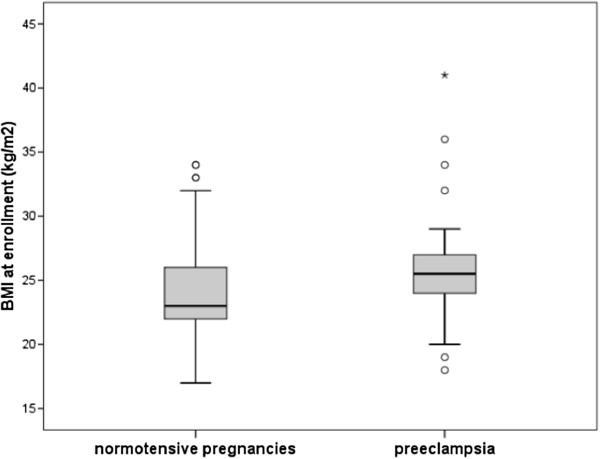
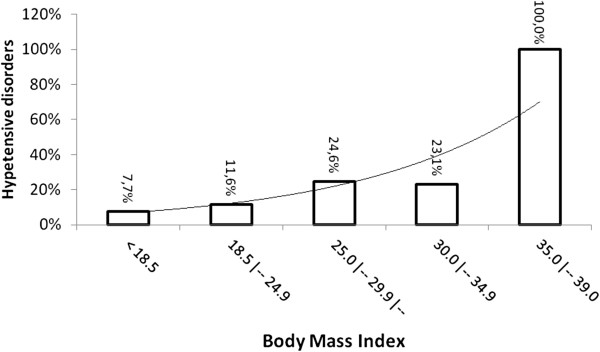
Of the 218 women who completed the study, the frequency of hypertensive disorder of pregnancy was 16.5% (36 of 218) and of preeclampsia was 13.8% (30 of 218). Women with preeclampsia had a higher body mass index (BMI), mean of 25.3 ± 4.8 compared to 23.5 ± 3.7 for the normotensive controls, p = 0.02. The risk of preeclampsia increased with BMI [Odds ratio (OR) 1.12, 95% Confidence Interval (CI = 1.02;1.24, p-value = 0.023)]. Women with preeclampsia developed chronic hypertension more often than normotensive controls (p = 0.043) and their systolic and ambulatory blood pressure monitoring was elevated (p = 0.034). Women with preeclampsia had higher BMI even 5 years post-pregnancy (p = 0.008).
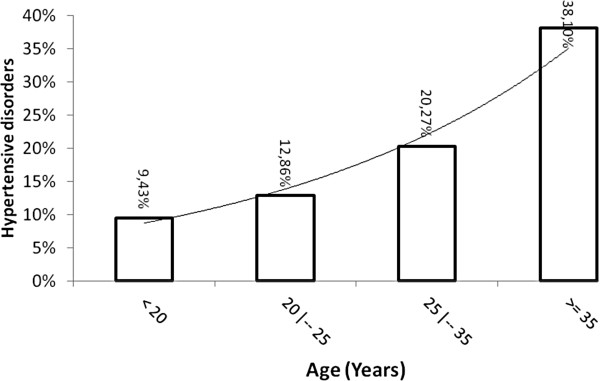
Women who are overweight or older have an increased risk of preeclampsia. Previous history of preeclampsia increases the risk of early onset of chronic hypertension. Therefore, effective preventive measures are needed, particularly women at lower social economic stratum who have less access to proper medical care and adequate nutrition.
子痫前期是一种在全球范围内发病率差异很大的疾病。在低收入国家,子痫前期的死亡率更高,是孕产妇死亡的主要原因。本研究旨在确定巴西一个城市地区低收入人群中子痫前期的发生频率和危险因素。
对 242 名妇女进行前瞻性病例对照研究,其中 30 名发生子痫前期,4 名发生妊娠期高血压,2 名发生重叠性高血压,11 名发生自然流产,13 名失访,192 名正常妊娠。后一组被认为是正常血压对照组。确定子痫前期的发生率和子痫前期发生后的心血管疾病风险。
在完成研究的 218 名妇女中,妊娠高血压疾病的发生率为 16.5%(36/218),子痫前期的发生率为 13.8%(30/218)。子痫前期患者的体重指数(BMI)更高,平均为 25.3±4.8,而正常血压对照组的平均 BMI 为 23.5±3.7,p=0.02。BMI 与子痫前期的风险呈正相关[比值比(OR)1.12,95%置信区间(CI)1.02~1.24,p 值=0.023]。与正常血压对照组相比,子痫前期患者更常发生慢性高血压(p=0.043),且其收缩压和动态血压监测结果更高(p=0.034)。即使在产后 5 年,子痫前期患者的 BMI 仍较高(p=0.008)。
超重或年龄较大的妇女发生子痫前期的风险增加。子痫前期的既往史增加了早发慢性高血压的风险。因此,需要采取有效的预防措施,特别是在社会经济地位较低的妇女中,她们获得适当医疗保健和充足营养的机会较少。