Department of Nutrition, Harvard School of Public Health, Boston, Massachusetts, USA.
PLoS One. 2013 Jul 30;8(7):e65174. doi: 10.1371/journal.pone.0065174. Print 2013.
The effects of systolic blood pressure (SBP), serum total cholesterol (TC), fasting plasma glucose (FPG), and body mass index (BMI) on the risk of cardiovascular diseases (CVD) have been established in epidemiological studies, but consistent estimates of effect sizes by age and sex are not available.
We reviewed large cohort pooling projects, evaluating effects of baseline or usual exposure to metabolic risks on ischemic heart disease (IHD), hypertensive heart disease (HHD), stroke, diabetes, and, as relevant selected other CVDs, after adjusting for important confounders. We pooled all data to estimate relative risks (RRs) for each risk factor and examined effect modification by age or other factors, using random effects models.
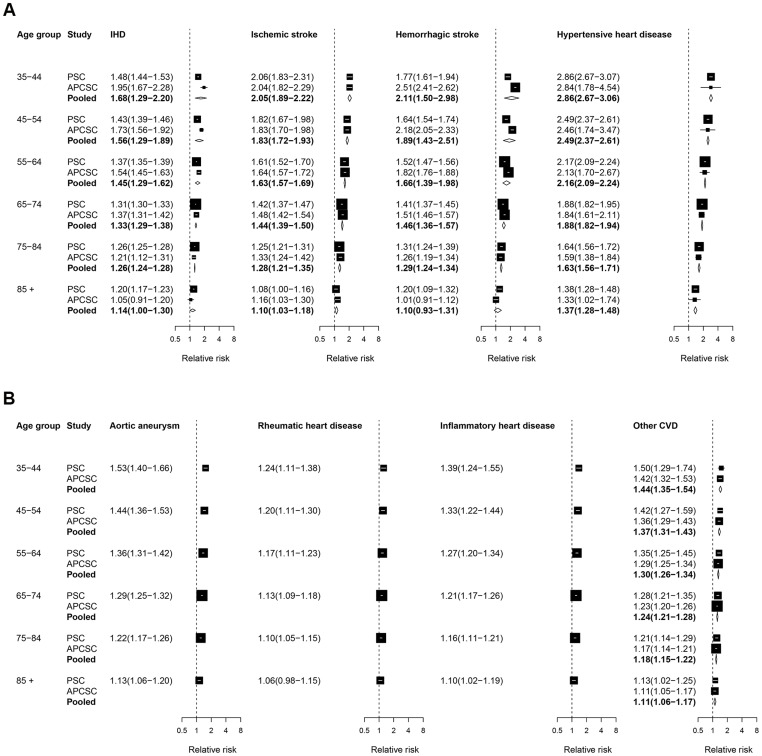
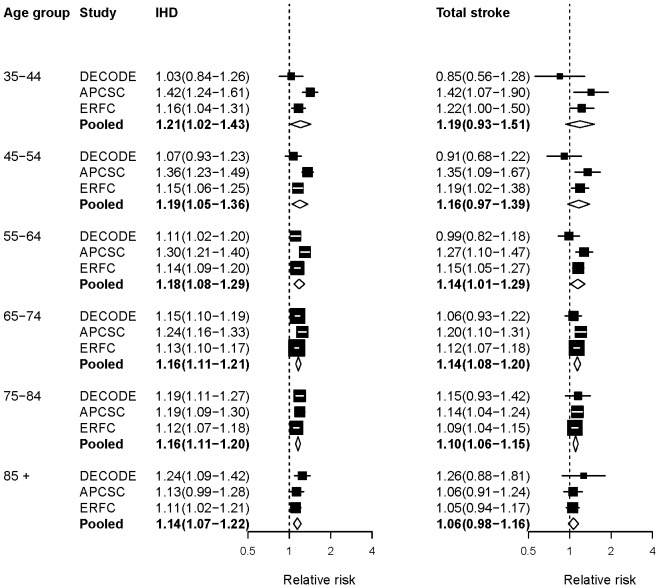
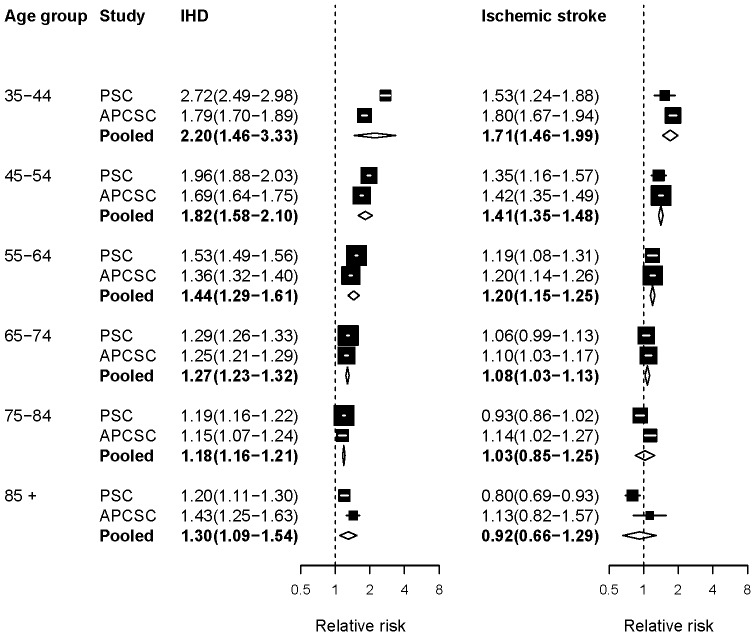
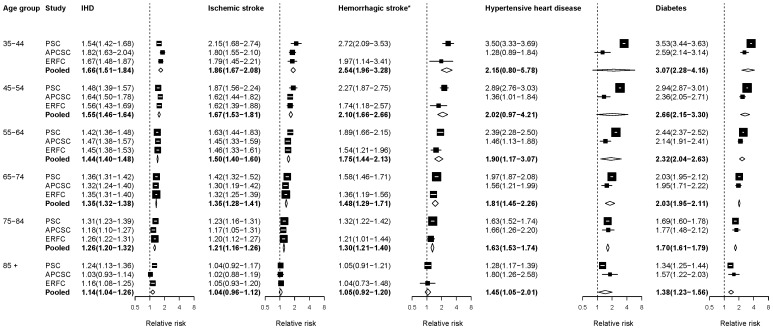
Across all risk factors, an average of 123 cohorts provided data on 1.4 million individuals and 52,000 CVD events. Each metabolic risk factor was robustly related to CVD. At the baseline age of 55-64 years, the RR for 10 mmHg higher SBP was largest for HHD (2.16; 95% CI 2.09-2.24), followed by effects on both stroke subtypes (1.66; 1.39-1.98 for hemorrhagic stroke and 1.63; 1.57-1.69 for ischemic stroke). In the same age group, RRs for 1 mmol/L higher TC were 1.44 (1.29-1.61) for IHD and 1.20 (1.15-1.25) for ischemic stroke. The RRs for 5 kg/m(2) higher BMI for ages 55-64 ranged from 2.32 (2.04-2.63) for diabetes, to 1.44 (1.40-1.48) for IHD. For 1 mmol/L higher FPG, RRs in this age group were 1.18 (1.08-1.29) for IHD and 1.14 (1.01-1.29) for total stroke. For all risk factors, proportional effects declined with age, were generally consistent by sex, and differed by region in only a few age groups for certain risk factor-disease pairs.
Our results provide robust, comparable and precise estimates of the effects of major metabolic risk factors on CVD and diabetes by age group.
在流行病学研究中,已经确定了收缩压(SBP)、血清总胆固醇(TC)、空腹血糖(FPG)和体重指数(BMI)对心血管疾病(CVD)风险的影响,但按年龄和性别划分的一致效应大小估计值尚不可用。
我们回顾了大型队列汇总项目,评估了基线或常规代谢风险暴露对缺血性心脏病(IHD)、高血压性心脏病(HHD)、中风、糖尿病以及相关的其他选定 CVD 的影响,同时调整了重要的混杂因素。我们汇总了所有数据,以估计每个危险因素的相对风险(RR),并使用随机效应模型检查年龄或其他因素的效应修饰。
在所有危险因素中,平均有 123 个队列提供了 140 万人的数据和 5.2 万例 CVD 事件。每个代谢危险因素都与 CVD 密切相关。在 55-64 岁的基线年龄,SBP 每升高 10mmHg,HHD 的 RR 最大(2.16;95%CI 2.09-2.24),其次是两种中风亚型的影响(1.66;1.39-1.98 为出血性中风,1.63;1.57-1.69 为缺血性中风)。在同一年龄组中,TC 每升高 1mmol/L,IHD 的 RR 为 1.44(1.29-1.61),缺血性中风的 RR 为 1.20(1.15-1.25)。55-64 岁时 BMI 每升高 5kg/m2,RR 范围从糖尿病的 2.32(2.04-2.63)到 IHD 的 1.44(1.40-1.48)。对于 FPG 每升高 1mmol/L,该年龄组 IHD 的 RR 为 1.18(1.08-1.29),总中风的 RR 为 1.14(1.01-1.29)。对于所有危险因素,比例效应随年龄下降,按性别基本一致,仅在某些年龄组中,某些危险因素与疾病的配对因地区而异。
我们的研究结果为按年龄组提供了主要代谢危险因素对 CVD 和糖尿病影响的稳健、可比和精确估计。