Psychiatry Department, Massachusetts General Hospital and Harvard Medical School, Charlestown, Massachusetts, USA.
PLoS One. 2013 Jul 31;8(7):e67485. doi: 10.1371/journal.pone.0067485. Print 2013.
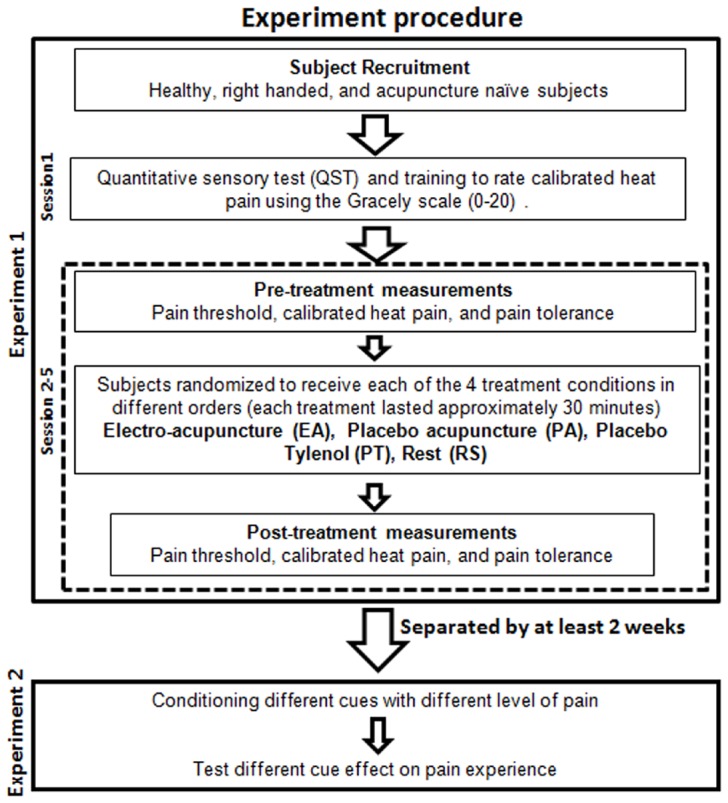
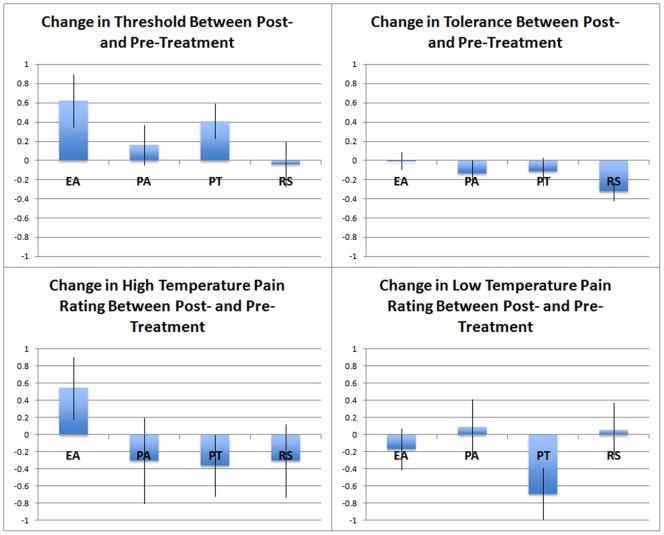
Placebo treatments and healing rituals have been used to treat pain throughout history. The present within-subject crossover study examines the variability in individual responses to placebo treatment with verbal suggestion and visual cue conditioning by investigating whether responses to different types of placebo treatment, as well as conditioning responses, correlate with one another. Secondarily, this study also examines whether responses to sham acupuncture correlate with responses to genuine acupuncture. Healthy subjects were recruited to participate in two sequential experiments. Experiment one is a five-session crossover study. In each session, subjects received one of four treatments: placebo pills (described as Tylenol), sham acupuncture, genuine acupuncture, or no treatment rest control condition. Before and after each treatment, paired with a verbal suggestion of positive effect, each subject's pain threshold, pain tolerance, and pain ratings to calibrated heat pain were measured. At least 14 days after completing experiment one, all subjects were invited to participate in experiment two, during which their analgesic responses to conditioned visual cues were tested. Forty-eight healthy subjects completed experiment one, and 45 completed experiment two. The results showed significantly different effects of genuine acupuncture, placebo pill and rest control on pain threshold. There was no significant association between placebo pills, sham acupuncture and cue conditioning effects, indicating that individuals may respond to unique healing rituals in different ways. This outcome suggests that placebo response may be a complex behavioral phenomenon that has properties that comprise a state, rather than a trait characteristic. This could explain the difficulty of detecting a signature for "placebo responders." However, a significant association was found between the genuine and sham acupuncture treatments, implying that the non-specific effects of acupuncture may contribute to the analgesic effect observed in genuine acupuncture analgesia.
安慰剂治疗和治疗仪式在历史上一直被用于治疗疼痛。本研究采用自身交叉设计,通过考察不同类型的安慰剂治疗以及条件反应的个体反应的变异性,研究了口头暗示和视觉线索条件作用对安慰剂治疗的个体反应的变异性,以确定它们之间是否存在相关性。其次,本研究还考察了假针刺治疗与真正的针刺治疗的反应是否相关。健康受试者被招募参加两个连续的实验。实验一是五期交叉研究。在每个阶段,受试者接受四种治疗方法之一:安慰剂药丸(描述为泰诺林)、假针刺、真正的针刺或无治疗休息对照条件。在每次治疗前后,与积极效果的口头建议配对,测量每个受试者的疼痛阈值、疼痛耐受力和对校准热痛的疼痛评分。在完成实验一至少 14 天后,所有受试者均受邀参加实验二,在此期间测试他们对条件视觉线索的镇痛反应。48 名健康受试者完成了实验一,45 名完成了实验二。结果显示,真正的针刺、安慰剂药丸和休息对照对疼痛阈值有显著不同的影响。安慰剂药丸、假针刺和线索条件作用之间没有显著的相关性,这表明个体可能以不同的方式对独特的治疗仪式做出反应。这一结果表明,安慰剂反应可能是一种复杂的行为现象,具有包含状态而不是特质特征的属性。这可以解释为什么很难检测到“安慰剂反应者”的特征。然而,在真正的和假的针刺治疗之间发现了显著的关联,这表明针刺的非特异性效应可能有助于观察到的真正的针刺镇痛的镇痛效果。