Chaire Aliment, Nutrition, Comportement Alimentaire, AgroParisTech, Paris, France.
PLoS One. 2013 Jul 30;8(7):e68436. doi: 10.1371/journal.pone.0068436. Print 2013.
Sensitivity to obesity is highly variable in humans, and rats fed a high fat diet (HFD) are used as a model of this inhomogeneity. Energy expenditure components (basal metabolism, thermic effect of feeding, activity) and variations in substrate partitioning are possible factors underlying the variability. Unfortunately, in rats as in humans, results have often been inconclusive and measurements usually made after obesity onset, obscuring if metabolism was a cause or consequence. Additionally, the role of high carbohydrate diet (HCD) has seldom been studied.
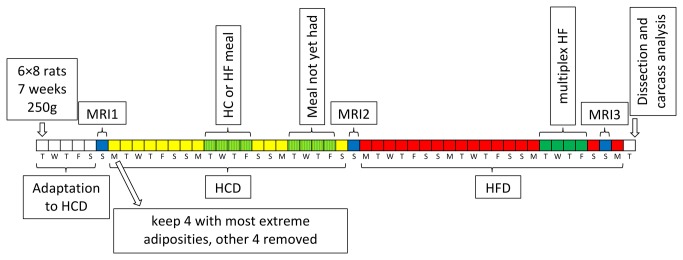
METHODOLOGY/FINDINGS: Rats (n=24) were fed for 3 weeks on HCD and then 3 weeks on HFD. Body composition was tracked by MRI and compared to energy expenditure components measured prior to obesity.
CONCLUSIONS/SIGNIFICANCE: The rat model of human obesity is based on substantial variance in adiposity gains under HFD (FR/FS model). Here, since we also found this phenomenon under HCD, where it was also linked to an identifiable metabolic difference, we should consider the existence of another model: the carbohydrate resistant (CR) or sensitive (CS) rat. This new model is potentially complementary to the FR/FS model due to relatively greater visceral fat accumulation on a low fat high carbohydrate diet.
人类对肥胖的敏感性差异很大,高脂肪饮食喂养的大鼠常被用作这种异质性的模型。能量消耗成分(基础代谢、摄食的热效应、活动)和底物分配的变化可能是导致这种变异性的因素。不幸的是,与人类一样,大鼠的结果往往也不一致,而且通常是在肥胖发生后进行测量,这使得代谢是肥胖的原因还是结果变得难以确定。此外,高碳水化合物饮食(HCD)的作用也很少被研究。
方法/发现:大鼠(n=24)先喂养 3 周 HCD,然后喂养 3 周 HFD。通过 MRI 跟踪身体成分,并与肥胖前测量的能量消耗成分进行比较。
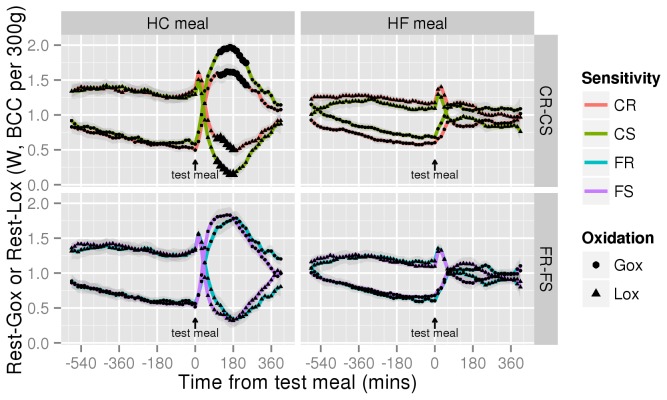
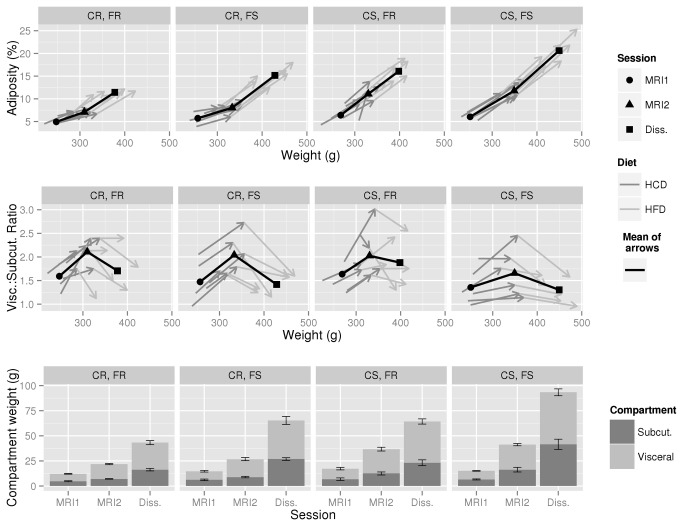
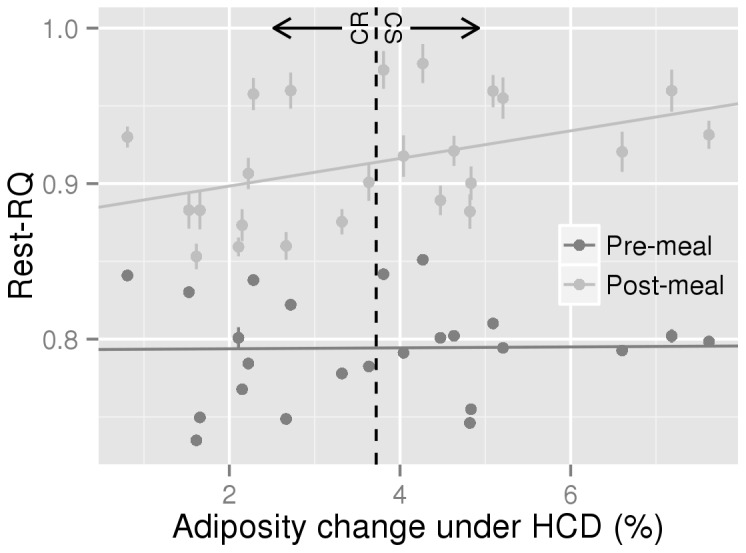
1)在 HFD 下,正如预期的那样,大鼠的肥胖程度差异很大,足以分为相对肥胖抵抗(FR)和敏感(FS)组;2)在 HCD 下,同样根据肥胖程度,大鼠也有足够的差异分为碳水化合物抵抗(CR)和敏感(CS)组,CS 组大鼠的正常体重隐藏了内脏脂肪堆积的偏向;3)HCD 肥胖的敏感性与 HFD 下的肥胖敏感性无关,HCD 和 HFD 的肥胖敏感性与能量消耗成分(BMR、TEF、活动成本)无关;4)只有对 HCD 测试餐的碳水化合物到脂肪的分配与 HCD 引起的肥胖有关。
结论/意义:人类肥胖的大鼠模型基于 HFD 下肥胖程度增加的显著差异(FR/FS 模型)。在这里,由于我们在 HCD 下也发现了这种现象,而且它也与可识别的代谢差异有关,我们应该考虑存在另一种模型:碳水化合物抵抗(CR)或敏感(CS)大鼠。由于在低脂高碳水化合物饮食下相对更多的内脏脂肪积累,这种新模型可能与 FR/FS 模型互补。