Department of Neurology, Kanazawa Medical University, Uchinada, Ishikawa Prefecture, Japan.
PLoS One. 2013 Aug 2;8(8):e69409. doi: 10.1371/journal.pone.0069409. Print 2013.
The most common strategy for treating patients with acute ischemic stroke is thrombolytic therapy, though only a few patients receive benefits because of the narrow time window. Inflammation occurring in the central nervous system (CNS) in association with ischemia is caused by immune cells including monocytes and involved in lesion expansion. If the specific roles of monocyte subsets in stroke can be revealed, they may become an effective target for new treatment strategies.
We performed immunological examinations of 36 consecutive ischemic stroke patients within 2 days of onset and compared the results with 24 age-matched patients with degenerative disorders. The stroke patients were repeatedly tested for the proportions of monocyte subsets in blood, and serum levels of pro- and anti-inflammatory cytokines immediately after admission, on days 3-7 and 12-16 after stroke onset, and on the day of discharge. In addition, immunological measurements were analyzed for relationships to stroke subtypes and complications, including progressive infarction (PI) and stroke-associated infection (SAI).
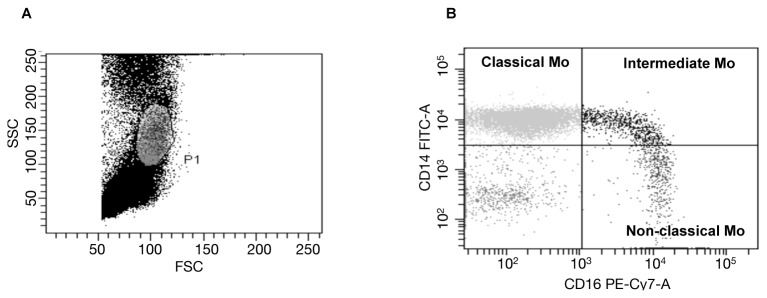
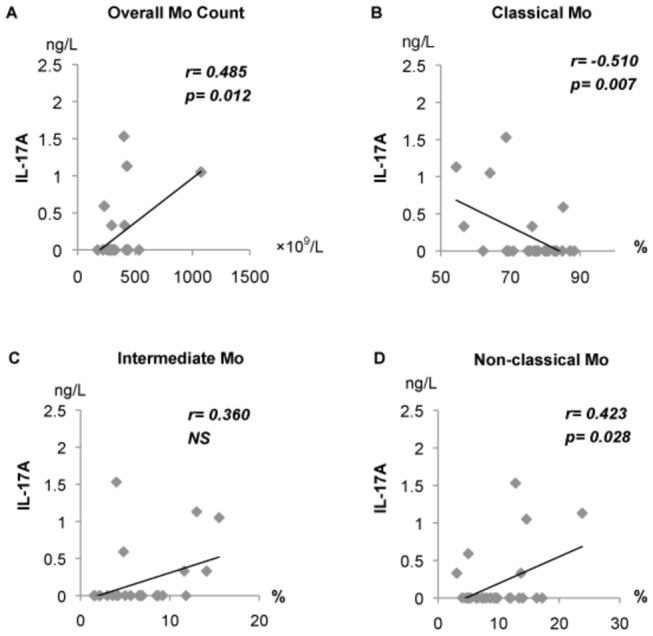
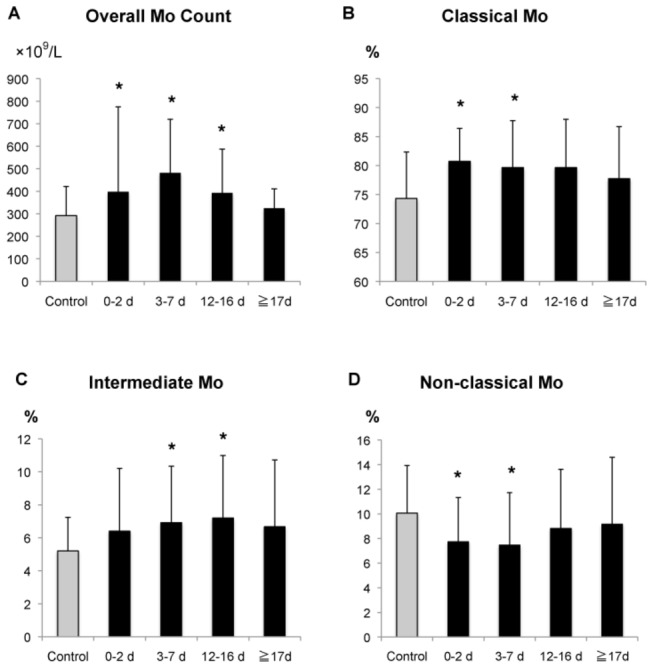
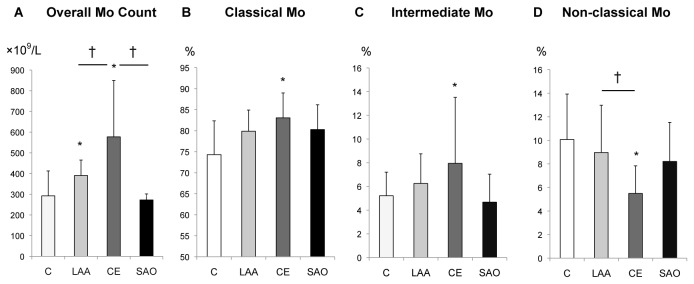
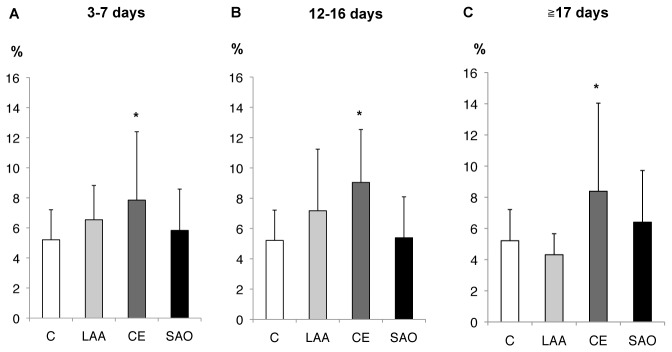
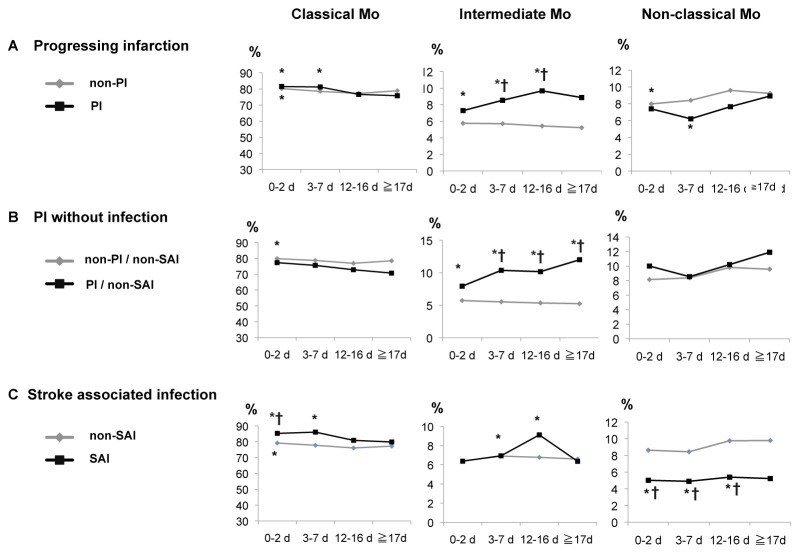
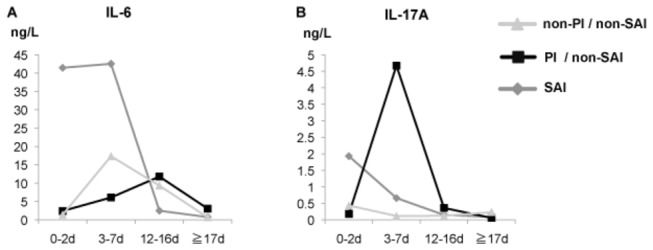
Monocyte count was significantly increased from 0-16 days after stroke as compared to the controls (p<0.05). CD14(high)CD16(-) classical and CD14(high)CD16(+) intermediate monocytes were significantly increased from 0-7 and 3-16 days after stroke, respectively (p<0.05), whereas CD14 (dim)CD16(high) non-classical monocytes were decreased from 0-7 days (p<0.05). Cardioembolic infarction was associated with a persistent increase in intermediate monocytes. Furthermore, intermediate monocytes were significantly increased in patients with PI (p<0.05), while non-classical monocytes were decreased in those with SAI (p<0.05). IL-17A levels were positively correlated with monocyte count (r=0.485, p=0.012) as well as the percentage of non-classical monocytes (r=0.423, p=0.028), and negatively with that of classical monocytes (r=-0.51, p=0.007) during days 12-16.
Our findings suggest that CD14(high)CD16(+) intermediate monocytes have a role in CNS tissue damage during acute and subacute phases in ischemic stroke especially in relation to cardioembolism.
治疗急性缺血性脑卒中患者最常用的策略是溶栓治疗,但由于时间窗口狭窄,只有少数患者从中受益。与缺血相关的中枢神经系统(CNS)炎症是由包括单核细胞在内的免疫细胞引起的,并参与病变的扩大。如果能够揭示单核细胞亚群在中风中的特定作用,它们可能成为新的治疗策略的有效靶点。
我们对发病后 2 天内的 36 例连续缺血性脑卒中患者进行了免疫学检查,并将结果与 24 例年龄匹配的退行性疾病患者进行了比较。脑卒中患者在发病后立即、第 3-7 天、第 12-16 天和出院当天多次检测血液中单核细胞亚群的比例以及促炎和抗炎细胞因子的血清水平。此外,还分析了免疫学测量结果与中风亚型和并发症的关系,包括进展性梗死(PI)和中风相关感染(SAI)。
与对照组相比,脑卒中后 0-16 天单核细胞计数显著增加(p<0.05)。CD14(high)CD16(-)经典单核细胞和 CD14(high)CD16(+)中间单核细胞分别从脑卒中后 0-7 天和 3-16 天显著增加(p<0.05),而 CD14(dim)CD16(high)非经典单核细胞则从 0-7 天减少(p<0.05)。心源性栓塞性梗死与中间单核细胞持续增加有关。此外,PI 患者中间单核细胞显著增加(p<0.05),而 SAI 患者非经典单核细胞减少(p<0.05)。IL-17A 水平与单核细胞计数呈正相关(r=0.485,p=0.012),与非经典单核细胞百分比呈正相关(r=0.423,p=0.028),与经典单核细胞百分比呈负相关(r=-0.51,p=0.007),在第 12-16 天。
我们的研究结果表明,CD14(high)CD16(+)中间单核细胞在缺血性中风的急性期和亚急性期,特别是在心源性栓塞中,在中枢神经系统组织损伤中起作用。