Tropical Infectious Diseases Research and Education Centre, Department of Medical Microbiology, Faculty of Medicine, University of Malaya, Kuala Lumpur, Malaysia.
PLoS Negl Trop Dis. 2013 Aug 1;7(8):e2341. doi: 10.1371/journal.pntd.0002341. Print 2013.
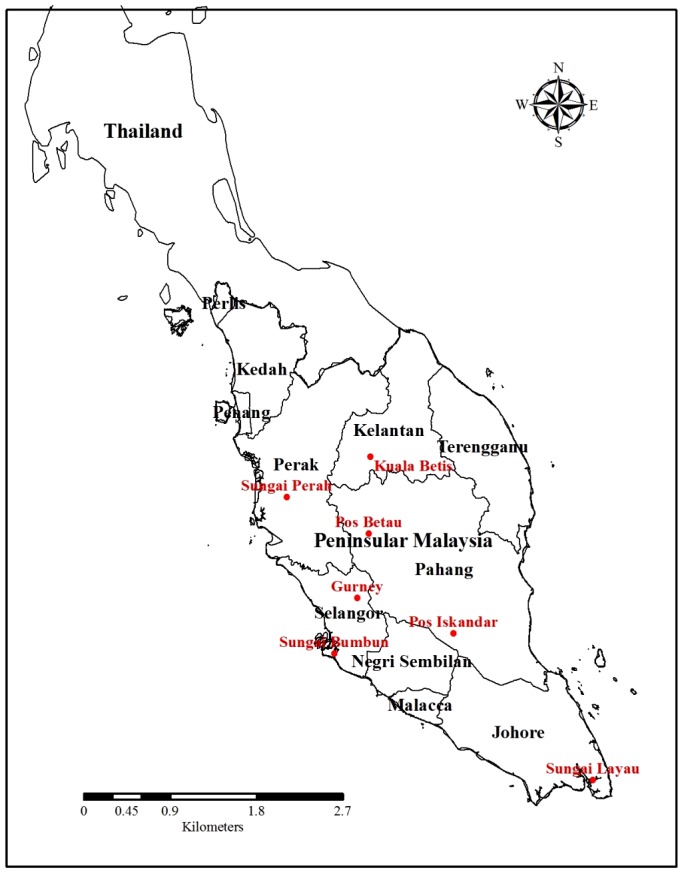
Limited data is available on the current status of scrub typhus infection in the aboriginal population in Malaysia. This study was aimed to provide recent data on the degree of exposure of 280 individuals from seven aboriginal subgroups to Orientia tsutsugamushi (causative agent of scrub typhus) in West Malaysia. The environment, socioeconomic and behavioural risk factors associated with the disease were also investigated.
METHODS/FINDINGS: The antibody prevalence to O. tsutsugamushi ranged from 0 to 36.4% in seven subgroups, with high prevalence rates noted in subgroups involved in agricultural activity and the lowest prevalence rates noted in subgroups whose main occupations were associated to fishing. Univariate analysis indicated populations with age above 18 years (OR = 1.15, 95% CI = 1.02-1.30, P = 0.015), working (OR = 1.99, 95% CI = 1.01-3.92, P = 0.044), working at agriculture area (OR = 1.18, 95% CI = 0.98-1.42, P = 0.031), receiving household income less than US$ 166.7 (RM500) per month (OR = 2.43, 95% CI = 1.16-5.11, P = 0.016) and having close contact with animal pets (OR = 4.06, 95% CI = 1.20-13.76, P = 0.016) are significantly associated with exposure to O. tsutsugamushi. Multivariate analysis confirms that participants who are above 18 years old, receiving household income less than US$ 166.7 (RM500) per month and having close contact with animal pets are 3.6 times (95% CI = 1.81-7.03, P<0.001), 1.3 times (95% CI = 1.14-1.64, P = 0.002) and 1.2 times (95% CI = 1.05-1.06, P = 0.006) more likely to have exposure to O. tsutsugamushi, respectively.
The present study indicates that scrub typhus is still an important disease in the aboriginal population in Malaysia. Awareness about the disease and education on the preventive measures are important in reducing the risk of acquiring scrub typhus in the population studied.
有关马来西亚原住民中恙虫病感染现状的资料有限。本研究旨在提供西马来西亚 280 名来自 7 个原住民亚群的个体接触东方体(恙虫病的病原体)的最新数据。还调查了与该病相关的环境、社会经济和行为危险因素。
方法/发现:7 个亚群中恙虫病抗体的流行率为 0 至 36.4%,从事农业活动的亚群的流行率较高,主要职业与渔业相关的亚群的流行率较低。单因素分析表明,年龄在 18 岁以上的人群(OR=1.15,95%CI=1.02-1.30,P=0.015)、工作人群(OR=1.99,95%CI=1.01-3.92,P=0.044)、在农业区工作人群(OR=1.18,95%CI=0.98-1.42,P=0.031)、家庭月收入低于 166.7 美元(500 令吉)(OR=2.43,95%CI=1.16-5.11,P=0.016)和与宠物动物密切接触人群(OR=4.06,95%CI=1.20-13.76,P=0.016)与接触东方体显著相关。多因素分析证实,18 岁以上、家庭月收入低于 166.7 美元(500 令吉)和与宠物动物密切接触的参与者接触东方体的风险分别是未接触者的 3.6 倍(95%CI=1.81-7.03,P<0.001)、1.3 倍(95%CI=1.14-1.64,P=0.002)和 1.2 倍(95%CI=1.05-1.06,P=0.006)。
本研究表明,恙虫病在马来西亚原住民中仍然是一种重要的疾病。提高对该病的认识和进行预防措施的教育对于降低研究人群中获得恙虫病的风险非常重要。