Ann Intensive Care. 2013 Aug 9;3:24. doi: 10.1186/2110-5820-3-24. eCollection 2013.
Sedation is used frequently for patients in intensive care units who require mechanical ventilation, but oversedation is one of the main side effects. Different strategies have been proposed to prevent oversedation. The extent to which these strategies have been adopted by intensivists is unknown.
We developed a six-section questionnaire that covered the drugs used, modalities of drug administration, use of sedation scales and procedural pain scales, use of written local procedures, and targeted objectives of consciousness. In November 2011, the questionnaire was sent to 1,078 intensivists identified from the French ICU Society (SRLF) database.
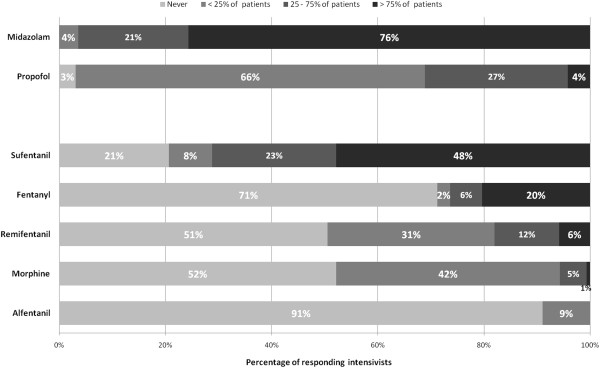
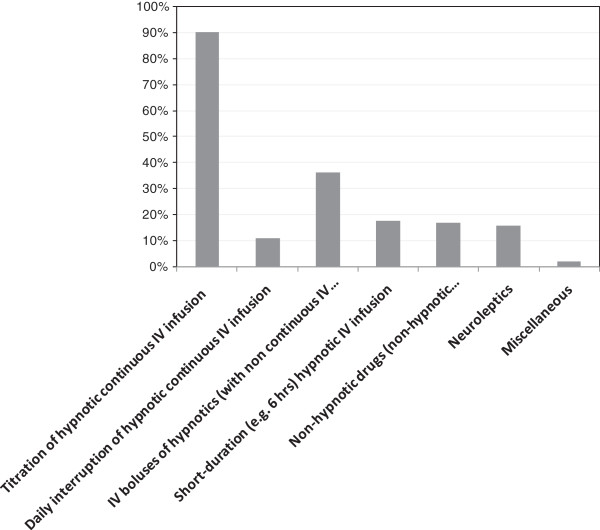
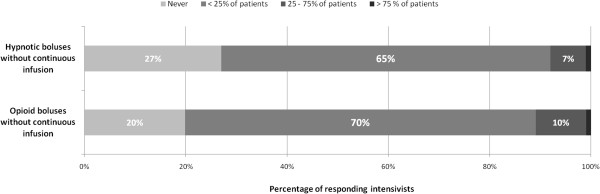
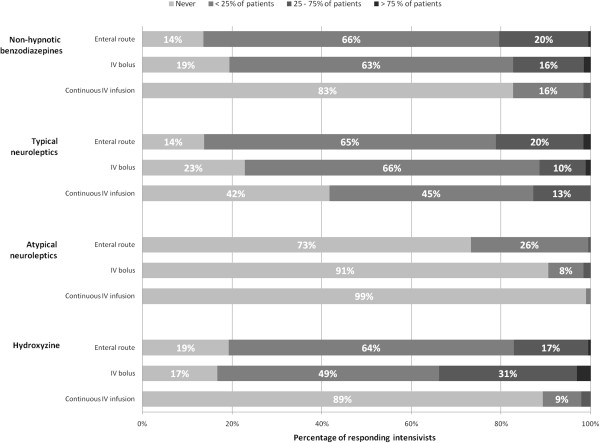
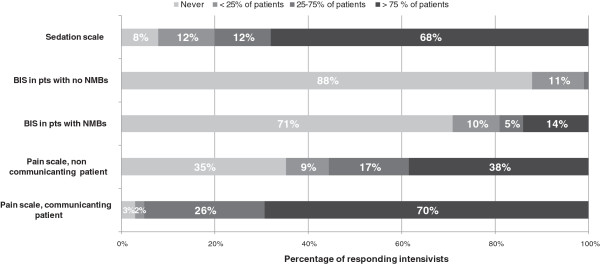
The questionnaire was returned by 195 intensivists (response rate 18.1%), representing 135 of the 282 ICUs (47.8%) listed in the French ICU society (SRLF) database. The analysis showed that midazolam and sufentanil are the most frequently used hypnotics and opioids, respectively, administered in continuous intravenous (IV) infusions. IV boluses of hypnotics without subsequent continuous IV infusion are used occasionally (in <25% of patients) by 65% of intensivists. Anxiolytic benzodiazepines (e.g., clorazepam, alprazolam), hydroxyzine, and typical neuroleptics, via either an enteral or IV route, are used occasionally by two thirds of respondents. The existence of a written, local sedation management procedure in the ICU is reported by 55% of respondents, 54% of whom declare that they use it routinely. Written local sedation procedures mainly rely on titration of continuous IV hypnotics (90% of the sedation procedures); less frequently, sedation procedures describe alternative approaches to prevent oversedation, including daily interruption of continuous IV hypnotic infusion, hypnotic boluses with no subsequent continuous IV infusion, or the use of nonhypnotic drugs. Among the responding intensivists, 98% consider eye opening, either spontaneously or after light physical stimulation, a reasonable target consciousness level in patients with no severe respiratory failure or intracranial hypertension.
Despite a low individual response rate, the respondents to our survey represent almost half of the ICUs in the French SRLF database. The presence of a written local sedation procedure, a cornerstone of preventing oversedation, is reported by only half of respondents; when present, it is used in for a limited number of patients. Sedation procedures mainly rely on titration of continuous IV hypnotics, but other strategies to limit oversedation also are included in sedation procedures. French intensivists no longer consider severely altered consciousness a sedation objective for most patients.
镇静常用于需要机械通气的重症监护病房患者,但过度镇静是主要副作用之一。已经提出了不同的策略来预防过度镇静。但是,强化治疗师采用这些策略的程度尚不清楚。
我们开发了一个六部分的问卷,涵盖了所使用的药物、药物给药方式、镇静评分和程序性疼痛评分的使用、书面局部程序的使用以及意识的目标。2011 年 11 月,该问卷发送给了从法国重症监护学会(SRLF)数据库中确定的 1078 名重症监护医生。
该问卷由 195 名重症监护医生(应答率 18.1%)回复,代表了法国重症监护学会(SRLF)数据库中列出的 282 个 ICU 中的 135 个(47.8%)。分析表明,咪达唑仑和舒芬太尼分别是最常用的催眠药和阿片类药物,以连续静脉输注(IV)的方式给药。65%的重症监护医生偶尔使用(<25%的患者)无后续连续 IV 输注的催眠药 IV 推注。安定类苯二氮䓬类(如氯硝西泮、阿普唑仑)、羟嗪和典型的神经阻滞剂通过肠内或 IV 途径偶尔被三分之二的受访者使用。55%的受访者报告说 ICU 中有书面的、局部的镇静管理程序,其中 54%的人表示他们经常使用。书面的局部镇静程序主要依赖于连续 IV 催眠药的滴定(90%的镇静程序);较少使用的是,镇静程序描述了预防过度镇静的替代方法,包括每天中断连续 IV 催眠药物输注、无后续连续 IV 输注的催眠药物推注或使用非催眠药物。在接受调查的重症监护医生中,98%的人认为睁眼,无论是自发的还是轻微的物理刺激后,都是没有严重呼吸衰竭或颅内高压的患者合理的意识水平目标。
尽管个人的回复率较低,但我们调查的受访者代表了法国 SRLF 数据库中近一半的 ICU。只有一半的受访者报告了书面的局部镇静程序,这是预防过度镇静的基石;当存在时,它只用于少数患者。镇静程序主要依赖于连续 IV 催眠药的滴定,但镇静程序中也包括其他限制过度镇静的策略。法国重症监护医生不再认为严重改变的意识是大多数患者的镇静目标。