National Center for Biotechnology Information, National Library of Medicine, National Institutes of Health, Bethesda, MD 20894, USA.
Biol Direct. 2013 Aug 15;8:20. doi: 10.1186/1745-6150-8-20.
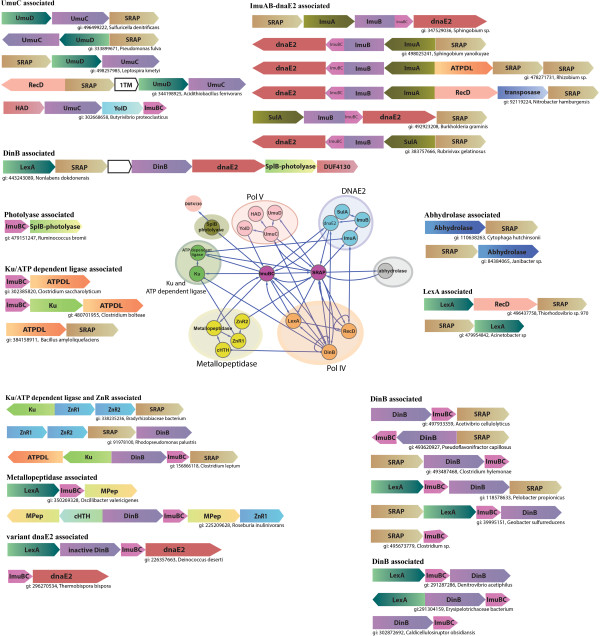
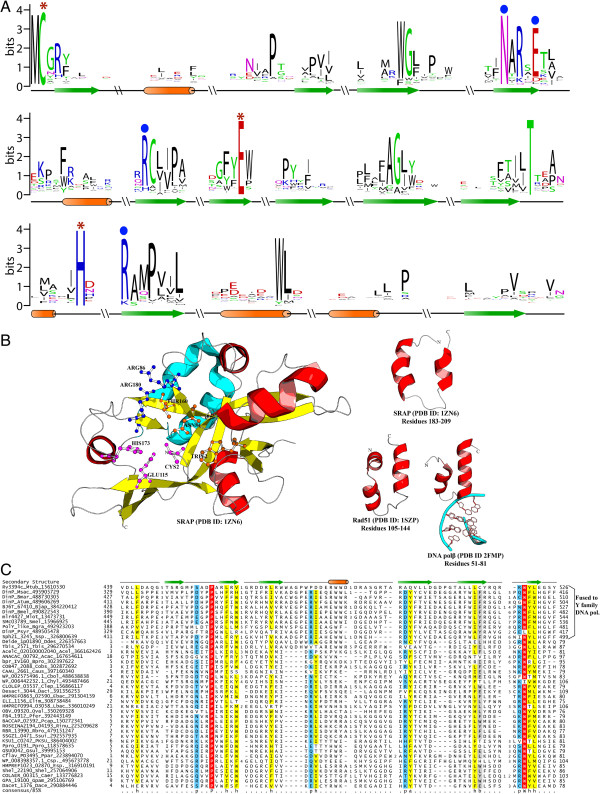
The bacterial SOS response is an elaborate program for DNA repair, cell cycle regulation and adaptive mutagenesis under stress conditions. Using sensitive sequence and structure analysis, combined with contextual information derived from comparative genomics and domain architectures, we identify two novel domain superfamilies in the SOS response system. We present evidence that one of these, the SOS response associated peptidase (SRAP; Pfam: DUF159) is a novel thiol autopeptidase. Given the involvement of other autopeptidases, such as LexA and UmuD, in the SOS response, this finding suggests that multiple structurally unrelated peptidases have been recruited to this process. The second of these, the ImuB-C superfamily, is linked to the Y-family DNA polymerase-related domain in ImuB, and also occurs as a standalone protein. We present evidence using gene neighborhood analysis that both these domains function with different mutagenic polymerases in bacteria, such as Pol IV (DinB), Pol V (UmuCD) and ImuA-ImuB-DnaE2 and also other repair systems, which either deploy Ku and an ATP-dependent ligase or a SplB-like radical SAM photolyase. We suggest that the SRAP superfamily domain functions as a DNA-associated autoproteolytic switch that recruits diverse repair enzymes upon DNA damage, whereas the ImuB-C domain performs a similar function albeit in a non-catalytic fashion. We propose that C3Orf37, the eukaryotic member of the SRAP superfamily, which has been recently shown to specifically bind DNA with 5-hydroxymethylcytosine, 5-formylcytosine and 5-carboxycytosine, is a sensor for these oxidized bases generated by the TET enzymes from methylcytosine. Hence, its autoproteolytic activity might help it act as a switch that recruits DNA repair enzymes to remove these oxidized methylcytosine species as part of the DNA demethylation pathway downstream of the TET enzymes.
细菌 SOS 反应是一种在应激条件下进行 DNA 修复、细胞周期调控和适应性诱变的精细程序。我们使用敏感的序列和结构分析,结合来自比较基因组学和结构域架构的上下文信息,在 SOS 反应系统中鉴定出两个新的结构域超家族。我们提供的证据表明,其中之一,即 SOS 反应相关肽酶(SOS response associated peptidase,SRAP;Pfam:DUF159)是一种新的硫醇自肽酶。鉴于其他自肽酶,如 LexA 和 UmuD,在 SOS 反应中的参与,这一发现表明,已经有多种结构上不相关的肽酶被招募到这个过程中。这两个超家族中的第二个是 ImuB-C 超家族,它与 ImuB 中的 Y 家族 DNA 聚合酶相关结构域相连,也作为独立的蛋白质存在。我们通过基因邻域分析提供的证据表明,这两个结构域在细菌中与不同的具有诱变活性的聚合酶一起发挥作用,如 Pol IV(DinB)、Pol V(UmuCD)和 ImuA-ImuB-DnaE2,以及其他修复系统,这些系统要么利用 Ku 和一个 ATP 依赖性连接酶,要么利用 SplB 样的自由基 SAM 光解酶。我们认为,SRAP 超家族结构域的功能是作为一种与 DNA 相关的自动蛋白水解开关,在 DNA 损伤时招募多种修复酶,而 ImuB-C 结构域则以非催化的方式执行类似的功能。我们提出,真核生物 SRAP 超家族的成员 C3Orf37 最近被证明可以特异性地与 5-羟甲基胞嘧啶、5-甲酰胞嘧啶和 5-羧基胞嘧啶结合的 DNA 结合,它是由 TET 酶从胞嘧啶甲基化产生的这些氧化碱基的传感器。因此,其自蛋白水解活性可能有助于它作为一种开关,招募 DNA 修复酶来去除这些氧化的甲基胞嘧啶物质,作为 TET 酶下游 DNA 去甲基化途径的一部分。