Laboratorio de Inmunología, Departamento de Fisiología, Centro Universitario de Ciencias de la Salud, Universidad de Guadalajara, Sierra Mojada # 950, Colonia Independencia, Guadalajara, Jalisco CP 44340, México.
J Biomed Sci. 2013 Aug 16;20(1):60. doi: 10.1186/1423-0127-20-60.
The NKG2D receptor confers important activating signals to NK cells via ligands expressed during cellular stress and viral infection. This receptor has generated great interest because not only is it expressed on NK cells, but it is also seen in virtually all CD8+ cytotoxic T cells and is classically considered absent in CD4+ T cells. However, recent studies have identified a distinctive population of CD4+ T cells that do express NKG2D, which could represent a particular cytotoxic effector population involved in viral infections and chronic diseases. On the other hand, increased incidence of human papillomavirus-associated lesions in CD4+ T cell-immunocompromised individuals suggests that CD4+ T cells play a key role in controlling the viral infection. Therefore, this study was focused on identifying the frequency of NKG2D-expressing CD4+ T cells in patients with cervical intraepithelial neoplasia (CIN) 1. Additionally, factors influencing CD4+NKG2D+ T cell expansion were also measured.
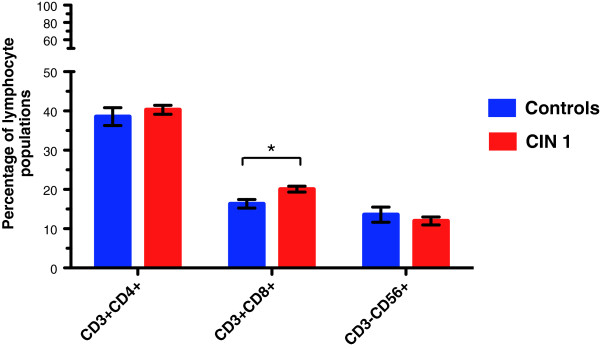
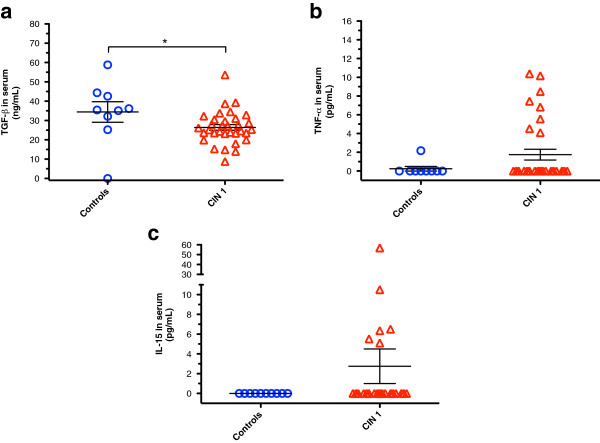
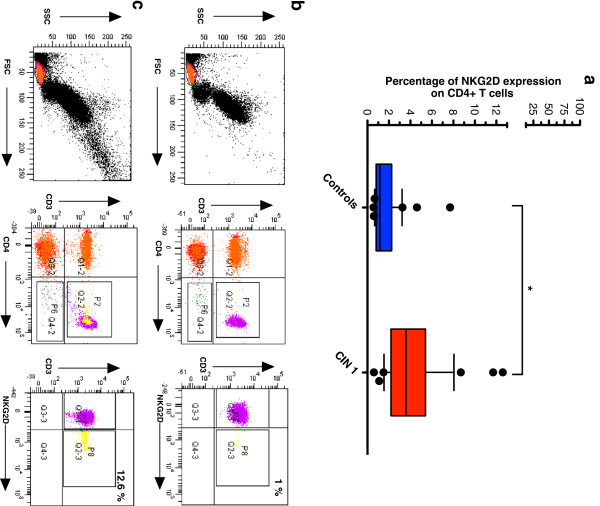
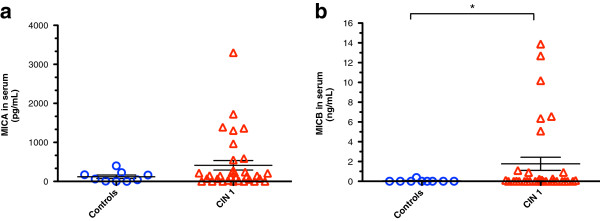
Close to 50% of patients with CIN 1 contained at least one of the 37 HPV types detected by our genotyping system. A tendency for increased CD4+ T cells and CD8+ T cells and decreased NK cells was found in CIN 1 patients. The percentage of circulating CD4+ T cells co-expressing the NKG2D receptor significantly increased in women with CIN 1 versus control group. Interestingly, the increase of CD4+NKG2D+ T cells was seen in patients with CIN 1, despite the overall levels of CD4+ T cells did not significantly increase. We also found a significant increase of soluble MICB in CIN 1 patients; however, no correlation with the presence of CD4+NKG2D+ T cells was seen. While TGF-beta was significantly decreased in the group of CIN 1 patients, both TNF-alpha and IL-15 showed a tendency to increase in this group.
Taken together, our results suggest that the significant increase within the CD4+NKG2D+ T cell population in CIN 1 patients might be the result of a chronic exposure to viral and/or pro-inflammatory factors, and concomitantly might also influence the clearance of CIN 1-type lesion.
NKG2D 受体通过细胞应激和病毒感染期间表达的配体为 NK 细胞提供重要的激活信号。该受体引起了极大的兴趣,不仅因为它在 NK 细胞上表达,而且几乎在所有 CD8+细胞毒性 T 细胞上都可见,并且经典上被认为不存在于 CD4+T 细胞中。然而,最近的研究已经鉴定出一种独特的 CD4+T 细胞群体确实表达了 NKG2D,这可能代表了一种参与病毒感染和慢性疾病的特定细胞毒性效应细胞群体。另一方面,CD4+T 细胞免疫受损个体中人类乳头瘤病毒相关病变的发生率增加表明 CD4+T 细胞在控制病毒感染中发挥关键作用。因此,本研究集中于鉴定宫颈上皮内瘤变(CIN)1 患者中表达 NKG2D 的 CD4+T 细胞的频率。此外,还测量了影响 CD4+NKG2D+T 细胞扩增的因素。
接近 50%的 CIN 1 患者至少含有我们基因分型系统检测到的 37 种 HPV 类型之一。在 CIN 1 患者中发现 CD4+T 细胞、CD8+T 细胞增加,NK 细胞减少的趋势。与对照组相比,患有 CIN 1 的女性循环中表达 NKG2D 受体的 CD4+T 细胞的百分比显着增加。有趣的是,尽管 CD4+T 细胞的总体水平没有显着增加,但在 CIN 1 患者中仍观察到 CD4+NKG2D+T 细胞的增加。我们还发现 CIN 1 患者中可溶性 MICB 显着增加,但与 CD4+NKG2D+T 细胞的存在无关。虽然 TGF-β在 CIN 1 患者组中显着降低,但 TNF-α和 IL-15 均显示出在此组中增加的趋势。
总之,我们的研究结果表明,CIN 1 患者中 CD4+NKG2D+T 细胞群体的显着增加可能是由于慢性暴露于病毒和/或促炎因子所致,并且同时可能也会影响 CIN 1 型病变的清除。