Department of Neonatology, The Rosie Hospital, Cambridge University Hospitals NHS Foundation Trust, United Kingdom; Bradford Neonatology, Bradford Teaching Hospitals NHS Trust, United Kingdom.
Resuscitation. 2013 Nov;84(11):1558-61. doi: 10.1016/j.resuscitation.2013.06.026. Epub 2013 Aug 12.
The International Liaison Committee on Resuscitation (ILCOR) and U.K. Resuscitation Council (UKRC) updated guidance on newborn resuscitation in late 2010.
To describe delivery room (DR) practice in stabilisation following very preterm birth (<32 weeks gestation) in the U.K.
We emailed a national survey of current DR stabilisation practice of very preterm infants to all U.K. delivery units and conducted telephone follow-up calls.
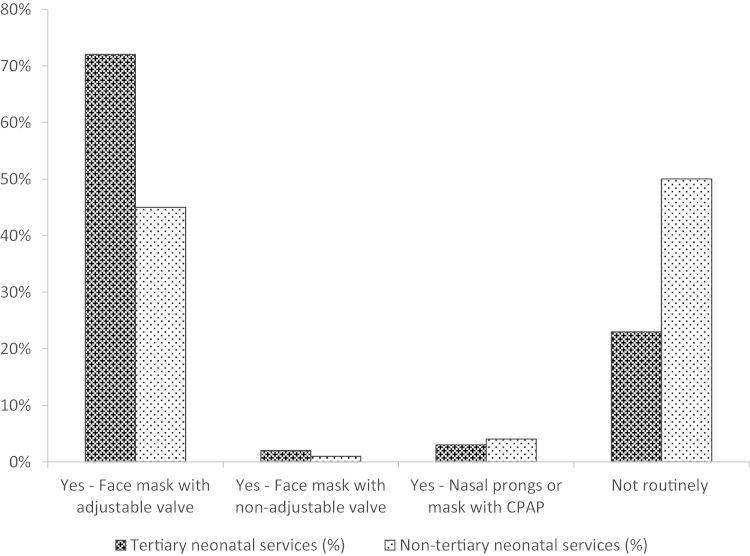
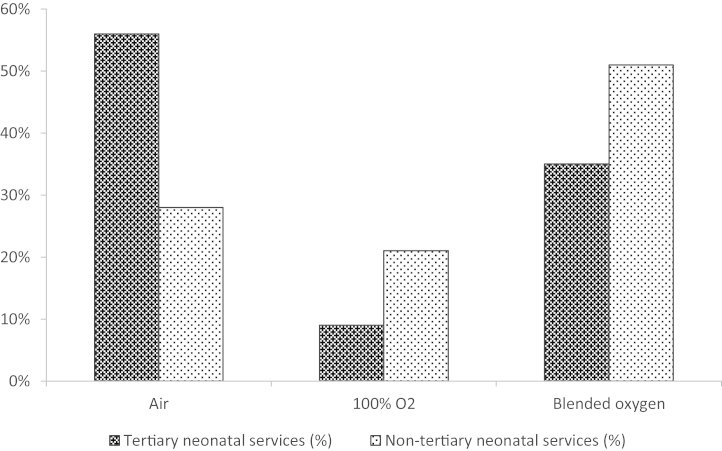
We obtained 197 responses from 199 units (99%) and complete data from 186 units. Tertiary units administered surfactant in the DR (93% vs. 78%, P=0.01), instituted DR CPAP (77% vs. 50%, P=0.0007), provided PEEP in the delivery room (91% vs. 69%, P=0.0008), and started resuscitation in air or blended oxygen (91% vs. 78%, P=0.04) more often than non-tertiary units. Routine out of hours consultant attendance at very preterm birth was more common in tertiary units (82% vs. 55%, P=0.0005).
Marked variation in DR stabilisation practice of very preterm infants persisted one year after the publication of revised UKRC guidance. Delivery room care provided in non-tertiary units was less consistent with current international guidance.
国际复苏联合会(ILCOR)和英国复苏委员会(UKRC)于 2010 年末更新了新生儿复苏指南。
描述英国在极早产儿(<32 孕周)分娩后复苏病房(DR)的稳定处理方法。
我们向英国所有分娩单位发送了一份关于极早产儿稳定处理方法的全国性 DR 实践的电子邮件调查,并进行了电话随访。
我们从 199 个单位(99%)获得了 197 份回复,并从 186 个单位获得了完整的数据。三级单位在 DR 中给予表面活性剂(93%比 78%,P=0.01)、建立 DR CPAP(77%比 50%,P=0.0007)、在 DR 中提供 PEEP(91%比 69%,P=0.0008)、以及更常开始空气或混合氧复苏(91%比 78%,P=0.04),比非三级单位更频繁。在极早产儿分娩时,三级单位更常安排顾问在非工作时间到场(82%比 55%,P=0.0005)。
在修订后的 UKRC 指南发布一年后,极早产儿 DR 稳定处理方法仍存在显著差异。非三级单位提供的 DR 护理与当前国际指南不太一致。