Shin Hyun-Guk, Lee Sang-Eun, Hong Sung-Hee, Kim Se-Mi, Choi Young-Ki, Park Hyung-Jin, Seo Kyoung-Won, Song Kun-Ho
Laboratory of Veterinary Internal Medicine, College of Veterinary Medicine, Chungnam National University, Daejeon 305-764, Korea.
J Vet Med Sci. 2013 Dec 30;75(12):1609-13. doi: 10.1292/jvms.13-0360. Epub 2013 Aug 13.
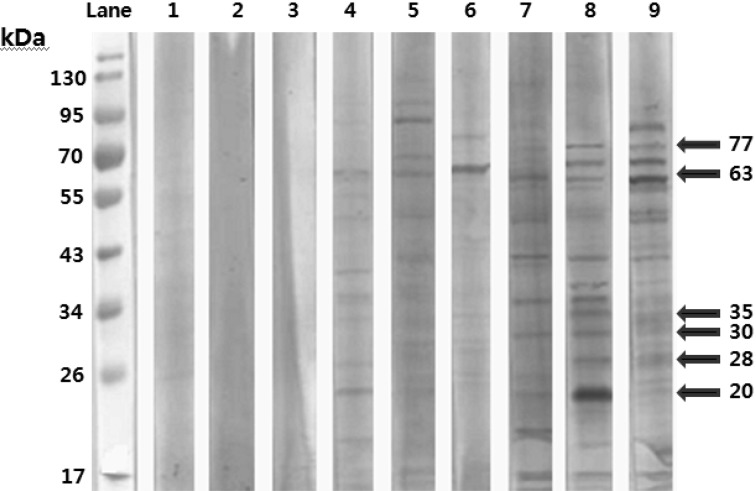
This study surveyed the Toxoplasma (T.) gondii infection prevalence in the Korean rabbit population. Rabbits (n=142) were obtained from two breeding farms in the Gongju area, Chungnam Province, and in the Kochang area, Junbuk Province, Korea. Of 142 sera samples analyzed by enzyme-linked immunosorbent assay (ELISA), 15 (10.6%) exhibited T. gondii-specific IgG antibodies, and 1 (0.7%) rabbit harbored T. gondii-specific IgM. Female rabbits (9/84; 10.7%) had a similar T. gondii prevalence to males (6/58; 10.3%). When stratified by age, rabbits aged >1 year had a similar prevalence of T. gondii infection (7/66; 10.6%) to rabbits aged <1 year (8/76; 10.5%). Immunoblotting detected 6 major antigenic bands corresponding to T. gondii-positive sera at 20, 28, 30, 35, 63 and 77 kDa. Nested polymerase chain reaction (PCR) of whole-blood samples detected the T. gondii B1 gene in 23 rabbits (16.2%). All PCR-positive samples corresponded to partial T. gondii B1 gene sequences with 99% homology to a T. gondii sequence deposited in GenBank (accession number EU340874). Female rabbits (13/84; 15.5%) harbored a similar prevalence of T. gondii DNA to males (10/58; 17.2%). Rabbits aged >1 year had a similar prevalence (12/66; 18.2%) of T. gondii infection to rabbits aged <1 year (11/76; 14.5%). No statistically significant differences were observed regarding the prevalences of infection according to sex or age using molecular or serological tests. This study is the first survey using serological tests and nested PCR to analyze the T. gondii prevalence in rabbits in Korea.
本研究调查了韩国兔群中弓形虫的感染率。兔子(n = 142)取自韩国忠南省公州市地区和全北道高敞地区的两个养殖场。通过酶联免疫吸附测定(ELISA)分析的142份血清样本中,15份(10.6%)呈现弓形虫特异性IgG抗体,1只兔子(0.7%)携带弓形虫特异性IgM。雌性兔子(9/84;10.7%)的弓形虫感染率与雄性兔子(6/58;10.3%)相似。按年龄分层时,年龄大于1岁的兔子弓形虫感染率(7/66;10.6%)与年龄小于1岁的兔子(8/76;10.5%)相似。免疫印迹法检测到与弓形虫阳性血清相对应的6条主要抗原带,分子量分别为20、28、30、35、63和77 kDa。全血样本的巢式聚合酶链反应(PCR)在23只兔子(16.2%)中检测到弓形虫B1基因。所有PCR阳性样本均对应于与GenBank中登录的弓形虫序列(登录号EU340874)具有99%同源性的部分弓形虫B1基因序列。雌性兔子(13/84;15.5%)的弓形虫DNA携带率与雄性兔子(10/58;17.2%)相似。年龄大于1岁的兔子弓形虫感染率(12/66;18.2%)与年龄小于1岁的兔子(11/76;14.5%)相似。使用分子或血清学检测,未观察到感染率在性别或年龄方面存在统计学显著差异。本研究是韩国首次使用血清学检测和巢式PCR分析兔群中弓形虫感染率的调查。