Functional Food and Nutrition Division, Department of Agrofood Resources, Rural Development Administration, Suwon 441-707, Korea.
Nutr Res Pract. 2013 Aug;7(4):294-301. doi: 10.4162/nrp.2013.7.4.294. Epub 2013 Aug 7.
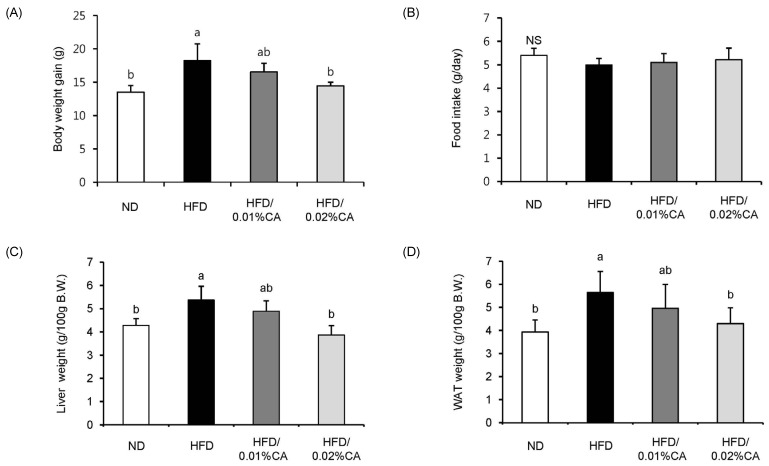
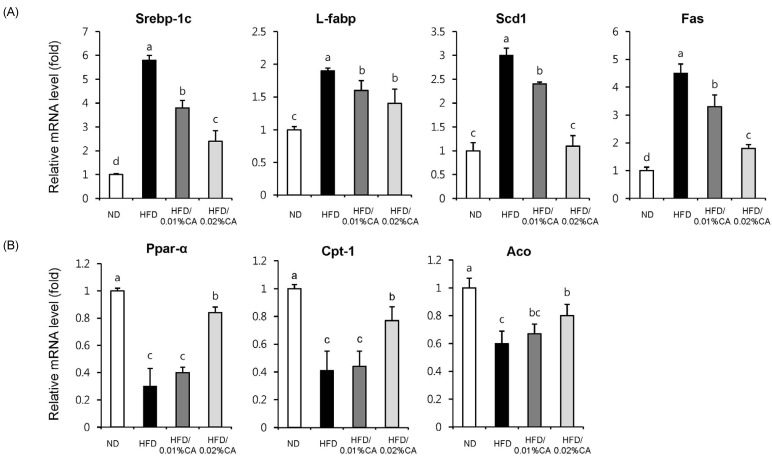
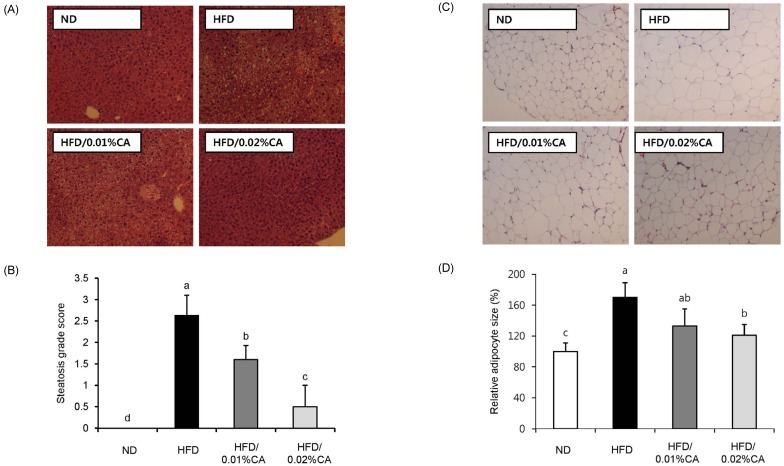
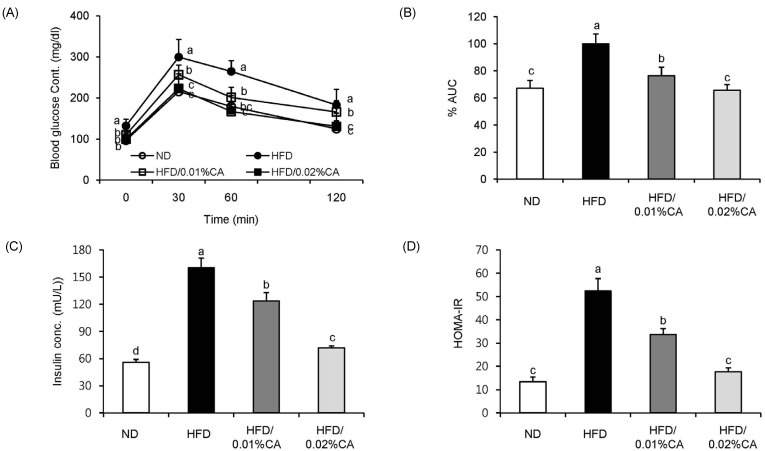
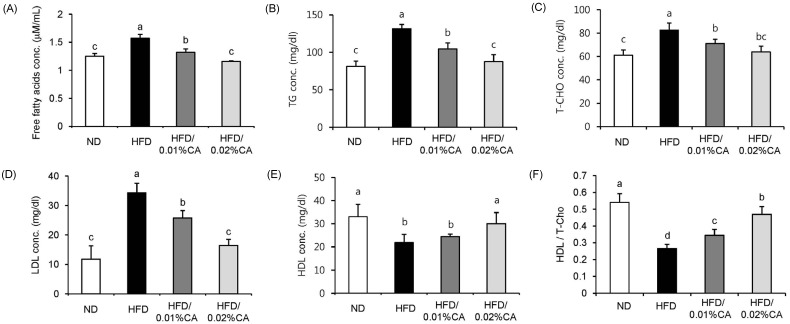
In this study, we examined the hepatic anti-steatosis activity of carnosic acid (CA), a phenolic compound of rosemary (Rosmarinus officinalis) leaves, as well as its possible mechanism of action, in a high-fat diet (HFD)-fed mice model. Mice were fed a HFD, or a HFD supplemented with 0.01% (w/w) CA or 0.02% (w/w) CA, for a period of 12 weeks, after which changes in body weight, blood lipid profiles, and fatty acid mechanism markers were evaluated. The 0.02% (w/w) CA diet resulted in a marked decline in steatosis grade, as well as in homeostasis model assessment of insulin resistance (HOMA-IR) index values, intraperitoneal glucose tolerance test (IGTT) results, body weight gain, liver weight, and blood lipid levels (P < 0.05). The expression level of hepatic lipogenic genes, such as sterol regulating element binding protein-1c (SREBP-1c), liver-fatty acid binding protein (L-FABP), stearoyl-CoA desaturase 1 (SCD1), and fatty acid synthase (FAS), was significantly lower in mice fed 0.01% (w/w) CA and 0.02% (w/w) CA diets than that in the HFD group; on the other hand, the expression level of β-oxidation-related genes, such as peroxisome proliferator-activated receptor α (PPAR-α), carnitine palmitoyltransferase 1 (CPT-1), and acyl-CoA oxidase (ACO), was higher in mice fed a 0.02% (w/w) CA diet, than that in the HFD group (P < 0.05). In addition, the hepatic content of palmitic acid (C16:0), palmitoleic acid (C16:1), and oleic acid (C18:1) was significantly lower in mice fed the 0.02% (w/w) CA diet than that in the HFD group (P < 0.05). These results suggest that orally administered CA suppressed HFD-induced hepatic steatosis and fatty liver-related metabolic disorders through decrease of de novo lipogenesis and fatty acid elongation and increase of fatty acid β-oxidation in mice.
在这项研究中,我们研究了迷迭香(Rosmarinus officinalis)叶中的酚类化合物——咖啡酸(CA)对高脂肪饮食(HFD)喂养小鼠模型的抗脂肪肝活性及其可能的作用机制。将小鼠喂食 HFD 或补充 0.01%(w/w)CA 或 0.02%(w/w)CA 的 HFD 12 周,评估体重、血脂谱和脂肪酸机制标志物的变化。0.02%(w/w)CA 饮食可显著降低脂肪肝分级以及稳态模型评估的胰岛素抵抗(HOMA-IR)指数值、腹腔内葡萄糖耐量试验(IGTT)结果、体重增加、肝重和血脂水平(P < 0.05)。喂食 0.01%(w/w)CA 和 0.02%(w/w)CA 饮食的小鼠肝内脂质生成基因(如固醇调节元件结合蛋白-1c(SREBP-1c)、肝脂肪酸结合蛋白(L-FABP)、硬脂酰辅酶 A 去饱和酶 1(SCD1)和脂肪酸合酶(FAS)的表达水平明显低于 HFD 组;另一方面,喂食 0.02%(w/w)CA 饮食的小鼠β-氧化相关基因(如过氧化物酶体增殖物激活受体-α(PPAR-α)、肉碱棕榈酰转移酶 1(CPT-1)和酰基辅酶 A 氧化酶(ACO)的表达水平高于 HFD 组(P < 0.05)。此外,喂食 0.02%(w/w)CA 饮食的小鼠肝内棕榈酸(C16:0)、棕榈油酸(C16:1)和油酸(C18:1)含量明显低于 HFD 组(P < 0.05)。这些结果表明,口服 CA 通过减少从头合成的脂肪生成和脂肪酸延长以及增加脂肪酸β-氧化来抑制 HFD 诱导的肝脂肪变性和与脂肪肝相关的代谢紊乱。