Department of Foods and Nutrition, College of Natural Sciences, Kookmin University, 861-1 Jeongnung-dong, Songbuk-gu, Seoul 136-702, Korea.
Nutr Res Pract. 2013 Aug;7(4):330-5. doi: 10.4162/nrp.2013.7.4.330. Epub 2013 Aug 7.
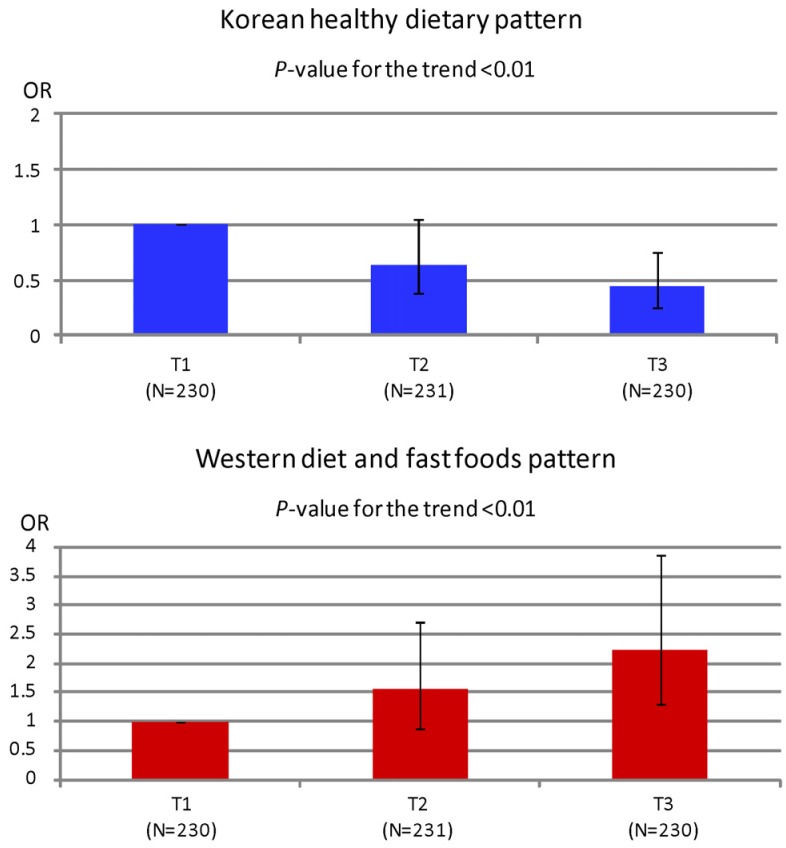
Data are limited on the association between dietary patterns and screen time among Korean adolescents. The present study identified dietary patterns of 691 adolescents, aged 13-18 years, who had participated in the Third Korean National Health and Nutrition Examination Survey (KNHANES III) and analyzed their associations with screen time. Screen time was defined as the time spent watching TV, using a computer, or playing video games was calculated as a sum of all these times. Dietary patterns and their factor scores were derived from a food frequency questionnaire using the factor analysis method. To analyze the association between dietary patterns and screen time, we conducted multiple linear regression analysis. We also performed multiple logistic regression analysis to estimate odds ratios (OR) of excessive screen time (2 hours or longer per day) and 95% confidence intervals (CI). We identified 2 dietary patterns labeled "the Korean healthy dietary pattern" and "the Western diet and fast foods pattern". The former included mixed grains, legumes, potatoes, red meat, eggs, fish, dairy products, fruits, vegetables, seaweeds, and mushrooms, whereas the latter included noodles, bread, red meat, poultry, fast foods, snack, and soft drinks. After controlling for potential confounding factors, factor scores for the Korean healthy dietary pattern were inversely associated (P-value for trend < 0.01) and those for the Western diet and fast foods pattern were positively associated with the screen time (P-value for trend < 0.01). Adolescents in the top tertile of the scores for the Korean healthy dietary pattern had a multivariable-adjusted OR [95% CI] of 0.44 (0.25-0.75) for excessive screen time compared with those in the lowest tertile. On the basis of these findings, adolescents who have excessive screen time may need to be encouraged to consume a more healthy diet.
关于韩国青少年的饮食模式与屏幕时间之间的关联,相关数据有限。本研究通过对参与第三次韩国国家健康和营养检查调查(KNHANES III)的 691 名 13-18 岁青少年的饮食模式进行了识别,并分析了它们与屏幕时间的关联。屏幕时间被定义为观看电视、使用计算机或玩电子游戏的时间总和。饮食模式及其因子得分是通过因子分析方法从食物频率问卷中得出的。为了分析饮食模式与屏幕时间之间的关联,我们进行了多元线性回归分析。我们还进行了多因素逻辑回归分析,以估计过度屏幕时间(每天 2 小时或更长时间)的比值比(OR)和 95%置信区间(CI)。我们确定了两种饮食模式,分别标记为“韩国健康饮食模式”和“西方饮食和快餐模式”。前者包括混合谷物、豆类、土豆、红肉、鸡蛋、鱼类、乳制品、水果、蔬菜、海藻和蘑菇,而后者包括面条、面包、红肉、家禽、快餐、零食和软饮料。在控制了潜在的混杂因素后,韩国健康饮食模式的因子得分与屏幕时间呈负相关(趋势 P 值<0.01),而西方饮食和快餐模式的因子得分与屏幕时间呈正相关(趋势 P 值<0.01)。与得分最低的三分位组相比,处于韩国健康饮食模式得分最高三分位组的青少年过度屏幕时间的多变量调整比值比(95%CI)为 0.44(0.25-0.75)。基于这些发现,可能需要鼓励那些过度使用屏幕的青少年摄入更健康的饮食。