International Agency for Research on Cancer, Lyon, France.
Emerg Infect Dis. 2013;19(9):1437-45. doi: 10.3201/eid1909.120200.
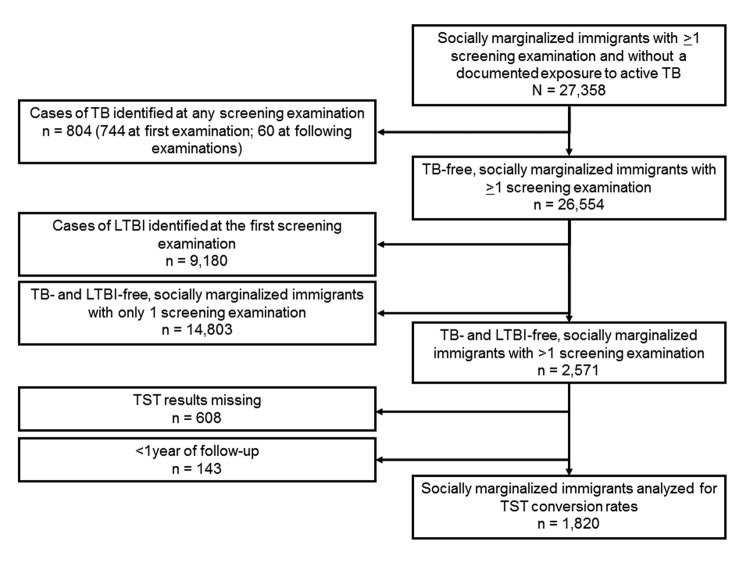
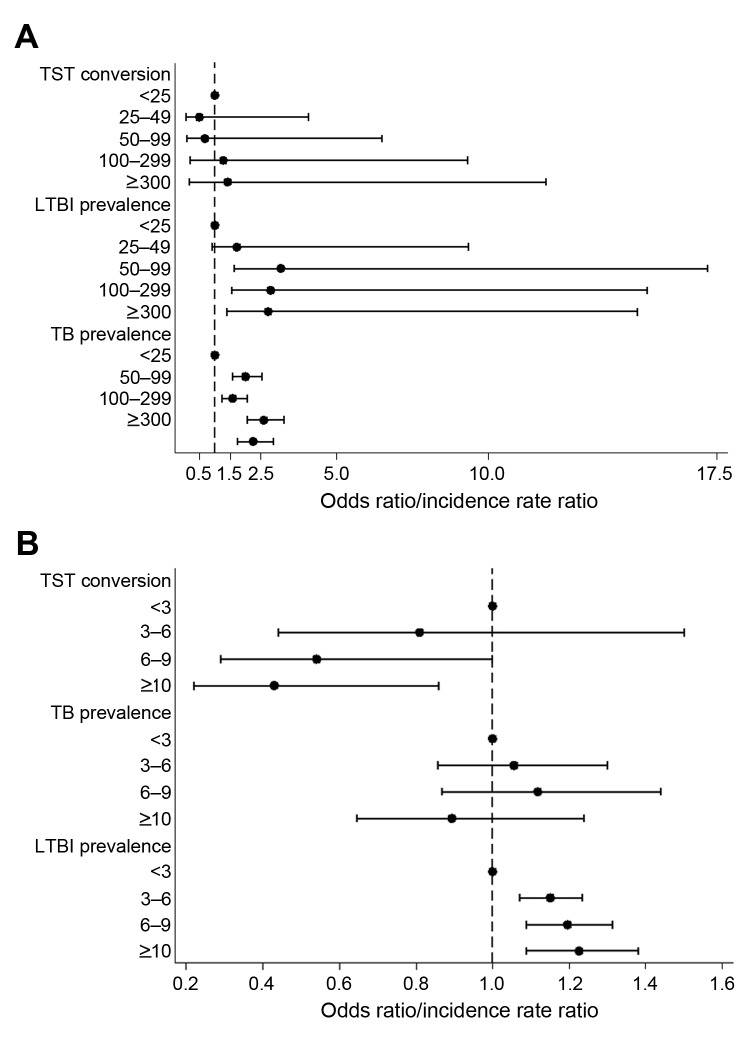
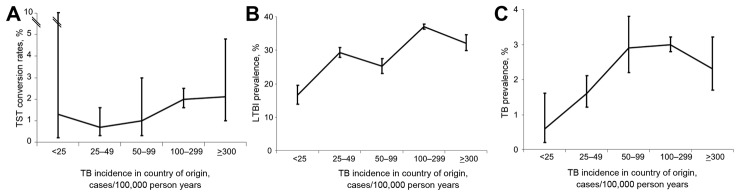
Migration from low- and middle-income countries to high-income countries increasingly determines the severity of tuberculosis (TB) cases in the adopted country. Socially marginalized groups, about whom little is known, may account for a reservoir of TB among the immigrant populations. We investigated the rates of and risk factors for Mycobacterium tuberculosis transmission, infection, and disease in a cohort of 27,358 socially marginalized immigrants who were systematically screened (1991-2010) in an area of Italy with low TB incidence. Overall TB and latent TB infection prevalence and annual tuberculin skin testing conversion rates (i.e., incidence of new infection) were 2.7%, 34.6%, and 1.7%, respectively. Prevalence of both TB and latent TB infection and incidence of infection increased as a function of the estimated TB incidence in the immigrants' countries of origin. Annual infection incidence decreased with time elapsed since immigration. These findings have implications for control policy and immigrant screening in countries with a low prevalence of TB.
从低收入和中等收入国家向高收入国家的移民越来越多地决定了被移民国家结核病(TB)病例的严重程度。社会边缘化群体,关于他们所知甚少,可能是移民群体中结核病的储层。我们调查了在意大利一个结核病发病率低的地区,对 27358 名社会边缘化移民进行系统筛查(1991-2010 年)后,结核分枝杆菌传播、感染和疾病的发生率和危险因素。总的来说,TB 和潜伏性 TB 感染的患病率和每年结核菌素皮肤试验转化率(即新感染的发生率)分别为 2.7%、34.6%和 1.7%。TB 和潜伏性 TB 感染的患病率以及感染的发生率均随移民原籍国估计的 TB 发病率而增加。自移民以来,每年的感染发生率随着时间的推移而降低。这些发现对发病率低的国家的控制政策和移民筛查具有重要意义。