Department of Otolaryngology, Huadong Hospital, Fudan University, Shanghai 200040, China.
Int J Mol Sci. 2013 Aug 19;14(8):16958-69. doi: 10.3390/ijms140816958.
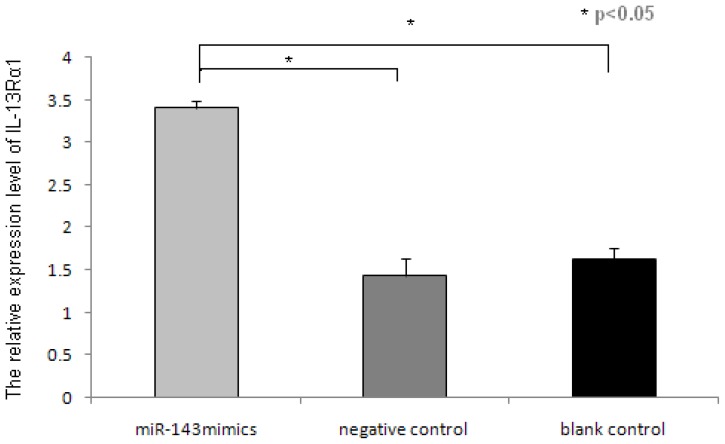
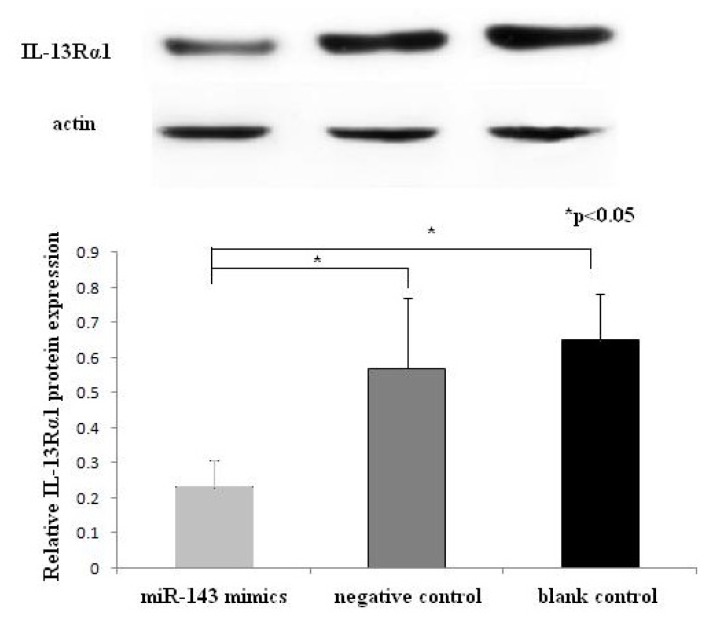
MicroRNA-143 (miR-143) was found to be downregulated in allergic rhinitis, and bioinformatics analysis predicted that IL-13Rα1 was a target gene of miR-143. To understand the molecular mechanisms of miR-143 involved in the pathogenesis of allergic inflammation, recombinant miR-143 plasmid vectors were constructed, and human mast cell-1(HMC-1) cells which play a central role in the allergic response were used for study. The plasmids were transfected into HMC-1 cells using a lentiviral vector. Expression of IL-13Rα1 mRNA was then detected by reverse transcriptase polymerase chain reaction (RT-PCR) and Western Blotting. The miR-143 lentiviral vector was successfully stably transfected in HMC-1 cells for target gene expression. Compared to the control, the target gene IL-13Rα1 was less expressed in HMC-1 transfected with miR-143 as determined by RT-PCR and Western Blotting (p < 0.05); this difference in expression was statistically significant and the inhibition efficiency was 71%. It indicates that miR-143 directly targets IL-13Rα1 and suppresses IL-13Rα1 expression in HMC-1 cells. Therefore, miR-143 may be associated with allergic reaction in human mast cells.
miR-143(miR-143)在变应性鼻炎中表达下调,生物信息学分析预测 IL-13Rα1 是 miR-143 的靶基因。为了了解 miR-143 参与变应性炎症发病机制的分子机制,构建了重组 miR-143 质粒载体,并用于研究在变应性反应中起核心作用的人肥大细胞-1(HMC-1)细胞。使用慢病毒载体将质粒转染入 HMC-1 细胞。然后通过逆转录聚合酶链反应(RT-PCR)和 Western Blotting 检测 IL-13Rα1 mRNA 的表达。miR-143 慢病毒载体成功稳定转染入 HMC-1 细胞,用于靶基因表达。与对照组相比,通过 RT-PCR 和 Western Blotting 确定转染 miR-143 的 HMC-1 中靶基因 IL-13Rα1 的表达减少(p<0.05);这种表达差异具有统计学意义,抑制效率为 71%。这表明 miR-143 可直接靶向 IL-13Rα1 并抑制 HMC-1 细胞中 IL-13Rα1 的表达。因此,miR-143 可能与人类肥大细胞的过敏反应有关。