FB Biowissenschaften, J.W. Goethe-Universität Frankfurt, Siesmayerstrasse 70, 60054 Frankfurt am Main, Germany.
J R Soc Interface. 2013 Aug 21;10(88):20130638. doi: 10.1098/rsif.2013.0638. Print 2013 Nov 6.
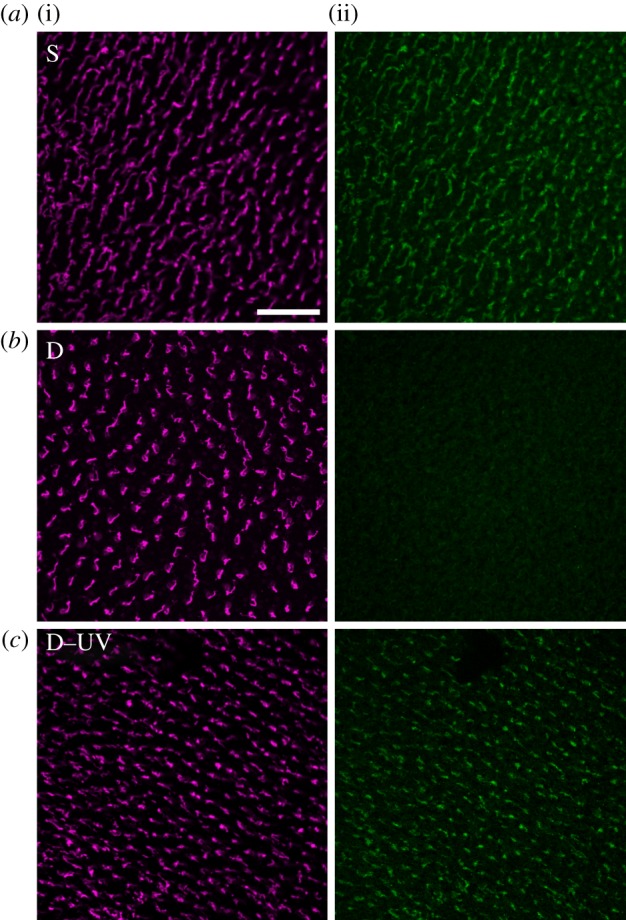
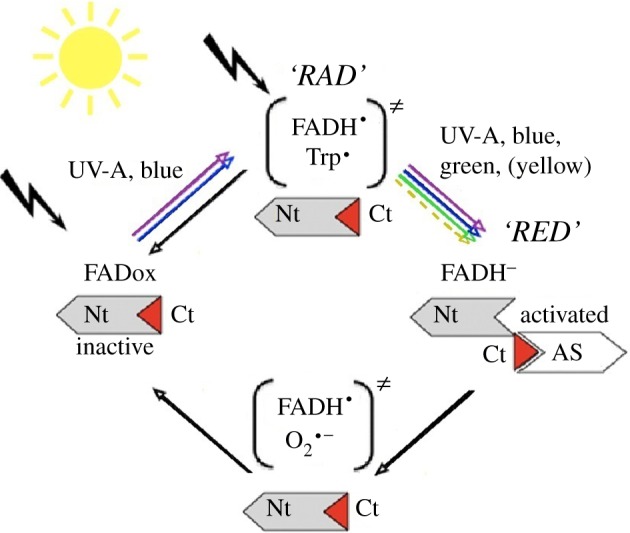
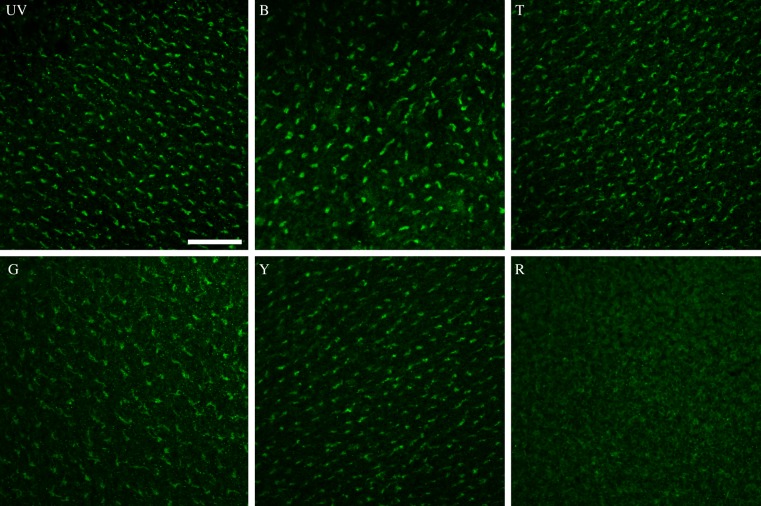
The radical pair model proposes that the avian magnetic compass is based on radical pair processes in the eye, with cryptochrome, a flavoprotein, suggested as receptor molecule. Cryptochrome 1a (Cry1a) is localized at the discs of the outer segments of the UV/violet cones of European robins and chickens. Here, we show the activation characteristics of a bird cryptochrome in vivo under natural conditions. We exposed chickens for 30 min to different light regimes and analysed the amount of Cry1a labelled with an antiserum against an epitope at the C-terminus of this protein. The staining after exposure to sunlight and to darkness indicated that the antiserum labels only an illuminated, activated form of Cry1a. Exposure to narrow-bandwidth lights of various wavelengths revealed activated Cry1a at UV, blue and turquoise light. With green and yellow, the amount of activated Cry1a was reduced, and with red, as in the dark, no activated Cry1a was labelled. Activated Cry1a is thus found at all those wavelengths at which birds can orient using their magnetic inclination compass, supporting the role of Cry1a as receptor molecule. The observation that activated Cry1a and well-oriented behaviour occur at 565 nm green light, a wavelength not absorbed by the fully oxidized form of cryptochrome, suggests that a state other than the previously suggested Trp/FAD radical pair formed during photoreduction is crucial for detecting magnetic directions.
自由基对模型提出,鸟类的磁罗盘基于眼睛中的自由基对过程,而隐花色素(一种黄素蛋白)被认为是受体分子。Cry1a(Cry1a)位于欧洲知更鸟和鸡的紫外/紫光锥的外节盘上。在这里,我们展示了在自然条件下活体鸟类隐花色素的激活特性。我们将鸡暴露在不同的光照条件下 30 分钟,并分析了针对该蛋白 C 末端表位的抗血清标记的 Cry1a 量。暴露在阳光和黑暗下的染色表明,该抗血清仅标记已激活的 Cry1a。用各种波长的窄带光照射发现,Cry1a 在 UV、蓝色和绿松石光下被激活。用绿光和黄光照射时,激活的 Cry1a 减少,而在红光下,如在黑暗中,未标记激活的 Cry1a。因此,在鸟类可以使用其磁倾斜罗盘定向的所有波长下都发现了激活的 Cry1a,这支持了 Cry1a 作为受体分子的作用。观察到激活的 Cry1a 和良好定向行为发生在 565nm 的绿光下,该波长不会被完全氧化的隐花色素形式吸收,这表明在光还原过程中形成的先前提出的色氨酸/FAD 自由基对之外的另一种状态对于检测磁场方向至关重要。