Nimpf Simon, Keays David A
Division of Neurobiology, Faculty of Biology, Ludwig-Maximilians-University Munich, Planegg-Martinsried, 82152 Munich, Germany.
University of Cambridge, Department of Physiology, Development & Neuroscience, Downing Street, CB2 3EG Cambridge, UK.
iScience. 2022 May 23;25(6):104454. doi: 10.1016/j.isci.2022.104454. eCollection 2022 Jun 17.
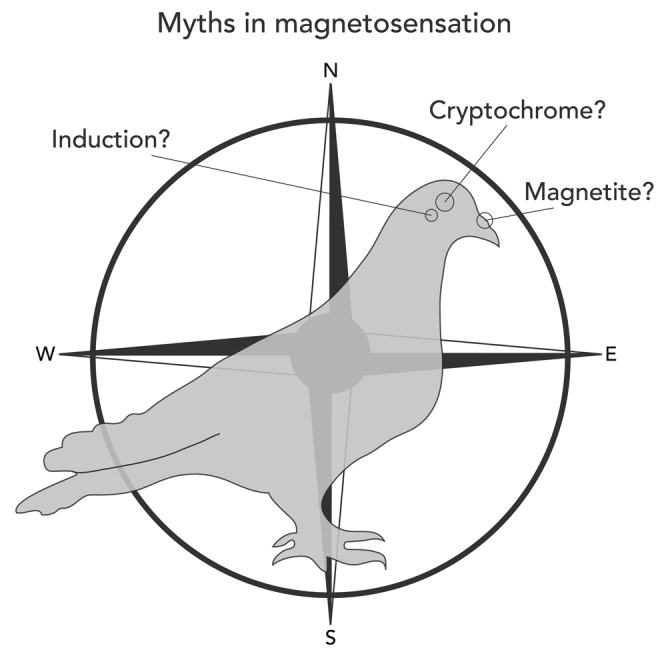
The ability to detect magnetic fields is a sensory modality that is used by many animals to navigate. While first postulated in the 1800s, for decades, it was considered a biological myth. A series of elegant behavioral experiments in the 1960s and 1970s showed conclusively that the sense is real; however, the underlying mechanism(s) remained unresolved. Consequently, this has given rise to a series of beliefs that are critically analyzed in this manuscript. We address six assertions: (1) Magnetoreception does not exist; (2) It has to be magnetite; (3) Birds have a conserved six loci magnetic sense system in their upper beak; (4) It has to be cryptochrome; (5) MagR is a protein biocompass; and (6) The electromagnetic induction hypothesis is dead. In advancing counter-arguments for these beliefs, we hope to stimulate debate, new ideas, and the design of well-controlled experiments that can aid our understanding of this fascinating biological phenomenon.
检测磁场的能力是一种许多动物用于导航的感官方式。虽然在19世纪就首次提出,但几十年来,它一直被视为一个生物学神话。20世纪60年代和70年代的一系列精妙的行为实验确凿地表明这种感官是真实存在的;然而,其潜在机制仍未得到解决。因此,这引发了一系列在本手稿中受到批判性分析的观点。我们探讨六个论断:(1)磁感受不存在;(2)它必定是磁铁矿;(3)鸟类在上喙中有一个保守的六个位点的磁感系统;(4)它必定是隐花色素;(5)MagR是一种蛋白质生物指南针;(6)电磁感应假说已无立足之地。在对这些观点提出反驳论据的过程中,我们希望激发辩论、新思想以及设计出能帮助我们理解这一迷人生物学现象的严格控制的实验。