Department of Brain and Cognitive Sciences, Seoul National University Seoul, South Korea.
Front Neural Circuits. 2013 Aug 14;7:134. doi: 10.3389/fncir.2013.00134. eCollection 2013.
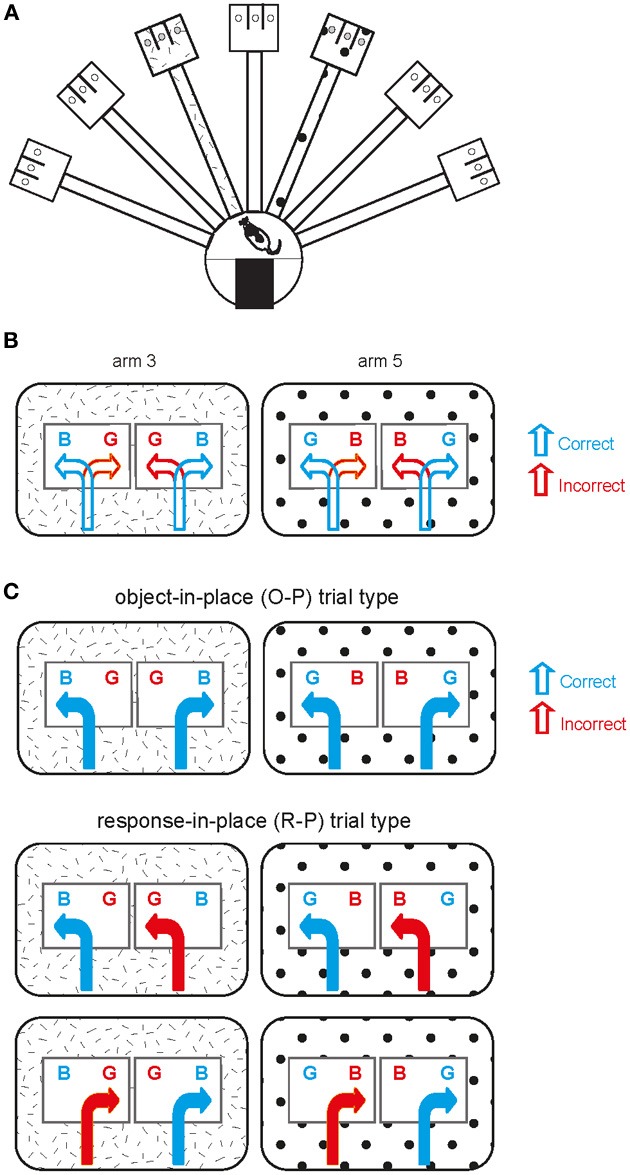
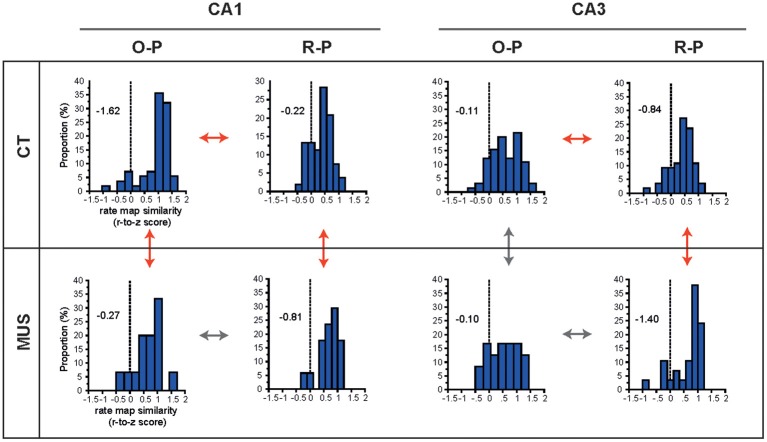
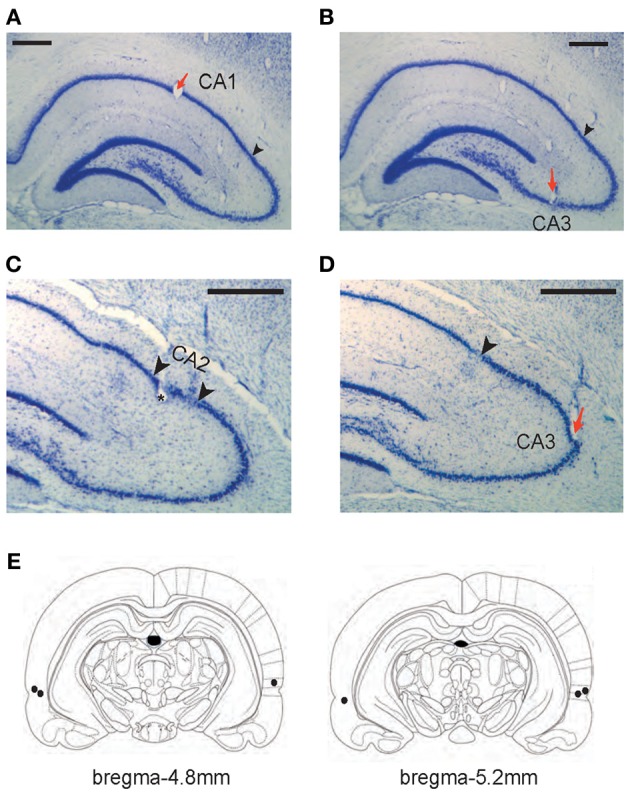
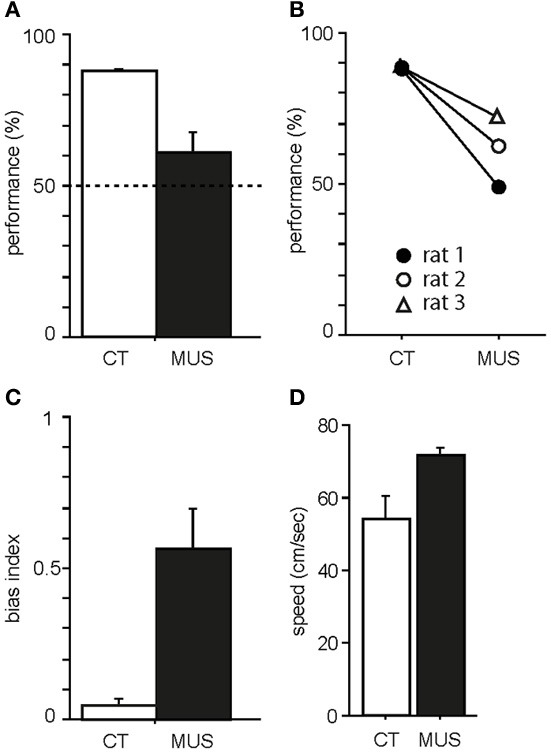
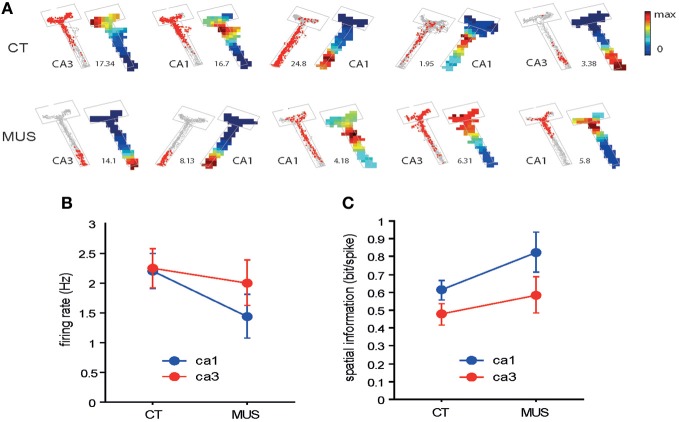
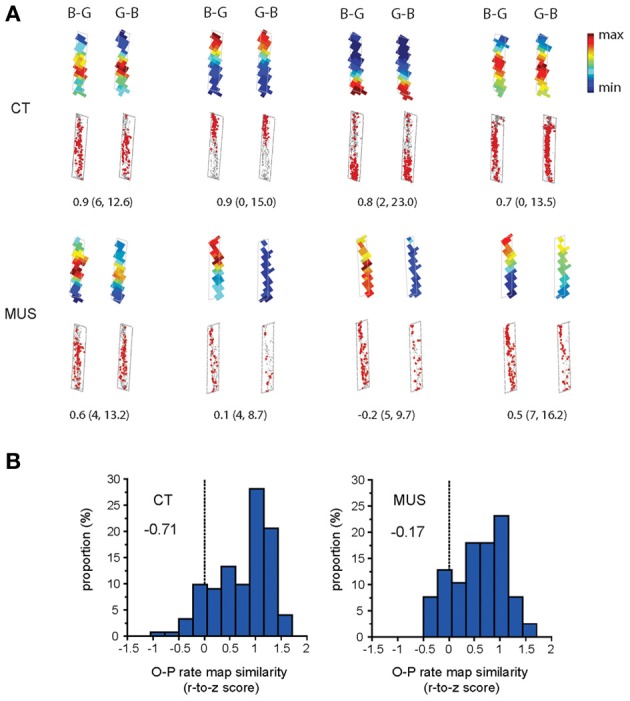
Objects and their locations can associatively define an event and a conjoint representation of object-place can form an event memory. Remembering how to respond to a certain object in a spatial context is dependent on both hippocampus and perirhinal cortex (PER). However, the relative functional contributions of the two regions are largely unknown in object-place associative memory. We investigated the PER influence on hippocampal firing in a goal-directed object-place memory task by comparing the firing patterns of CA1 and CA3 of the dorsal hippocampus between conditions of PER muscimol inactivation and vehicle control infusions. Rats were required to choose one of the two objects in a specific spatial context (regardless of the object positions in the context), which was shown to be dependent on both hippocampus and PER. Inactivation of PER with muscimol (MUS) severely disrupted performance of well-trained rats, resulting in response bias (i.e., choosing any object on a particular side). MUS did not significantly alter the baseline firing rates of hippocampal neurons. We measured the similarity in firing patterns between two trial conditions in which the same target objects were chosen on opposite sides within the same arm [object-in-place (O-P) strategy] and compared the results with the similarity in firing between two trial conditions in which the rat chose any object encountered on a particular side [response-in-place (R-P) strategy]. We found that the similarity in firing patterns for O-P trials was significantly reduced with MUS compared to control conditions (CTs). Importantly, this was largely because MUS injections affected the O-P firing patterns in CA1 neurons, but not in CA3. The results suggest that PER is critical for goal-directed organization of object-place associative memory in the hippocampus presumably by influencing how object information is associated with spatial information in CA1 according to task demand.
物体及其位置可以关联地定义一个事件,而物体-位置的联合表示可以形成一个事件记忆。记住如何在空间环境中对特定物体做出反应依赖于海马体和边缘下皮层(PER)。然而,在物体-位置联想记忆中,两个区域的相对功能贡献在很大程度上是未知的。我们通过比较 PER 抑制和载体对照输注条件下背侧海马 CA1 和 CA3 的放电模式,研究了 PER 对海马放电的影响在目标导向的物体-位置记忆任务中。要求大鼠在特定的空间环境中选择两个物体中的一个(无论物体在环境中的位置如何),这被证明既依赖于海马体又依赖于 PER。用 muscimol(MUS)抑制 PER 严重破坏了训练有素的大鼠的表现,导致反应偏向(即,选择特定一侧的任何物体)。MUS 并未显著改变海马神经元的基线放电率。我们测量了在相同臂内选择相同目标物体在相对侧的两个试验条件下的放电模式相似性[物体-位置(O-P)策略],并将结果与大鼠在特定侧选择遇到的任何物体的两个试验条件下的放电相似性进行了比较[反应-位置(R-P)策略]。我们发现,与对照条件(CT)相比,MUS 条件下 O-P 试验的放电模式相似性显著降低。重要的是,这主要是因为 MUS 注射影响了 CA1 神经元中的 O-P 放电模式,但对 CA3 没有影响。结果表明,PER 对于海马体中目标导向的物体-位置联想记忆的组织是至关重要的,可能是通过根据任务需求影响物体信息与 CA1 中空间信息的关联方式。