Department of Clinical Sciences, Lund University, Malmö, Sweden.
PLoS One. 2013 Aug 15;8(8):e71846. doi: 10.1371/journal.pone.0071846. eCollection 2013.
We tested whether characteristic changes of the plasma lipidome in individuals with comparable total lipids level associate with future cardiovascular disease (CVD) outcome and whether 23 validated gene variants associated with coronary artery disease (CAD) affect CVD associated lipid species.
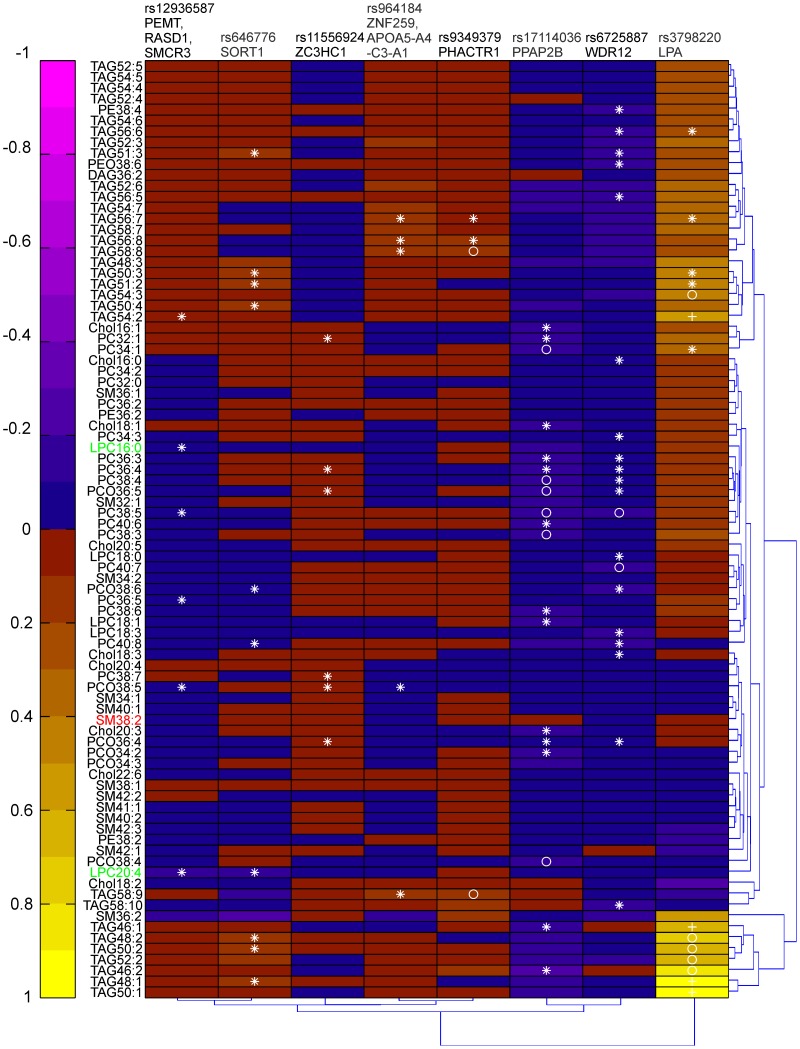
Screening of the fasted plasma lipidome was performed by top-down shotgun analysis and lipidome compositions compared between incident CVD cases (n = 211) and controls (n = 216) from the prospective population-based MDC study using logistic regression adjusting for Framingham risk factors. Associations with incident CVD were seen for eight lipid species (0.21≤q≤0.23). Each standard deviation unit higher baseline levels of two lysophosphatidylcholine species (LPC), LPC16∶0 and LPC20∶4, was associated with a decreased risk for CVD (P = 0.024-0.028). Sphingomyelin (SM) 38∶2 was associated with increased odds of CVD (P = 0.057). Five triglyceride (TAG) species were associated with protection (P = 0.031-0.049). LPC16∶0 was negatively correlated with the carotid intima-media thickness (P = 0.010) and with HbA1c (P = 0.012) whereas SM38∶2 was positively correlated with LDL-cholesterol (P = 0.0*10(-6)) and the q-values were good (q≤0.03). The risk allele of 8 CAD-associated gene variants showed significant association with the plasma level of several lipid species. However, the q-values were high for many of the associations (0.015≤q≤0.75). Risk allele carriers of 3 CAD-loci had reduced level of LPC16∶0 and/or LPC 20∶4 (P≤0.056).
Our study suggests that CVD development is preceded by reduced levels of LPC16∶0, LPC20∶4 and some specific TAG species and by increased levels of SM38∶2. It also indicates that certain lipid species are intermediate phenotypes between genetic susceptibility and overt CVD. But it is a preliminary study that awaits replication in a larger population because statistical significance was lost for the associations between lipid species and future cardiovascular events when correcting for multiple testing.
我们检测了具有相似总脂质水平的个体血浆脂质组特征变化是否与未来心血管疾病(CVD)结局相关,以及与冠心病(CAD)相关的 23 个已验证的基因变异是否影响与 CVD 相关的脂质种类。
通过自上而下的 shotgun 分析筛选空腹血浆脂质组,并使用逻辑回归对前瞻性基于人群的 MDC 研究中的 CVD 事件(n=211)和对照组(n=216)进行比较,调整 Framingham 风险因素。有 8 种脂质种类(0.21≤q≤0.23)与 CVD 事件呈正相关。基线水平较高的两种溶血磷脂酰胆碱(LPC),即 LPC16∶0 和 LPC20∶4,每增加一个标准差单位,CVD 风险就会降低(P=0.024-0.028)。鞘磷脂(SM)38∶2 与 CVD 发病风险增加相关(P=0.057)。5 种甘油三酯(TAG)种类与保护作用相关(P=0.031-0.049)。LPC16∶0 与颈动脉内膜中层厚度呈负相关(P=0.010),与 HbA1c 呈负相关(P=0.012),而 SM38∶2 与 LDL-胆固醇呈正相关(P=0.0*10(-6)),q 值较好(q≤0.03)。8 个 CAD 相关基因变异的风险等位基因与几种脂质种类的血浆水平显著相关。然而,许多关联的 q 值较高(0.015≤q≤0.75)。3 个 CAD 基因座的风险等位基因携带者的 LPC16∶0 和/或 LPC20∶4 水平降低(P≤0.056)。
我们的研究表明,CVD 发展之前,LPC16∶0、LPC20∶4 和某些特定的 TAG 种类的水平降低,SM38∶2 的水平升高。它还表明,某些脂质种类是遗传易感性与明显 CVD 之间的中间表型。但这只是一项初步研究,需要在更大的人群中进行复制,因为当对多个检验进行校正时,脂质种类与未来心血管事件之间的关联失去了统计学意义。