Phillip Veit, Rasch Sebastian, Gaa Jochen, Schmid Roland M, Algül Hana
II Medizinische Klinik und Poliklinik, Klinikum Rechts der Isar, Technische Universität München, München, Germany.
PLoS One. 2013 Aug 20;8(8):e72903. doi: 10.1371/journal.pone.0072903. eCollection 2013.
BACKGROUND/OBJECTIVES: A rare, but life-threatening complication in pancreatitis is a spontaneous bleeding from intestinal vessels with or without previous formation of (pseudo-) aneurysms. And yet, the optimal diagnostic and therapeutic strategies remain unclear.
We performed a retrospective analysis of all patients with pancreatitis and intraabdominal bleeding at a German tertiary referral center between January 2002 and December 2012.
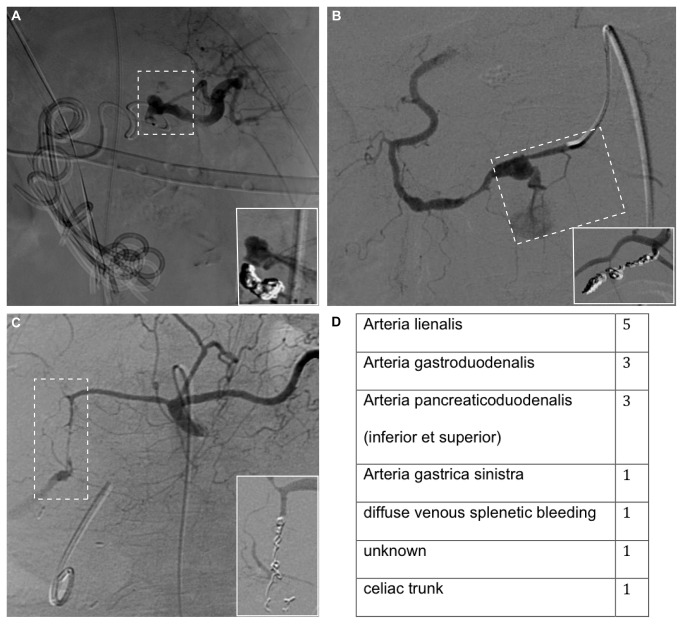
Bleeding occurred in <1% (14/3,421) of patients with pancreatitis. Most involved vessels were arteria lienalis, arteria gastroduodenalis, and arteria pancreaticoduodenalis. All bleedings could be stopped by transcatheter arterial coil embolization. Recurrent bleeding after coil embolization occurred in 2/14 (14%) patients.
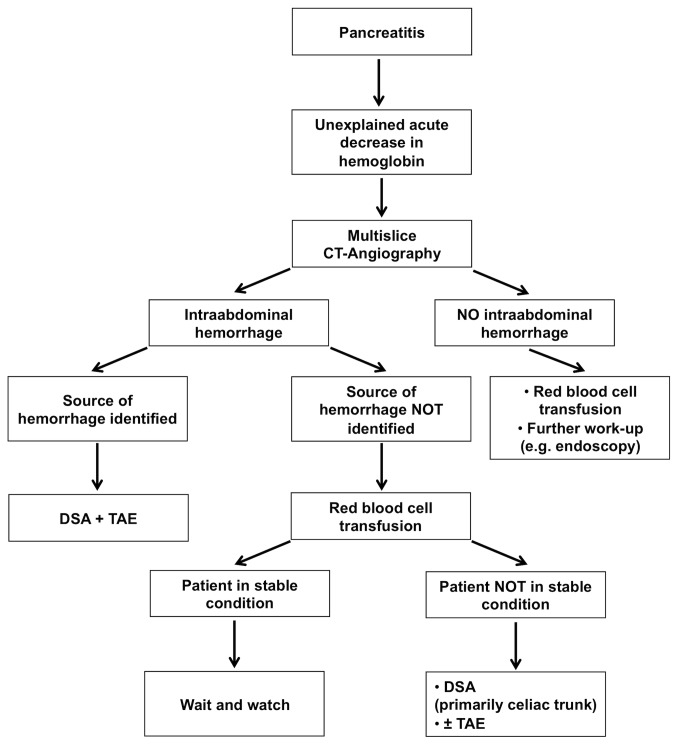
In cases of intraabdominal hemorrhage in patients with pancreatitis, transcatheter arterial coil embolization should be considered as the first interventional procedure.
背景/目的:胰腺炎中一种罕见但危及生命的并发症是肠道血管自发性出血,可伴有或不伴有先前(假性)动脉瘤的形成。然而,最佳的诊断和治疗策略仍不明确。
我们对2002年1月至2012年12月期间在德国一家三级转诊中心就诊的所有胰腺炎合并腹腔内出血患者进行了回顾性分析。
胰腺炎患者中出血发生率<1%(14/3421)。最常累及的血管是脾动脉、胃十二指肠动脉和胰十二指肠动脉。所有出血均通过经导管动脉线圈栓塞得以止血。2/14(14%)的患者在栓塞后出现复发出血。
对于胰腺炎患者腹腔内出血的情况,应考虑将经导管动脉线圈栓塞作为首选的介入治疗方法。