van den Eijnden Regina, Vermulst Ad, van Rooij Antonius J, Scholte Ron, van de Mheen Dike
Department of Interdisciplinary Social Sciences, Utrecht University, P.O. Box 80140, 3508 TC, Utrecht, The Netherlands,
J Youth Adolesc. 2014 May;43(5):790-802. doi: 10.1007/s10964-013-0003-9. Epub 2013 Aug 27.
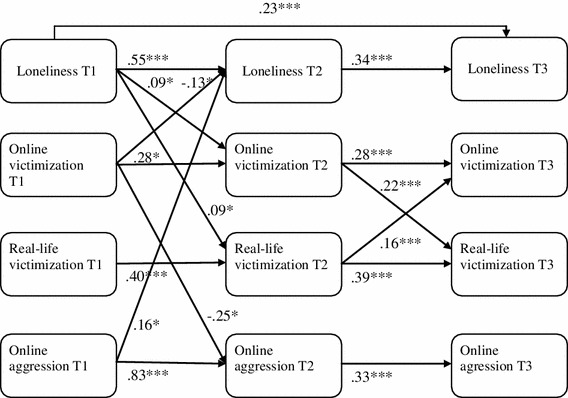
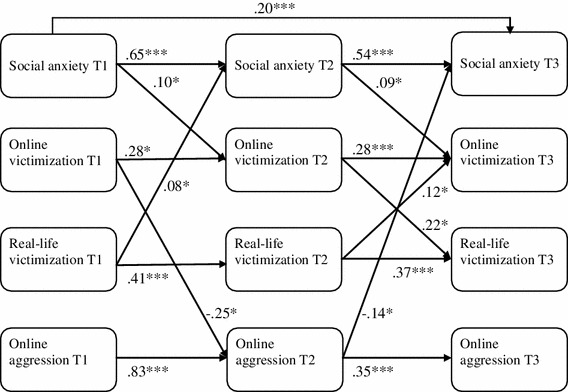
Although peer victimization is of major concern and adolescents spend increasing amounts of time on the Internet, relatively little is known about the psychosocial antecedents and consequences of online victimization. The main aim of this study was to compare the psychosocial antecedents and consequences of online versus real-life victimization. More specifically, the bidirectional relationship between online and real-life victimization on the one hand and psychosocial problems (i.e., loneliness and social anxiety) on the other was examined. In addition, the moderating role of online aggression in the relationship between online victimization and subsequent psychosocial problems was studied. This prospective study, consisting of three annual measurements, was conducted among a sample of 831 adolescents (50.3 % girls) aged 11-15, of which most (80.2 %) had a Dutch ethnic background. The results indicate a unidirectional relationship whereby loneliness and social anxiety predict an increase in latter online victimization rather than the reverse. A bidirectional relationship was found for real-life victimization: loneliness (but not social anxiety) predicted an increase in latter real-life victimization, which in turn predicted an increase in subsequent social anxiety (but not loneliness). No moderating effects of online aggression were found. The findings of the present study suggest that negative online and in real life peer interactions have a differential meaning for, and impact on adolescents' well-being.
尽管同伴欺凌是一个主要问题,且青少年在互联网上花费的时间越来越多,但对于网络欺凌的心理社会成因及后果,我们所知甚少。本研究的主要目的是比较网络欺凌与现实生活中欺凌的心理社会成因及后果。更具体地说,一方面考察了网络欺凌与现实生活中欺凌之间的双向关系,另一方面考察了它们与心理社会问题(即孤独感和社交焦虑)之间的双向关系。此外,还研究了网络攻击行为在网络欺凌与后续心理社会问题之间关系中的调节作用。这项前瞻性研究包括三次年度测量,研究对象为831名11至15岁的青少年(50.3%为女孩),其中大多数(80.2%)有荷兰裔背景。结果表明存在一种单向关系,即孤独感和社交焦虑预示着随后网络欺凌的增加,而非相反。对于现实生活中的欺凌,发现了一种双向关系:孤独感(而非社交焦虑)预示着随后现实生活中欺凌的增加,而这反过来又预示着后续社交焦虑(而非孤独感)的增加。未发现网络攻击行为的调节作用。本研究结果表明,网络和现实生活中负面的同伴互动对青少年的幸福感具有不同的意义和影响。