Faculty of Nursing, University of Alberta, 11405-87 Avenue, Edmonton, AB T6G 1C9, Canada.
Health Qual Life Outcomes. 2013 Aug 28;11:146. doi: 10.1186/1477-7525-11-146.
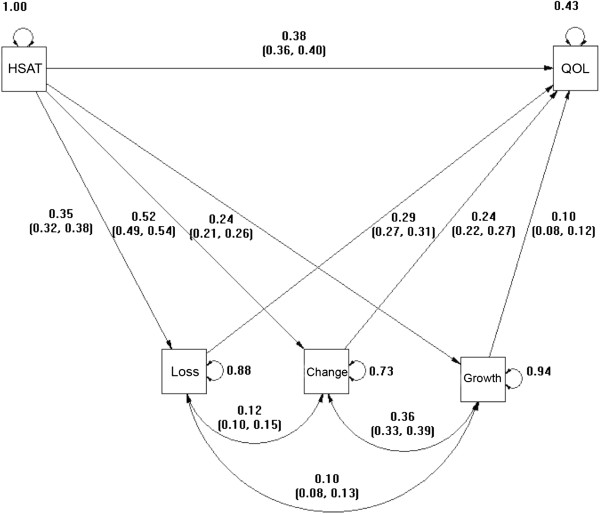
With ever-increasing life expectancy globally, it is imperative to build knowledge of how older peoples' views of their own aging, considering their health-related circumstances, affect quality of life for practitioners and policy-makers alike. Based on our literature review, we wanted to determine whether older adults' attitudes toward their own aging would partly mediate the effect of their health satisfaction ratings upon their quality of life. Furthermore, would these attitudes mediate the relationship between health satisfaction and quality of life in the same way when we account for older adults' country of origin, and their age and gender?
This was a secondary analysis of cross-sectional survey data collected in 20 countries taking part in the 2003 WHOQOL-OLD Field study. The study sample consisted of 4593 adults whom were, on average, 72.10 years of age (range = 60 to 100 years of age); 42.8% were female. The WHOQOL-BREF measured quality of life and health satisfaction. The Attitudes to Aging Questionnaire measured participants' attitudes toward physical change, psychosocial loss, and psychological growth. All items in both questionnaires were measured on a 5-point Likert scale. Questionnaire responses were analyzed using multilevel modeling and path analysis.
All three attitudes to aging partly mediated the relationship between health satisfaction and physical, psychological, social, environmental, and global quality of life. These partial mediations manifested in the same way across all 20 country samples, regardless of age or gender. Attitudes toward physical change were the strongest mediator of health satisfaction upon global and domain-specific quality of life, followed by psychosocial loss and psychosocial growth.
Our study is the first cross-cultural study with a large sample to show that quality of life judgements, between 60 to 100 years of age, are a product of older men's and women's perceptions of health-related circumstances, and attitudes toward physical and psychosocial aspects of the aging self. A prospective study of the linkages between older peoples' subjective views of health and attitudes toward the aging self over time using multiple subjective measures of health is warranted. Understanding these linkages may help practitioners and policy makers consider strategies to enhance quality of life.
随着全球预期寿命的不断增加,了解老年人对自身衰老的看法,以及他们的健康状况如何影响医生和政策制定者的生活质量,这一点至关重要。基于我们的文献综述,我们想确定老年人对自身衰老的态度是否会部分中介他们的健康满意度对生活质量的影响。此外,当我们考虑到老年人的原籍国、年龄和性别时,这些态度是否会以同样的方式中介健康满意度和生活质量之间的关系?
这是对 2003 年世卫组织老龄化世界卫生组织生活质量研究中参与的 20 个国家进行的横断面调查数据的二次分析。研究样本由 4593 名平均年龄为 72.10 岁(范围为 60 至 100 岁)的成年人组成;42.8%为女性。世卫组织生活质量简表(WHOQOL-BREF)衡量生活质量和健康满意度。衰老态度问卷(Attitudes to Aging Questionnaire)衡量参与者对身体变化、心理社会丧失和心理成长的态度。两个问卷中的所有项目均采用 5 级李克特量表进行测量。使用多层次模型和路径分析对问卷回答进行分析。
所有三种衰老态度都部分中介了健康满意度与身体、心理、社会、环境和整体生活质量之间的关系。这些部分中介在所有 20 个国家样本中表现相同,无论年龄或性别如何。对身体变化的态度是健康满意度对全球和特定领域生活质量的最强中介,其次是心理社会丧失和心理社会成长。
我们的研究是第一个具有大量样本的跨文化研究,表明 60 至 100 岁之间的生活质量判断是男性和女性对与健康相关的环境的看法,以及对衰老自我的身体和心理社会方面的态度的产物。需要进行一项前瞻性研究,以探讨老年人对健康的主观看法与随着时间的推移对衰老自我的态度之间的联系,使用多种主观健康测量方法。了解这些联系可能有助于医生和政策制定者考虑增强生活质量的策略。