Centers for Disease Control and Prevention, Division of Nutrition, Physical Activity, and Obesity, 4770 Buford Hwy, NE; Mail Stop F-77, Atlanta, GA 30341, USA.
Prev Chronic Dis. 2013 Aug 29;10:E144. doi: 10.5888/pcd10.120153.
States and communities are considering policy and environmental strategies, including enacting legislation, to reduce and prevent childhood obesity. One legislative approach has been to create task forces to understand key issues and develop a course of action. The goal of this study was to describe state-level, childhood obesity task forces in the United States created by legislation from 2001 through 2010.
We used the Center for Disease Control and Prevention's Division of Nutrition, Physical Activity, and Obesity database to identify state-level childhood obesity task forces created through legislation from 2001 through 2010.
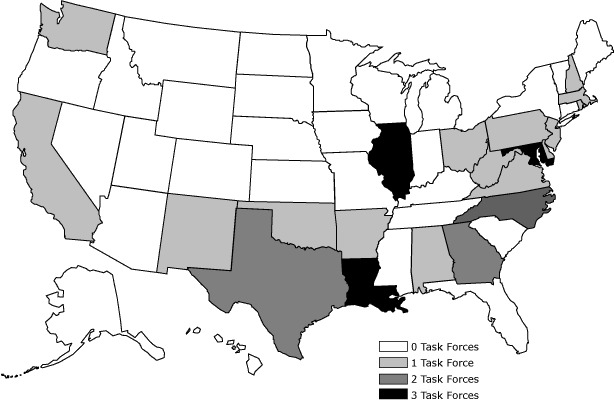
We identified 21 states that had enacted legislation creating childhood obesity task forces of which 6 had created more than one task force. Most task forces were charged with both gathering and reviewing information and making recommendations for obesity-prevention actions in the state. Most legislation required that task forces include representation from the state legislature, state agencies, community organizations, and community members.
Evaluation of the effectiveness of obesity-prevention task forces and the primary components that contribute to their success may help to determine the advantages of the use of such strategies in obesity prevention.
各州和社区正在考虑政策和环境策略,包括制定立法,以减少和预防儿童肥胖。一种立法方法是成立专门工作组,以了解关键问题并制定行动方案。本研究的目的是描述 2001 年至 2010 年通过立法在美国成立的州级儿童肥胖问题特别工作组。
我们使用疾病控制与预防中心营养、身体活动和肥胖司的数据库,确定 2001 年至 2010 年通过立法设立的州级儿童肥胖问题特别工作组。
我们确定了 21 个州已经通过立法设立了儿童肥胖问题特别工作组,其中 6 个州设立了不止一个特别工作组。大多数特别工作组的职责包括收集和审查信息,并为该州的肥胖预防行动提出建议。大多数立法要求特别工作组包括州立法机构、州机构、社区组织和社区成员的代表。
评估肥胖预防特别工作组的有效性以及促成其成功的主要因素,可能有助于确定在肥胖预防中使用此类策略的优势。