Clinical Epidemiology Division, IRCCS AOU San Martino IST Istituto Nazionale per la Ricerca sul Cancro, Genoa, Italy.
Mol Cancer. 2013 Aug 29;12(1):97. doi: 10.1186/1476-4598-12-97.
Glycolysis in presence of oxygen with high glucose consumption is known to be the metabolism of choice in many tumors. In lung cancer this phenomenon is routinely exploited in diagnostic PET imaging of fluorodeoxyglucose uptake, but not much is known about the prognostic capabilities of glycolysis level assessment in resected lung tumor samples.
In this retrospective study, we used real time polymerase chain reaction(RQ-PCR) to assess the expression level of the gene for Glyceraldehyde 3-phosphate dehydrogenase(GAPDH), key enzyme for glucose breakdown, in tumor samples from 82 consecutive early stages resected non small cell lung cancer(NSCLC) patients. We then compared our results in six large publicly available NSCLC microarray datasets collecting data from over 1250 total patients.
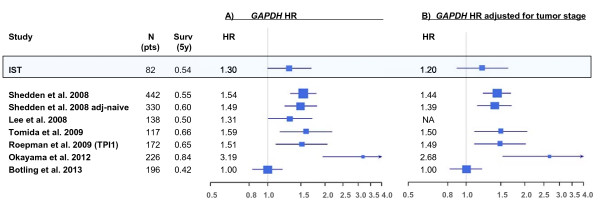
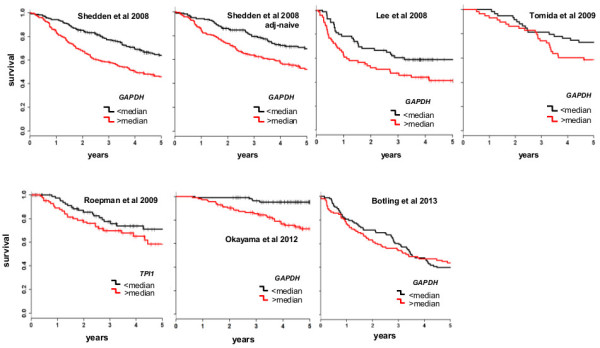
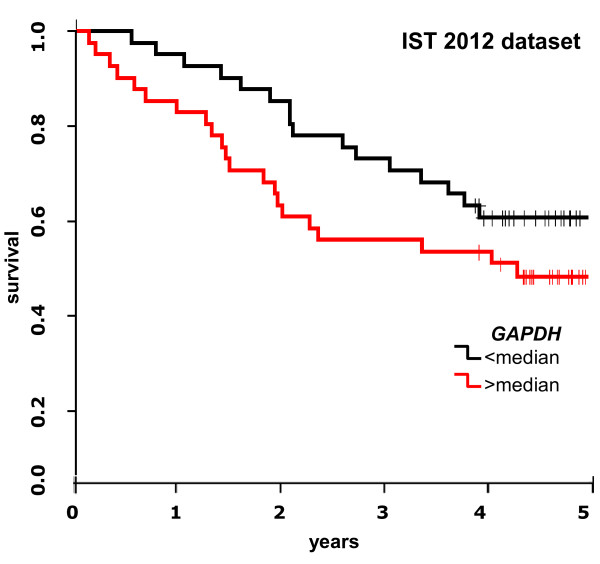
In our study GAPDH gene over expression was found to be an adverse prognostic factor in early stages NSCLC (n = 82 HR = 1.30 p = 0.050). This result was confirmed in 5 of 6 public datasets analyzed: Shedden et al. 2008: n = 442 HR = 1.54 p < 0.0001; Lee et al. 2008: n = 138 HR = 1.31 p = 0.043; Tomida et al. 2009: n = 117 HR = 1.59 p = 0.004; Roepman et al. 2009: n = 172 (TPI1 gene) HR = 1.51 p = 0.009; Okayama et al. 2012: n = 226 HR = 3.19 p < 0.0001; Botling et al. 2013: n = 196 HR = 1.00 p = 0.97). Furthermore, in the large and clinically well annotated Shedden et al. microarray dataset, GAPDH hazard ratio did not change whether calculated for the whole dataset or for the subgroup of adjuvant naive patients only (n = 330 HR = 1.49 p < 0.0001).
GAPDH gene over expression in resected tumor samples is an adverse prognostic factor in NSCLC. Our results confirm the prognostic value of glucose metabolism assessment in NSCLC.
在高葡萄糖消耗的情况下有氧糖酵解是许多肿瘤首选的代谢途径。在肺癌中,这种现象在氟脱氧葡萄糖摄取的诊断 PET 成像中经常被利用,但关于切除的肺癌肿瘤样本中糖酵解水平评估的预后能力知之甚少。
在这项回顾性研究中,我们使用实时聚合酶链反应(RQ-PCR)来评估 82 例连续早期非小细胞肺癌(NSCLC)患者肿瘤样本中甘油醛-3-磷酸脱氢酶(GAPDH)基因的表达水平,该基因是葡萄糖分解的关键酶。然后,我们将结果与来自超过 1250 名患者的 6 个大型 NSCLC 微阵列数据集进行了比较。
在我们的研究中,GAPDH 基因过表达被发现是早期 NSCLC 的不良预后因素(n=82,HR=1.30,p=0.050)。这一结果在 6 个公共数据集的 5 个分析中得到了证实:Shedden 等人 2008 年:n=442,HR=1.54,p<0.0001;Lee 等人 2008 年:n=138,HR=1.31,p=0.043;Tomida 等人 2009 年:n=117,HR=1.59,p=0.004;Roepman 等人 2009 年:n=172(TPI1 基因),HR=1.51,p=0.009;Okayama 等人 2012 年:n=226,HR=3.19,p<0.0001;Botling 等人 2013 年:n=196,HR=1.00,p=0.97)。此外,在大型临床注释良好的 Shedden 等人的微阵列数据集中,GAPDH 风险比无论是在整个数据集还是在仅接受辅助治疗的患者亚组(n=330,HR=1.49,p<0.0001)中计算都没有变化。
切除肿瘤样本中 GAPDH 基因过表达是 NSCLC 的不良预后因素。我们的结果证实了 NSCLC 中葡萄糖代谢评估的预后价值。