Department of Plant Systematics, Institute of Biology, Eötvös University, Budapest, Hungary.
PLoS Comput Biol. 2013;9(8):e1003193. doi: 10.1371/journal.pcbi.1003193. Epub 2013 Aug 22.
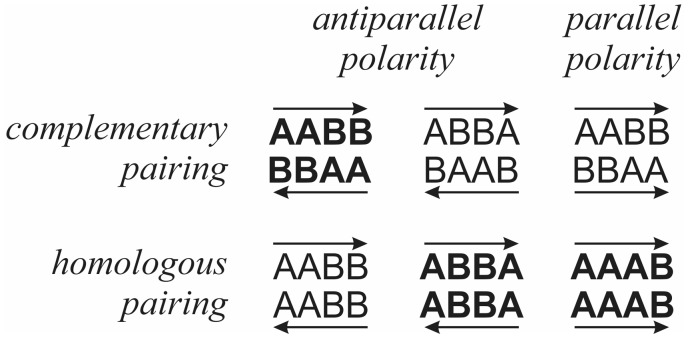
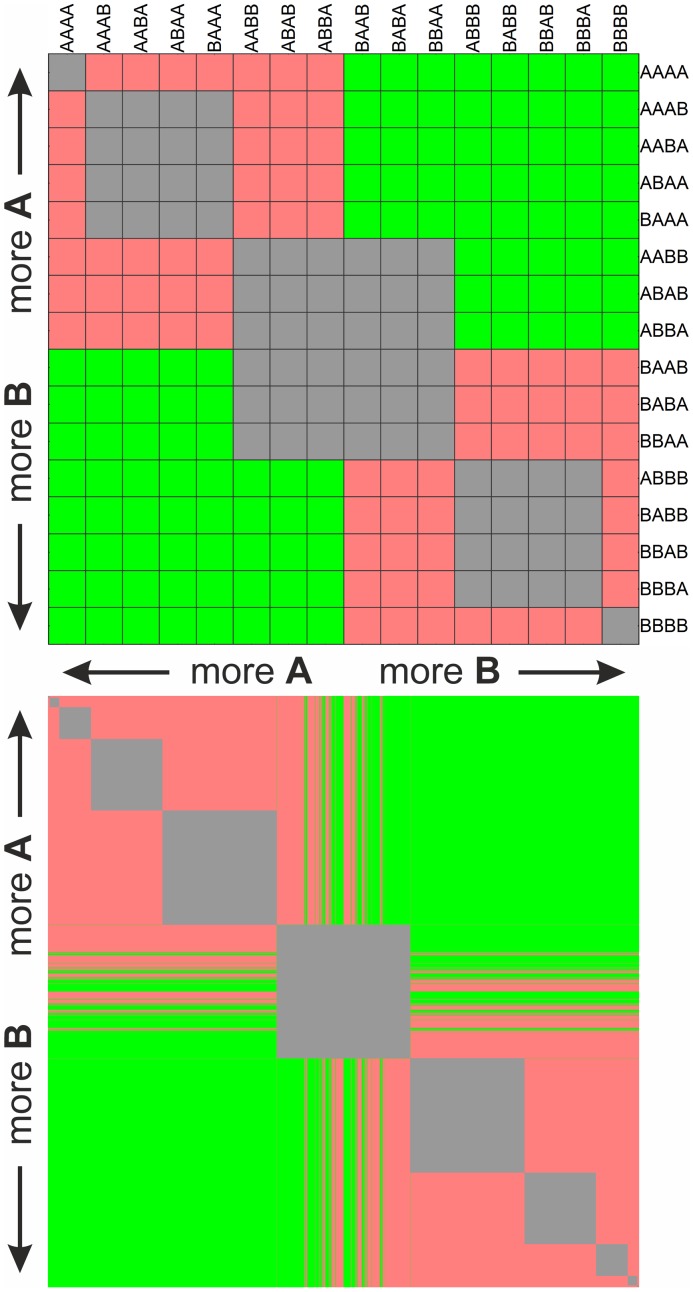
Models of competitive template replication, although basic for replicator dynamics and primordial evolution, have not yet taken different sequences explicitly into account, neither have they analyzed the effect of resource partitioning (feeding on different resources) on coexistence. Here we show by analytical and numerical calculations that Gause's principle of competitive exclusion holds for template replicators if resources (nucleotides) affect growth linearly and coexistence is at fixed point attractors. Cases of complementary or homologous pairing between building blocks with parallel or antiparallel strands show no deviation from the rule that the nucleotide compositions of stably coexisting species must be different and there cannot be more coexisting replicator species than nucleotide types. Besides this overlooked mechanism of template coexistence we show also that interesting sequence effects prevail as parts of sequences that are copied earlier affect coexistence more strongly due to the higher concentration of the corresponding replication intermediates. Template and copy always count as one species due their constraint of strict stoichiometric coupling. Stability of fixed-point coexistence tends to decrease with the length of sequences, although this effect is unlikely to be detrimental for sequences below 100 nucleotides. In sum, resource partitioning (niche differentiation) is the default form of competitive coexistence for replicating templates feeding on a cocktail of different nucleotides, as it may have been the case in the RNA world. Our analysis of different pairing and strand orientation schemes is relevant for artificial and potentially astrobiological genetics.
竞争模板复制模型虽然是复制子动态和原始进化的基础,但尚未明确考虑到不同的序列,也没有分析资源分配(食用不同的资源)对共存的影响。在这里,我们通过分析和数值计算表明,如果资源(核苷酸)对生长的影响呈线性,并且共存是在固定点吸引子处,那么 Gause 的竞争排斥原理适用于模板复制子。构建块之间具有平行或反平行链的互补或同源配对的情况并没有偏离这样的规则,即稳定共存的物种的核苷酸组成必须不同,并且共存的复制子物种数量不能超过核苷酸类型。除了这种被忽视的模板共存机制之外,我们还表明,有趣的序列效应作为较早被复制的序列的一部分占主导地位,由于相应复制中间体的浓度较高,它们对共存的影响更强烈。由于严格的化学计量偶联的约束,模板和副本总是算作一个物种。由于序列的长度,固定点共存的稳定性趋于降低,尽管对于长度低于 100 个核苷酸的序列,这种效应不太可能是有害的。总的来说,对于在不同核苷酸混合物中觅食的复制模板来说,资源分配(生态位分化)是竞争共存的默认形式,就像在 RNA 世界中那样。我们对不同配对和链取向方案的分析对于人工和潜在的天体生物学遗传学是相关的。