Department of Psychiatry, NYU School of Medicine, New York, New York, United States of America.
PLoS One. 2013 Aug 22;8(8):e70084. doi: 10.1371/journal.pone.0070084. eCollection 2013.
Uncovering heterogeneities in the progression of early PTSD symptoms can improve our understanding of the disorder's pathogenesis and prophylaxis.
To describe discrete symptom trajectories and examine their relevance for preventive interventions.
Latent Growth Mixture Modeling (LGMM) of data from a randomized controlled study of early treatment. LGMM identifies latent longitudinal trajectories by exploring discrete mixture distributions underlying observable data.
Hadassah Hospital unselectively receives trauma survivors from Jerusalem and vicinity.
Adult survivors of potentially traumatic events consecutively admitted to the hospital's emergency department (ED) were assessed ten days and one-, five-, nine- and fifteen months after ED admission. Participants with data at ten days and at least two additional assessments (n = 957) were included; 125 received cognitive behavioral therapy (CBT) between one and nine months.
We used LGMM to identify latent parameters of symptom progression and tested the effect of CBT on these parameters. CBT consisted of 12 weekly sessions of either cognitive therapy (n = 41) or prolonged exposure (PE, n = 49), starting 29.8±5.7 days after ED admission, or delayed PE (n = 35) starting at 151.8±42.4 days. CBT effectively reduced PTSD symptoms in the entire sample.
Latent trajectories of PTSD symptoms; effects of CBT on these trajectories.
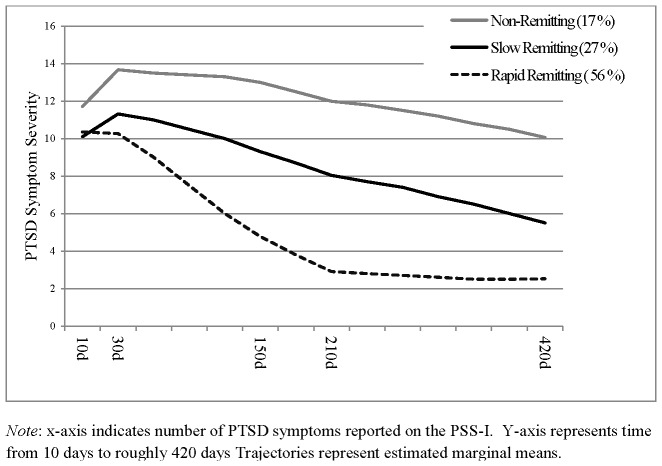
THREE TRAJECTORIES WERE IDENTIFIED: Rapid Remitting (rapid decrease in symptoms from 1- to 5-months; 56% of the sample), Slow Remitting (progressive decrease in symptoms over 15 months; 27%) and Non-Remitting (persistently elevated symptoms; 17%). CBT accelerated the recovery of the Slow Remitting class but did not affect the other classes.
The early course of PTSD symptoms is characterized by distinct and diverging response patterns that are centrally relevant to understanding the disorder and preventing its occurrence. Studies of the pathogenesis of PTSD may benefit from using clustered symptom trajectories as their dependent variables.
揭示早期创伤后应激障碍症状进展的异质性可以提高我们对该疾病发病机制和预防的理解。
描述离散的症状轨迹,并探讨其与预防干预的相关性。
对早期治疗的随机对照研究数据进行潜在增长混合模型(LGMM)分析。LGMM 通过探索观测数据背后的离散混合分布来识别潜在的纵向轨迹。
哈达萨医院无选择性地接收来自耶路撒冷及其周边地区的创伤幸存者。
连续入住医院急诊部的潜在创伤性事件成年幸存者在急诊部就诊后 10 天、1、5、9 和 15 个月进行评估。纳入了在 10 天和至少两次额外评估时具有数据的参与者(n=957);125 名参与者在 1 至 9 个月期间接受了认知行为疗法(CBT)。
我们使用 LGMM 来确定症状进展的潜在参数,并测试了 CBT 对这些参数的影响。CBT 包括认知疗法(n=41)或延长暴露(PE,n=49),每周 12 次,从急诊部就诊后 29.8±5.7 天开始,或延迟 PE(n=35)从就诊后 151.8±42.4 天开始。CBT 有效地降低了整个样本的 PTSD 症状。
PTSD 症状的潜在轨迹;CBT 对这些轨迹的影响。
确定了三种轨迹:快速缓解(症状从 1 个月到 5 个月快速下降;样本的 56%)、缓慢缓解(15 个月内症状逐渐下降;27%)和未缓解(持续升高的症状;17%)。CBT 加速了缓慢缓解类的恢复,但对其他类没有影响。
PTSD 症状的早期过程以明显不同的反应模式为特征,这些模式与理解该疾病和预防其发生密切相关。对 PTSD 发病机制的研究可能受益于使用聚类症状轨迹作为其因变量。