Department of Physics, University of California Santa Barbara, Santa Barbara, California, USA.
PLoS One. 2013 Aug 26;8(8):e72351. doi: 10.1371/journal.pone.0072351. eCollection 2013.
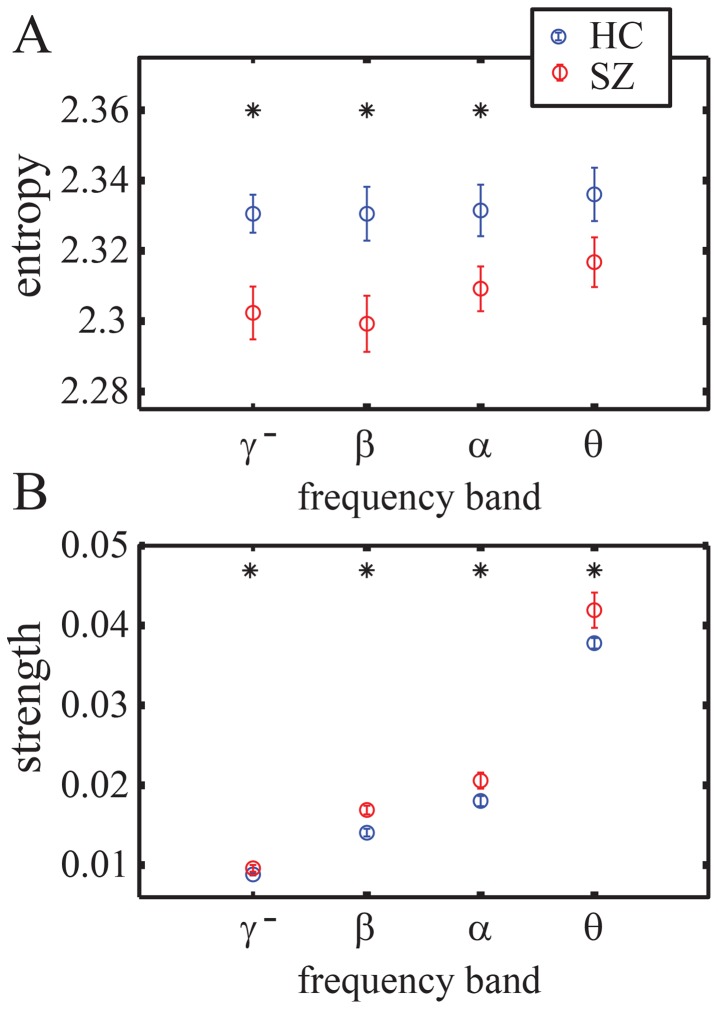
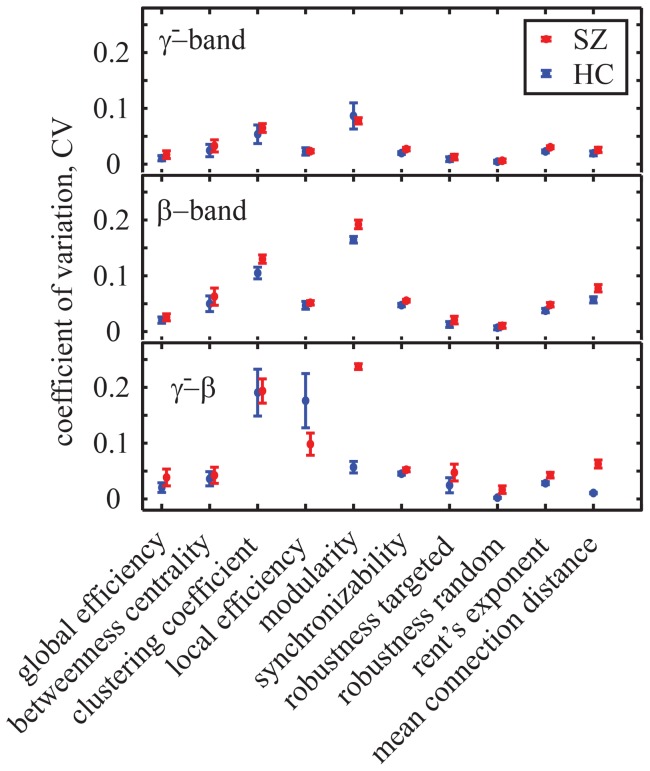
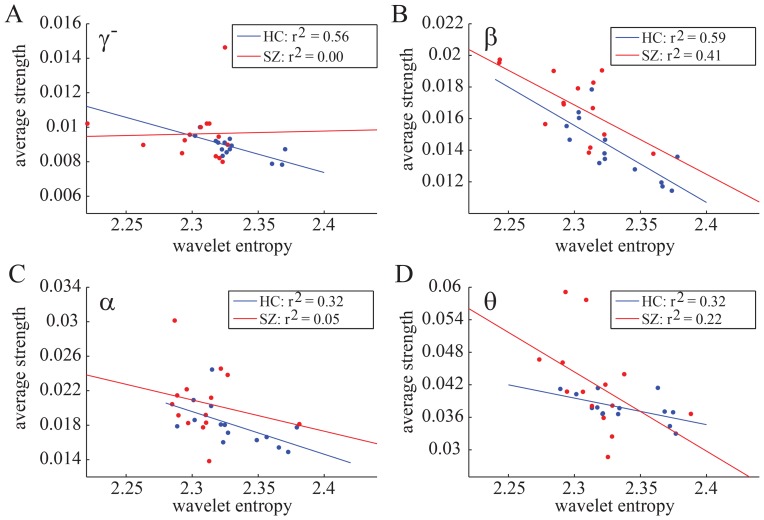
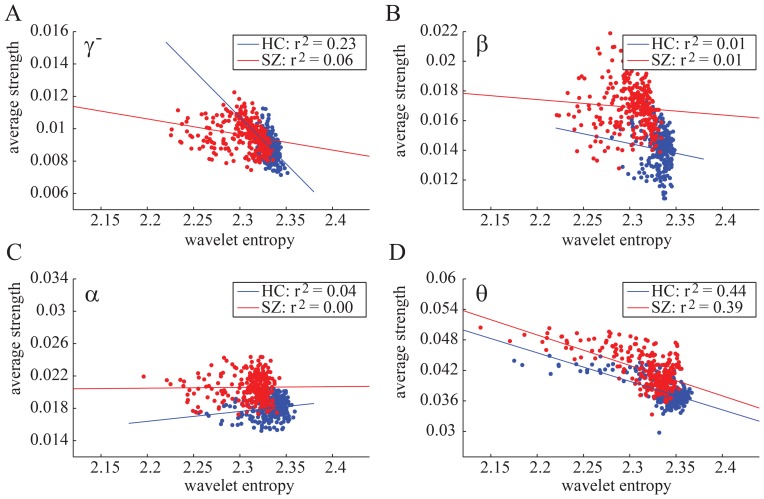
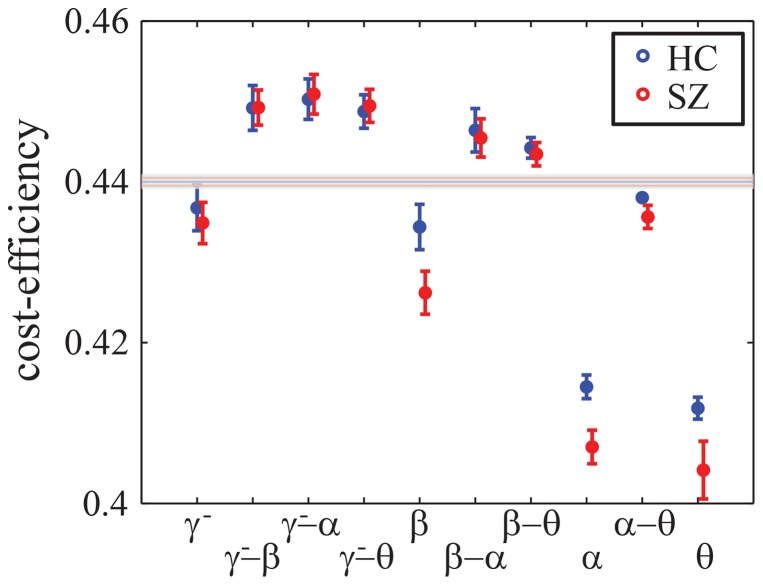
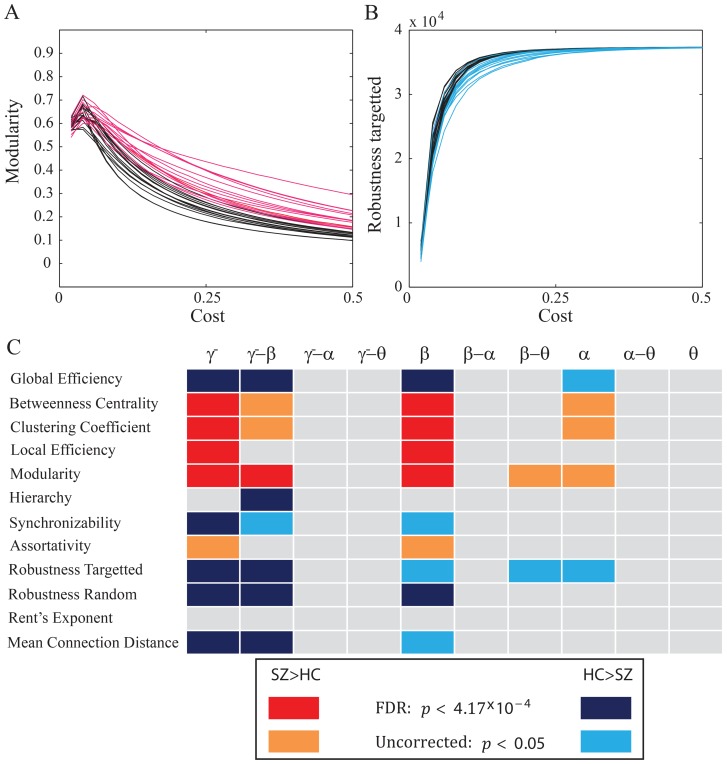
Empirical studies over the past two decades have provided support for the hypothesis that schizophrenia is characterized by altered connectivity patterns in functional brain networks. These alterations have been proposed as genetically mediated diagnostic biomarkers and are thought to underlie altered cognitive functions such as working memory. However, the nature of this dysconnectivity remains far from understood. In this study, we perform an extensive analysis of functional connectivity patterns extracted from MEG data in 14 subjects with schizophrenia and 14 healthy controls during a 2-back working memory task. We investigate uni-, bi- and multivariate properties of sensor time series by computing wavelet entropy of and correlation between time series, and by constructing binary networks of functional connectivity both within and between classical frequency bands ([Formula: see text], [Formula: see text], [Formula: see text], and [Formula: see text]). Networks are based on the mutual information between wavelet time series, and estimated for each trial window separately, enabling us to consider both network topology and network dynamics. We observed significant decreases in time series entropy and significant increases in functional connectivity in the schizophrenia group in comparison to the healthy controls and identified an inverse relationship between these measures across both subjects and sensors that varied over frequency bands and was more pronounced in controls than in patients. The topological organization of connectivity was altered in schizophrenia specifically in high frequency [Formula: see text] and [Formula: see text] band networks as well as in the [Formula: see text]-[Formula: see text] cross-frequency networks. Network topology varied over trials to a greater extent in patients than in controls, suggesting disease-associated alterations in dynamic network properties of brain function. Our results identify signatures of aberrant neurophysiological behavior in schizophrenia across uni-, bi- and multivariate scales and lay the groundwork for further clinical studies that might lead to the discovery of new intermediate phenotypes.
过去二十年的实证研究为精神分裂症的特征是功能性大脑网络连接模式改变的假设提供了支持。这些改变被提出作为遗传介导的诊断生物标志物,被认为是改变工作记忆等认知功能的基础。然而,这种去连接的性质仍然远未被理解。在这项研究中,我们对 14 名精神分裂症患者和 14 名健康对照者在进行 2 背工作记忆任务时从 MEG 数据中提取的功能连接模式进行了广泛的分析。我们通过计算时间序列之间的小波熵和相关性以及构建功能连接的二进制网络([Formula: see text]、[Formula: see text]、[Formula: see text] 和 [Formula: see text])来研究传感器时间序列的单变量、双变量和多变量特性。网络基于小波时间序列之间的互信息,并分别为每个试验窗口进行估计,使我们能够同时考虑网络拓扑结构和网络动态。与健康对照组相比,我们观察到精神分裂症组的时间序列熵显著降低,功能连接显著增加,并在两个组的个体和传感器中发现这些测量值之间存在反比关系,在对照组中比在患者中更为明显。连接的拓扑组织在精神分裂症中发生改变,特别是在高频 [Formula: see text] 和 [Formula: see text] 波段网络以及 [Formula: see text]-[Formula: see text] 跨频网络中。与对照组相比,患者的网络拓扑在试验中变化更大,这表明与疾病相关的脑功能动态网络特性发生改变。我们的结果在单变量、双变量和多变量尺度上确定了精神分裂症中异常神经生理行为的特征,并为进一步的临床研究奠定了基础,这些研究可能会发现新的中间表型。