Department of Radiation Oncology, Emory University, Atlanta, Georgia, USA.
Ultrasound Med Biol. 2013 Nov;39(11):2166-75. doi: 10.1016/j.ultrasmedbio.2013.04.006. Epub 2013 Aug 27.
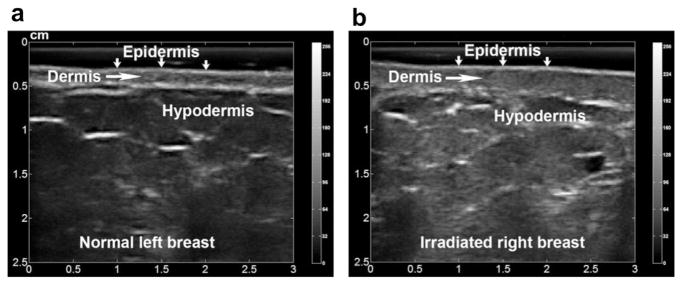
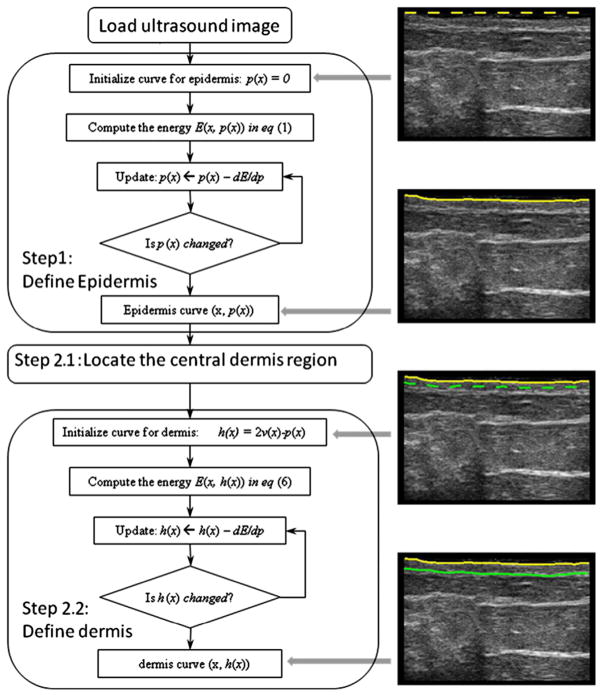
Skin toxicity is the most common side effect of breast cancer radiotherapy and impairs the quality of life of many breast cancer survivors. We, along with other researchers, have recently found quantitative ultrasound to be effective as a skin toxicity assessment tool. Although more reliable than standard clinical evaluations (visual observation and palpation), the current procedure for ultrasound-based skin toxicity measurements requires manual delineation of the skin layers (i.e., epidermis-dermis and dermis-hypodermis interfaces) on each ultrasound B-mode image. Manual skin segmentation is time consuming and subjective. Moreover, radiation-induced skin injury may decrease image contrast between the dermis and hypodermis, which increases the difficulty of delineation. Therefore, we have developed an automatic skin segmentation tool (ASST) based on the active contour model with two significant modifications: (i) The proposed algorithm introduces a novel dual-curve scheme for the double skin layer extraction, as opposed to the original single active contour method. (ii) The proposed algorithm is based on a geometric contour framework as opposed to the previous parametric algorithm. This ASST algorithm was tested on a breast cancer image database of 730 ultrasound breast images (73 ultrasound studies of 23 patients). We compared skin segmentation results obtained with the ASST with manual contours performed by two physicians. The average percentage differences in skin thickness between the ASST measurement and that of each physician were less than 5% (4.8 ± 17.8% and -3.8 ± 21.1%, respectively). In summary, we have developed an automatic skin segmentation method that ensures objective assessment of radiation-induced changes in skin thickness. Our ultrasound technology offers a unique opportunity to quantify tissue injury in a more meaningful and reproducible manner than the subjective assessments currently employed in the clinic.
皮肤毒性是乳腺癌放疗最常见的副作用,会降低许多乳腺癌幸存者的生活质量。我们与其他研究人员最近发现,定量超声是一种有效的皮肤毒性评估工具。虽然比标准临床评估(视觉观察和触诊)更可靠,但目前基于超声的皮肤毒性测量程序需要手动描绘每个超声 B 模式图像上的皮肤层(即表皮-真皮和真皮-皮下界面)。手动皮肤分割既耗时又主观。此外,辐射引起的皮肤损伤可能会降低真皮和皮下之间的图像对比度,从而增加描绘的难度。因此,我们基于主动轮廓模型开发了一种自动皮肤分割工具(ASST),并进行了两项重大修改:(i)所提出的算法引入了一种新的双曲线方案,用于双皮肤层提取,而不是原始的单主动轮廓方法。(ii)所提出的算法基于几何轮廓框架,而不是以前的参数算法。该 ASST 算法在一个包含 730 个乳腺癌超声图像(23 名患者的 73 个超声研究)的乳腺癌图像数据库上进行了测试。我们将 ASST 获得的皮肤分割结果与两名医生进行的手动轮廓进行了比较。ASST 测量的皮肤厚度与每位医生的测量结果之间的平均百分比差异小于 5%(分别为 4.8 ± 17.8%和-3.8 ± 21.1%)。总之,我们已经开发出一种自动皮肤分割方法,可确保对皮肤厚度的辐射诱导变化进行客观评估。我们的超声技术提供了一个独特的机会,可以比临床中目前使用的主观评估更有意义和可重复地量化组织损伤。