Ellegood J, Markx S, Lerch J P, Steadman P E, Genç C, Provenzano F, Kushner S A, Henkelman R M, Karayiorgou M, Gogos J A
Mouse Imaging Centre, Hospital for Sick Children, Toronto, Ontario, Canada.
Department of Psychiatry, College of Physicians and Surgeons, Columbia University, New York, New York, USA.
Mol Psychiatry. 2014 Jan;19(1):99-107. doi: 10.1038/mp.2013.112. Epub 2013 Sep 3.
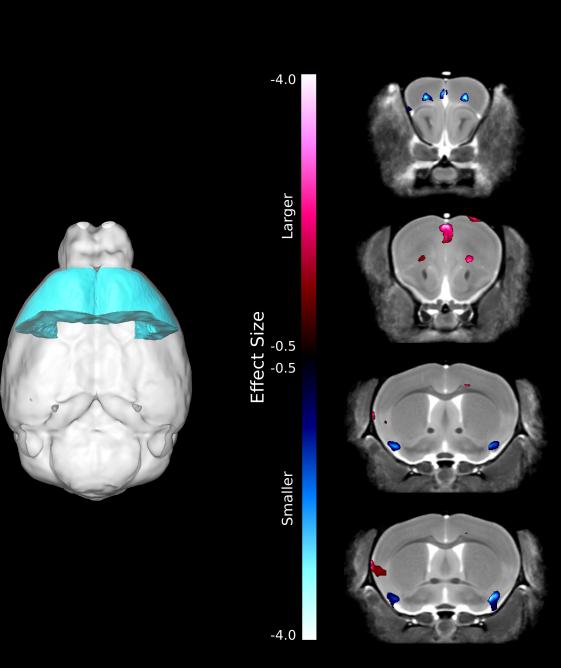
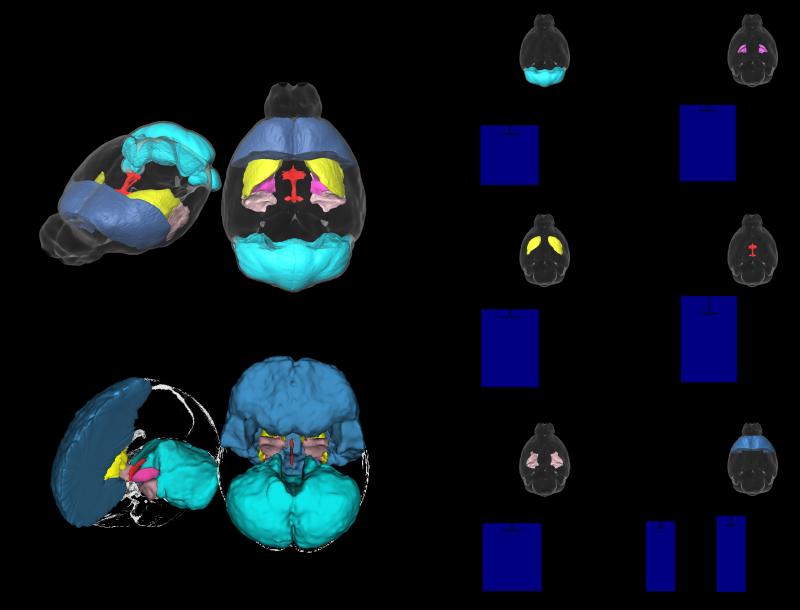
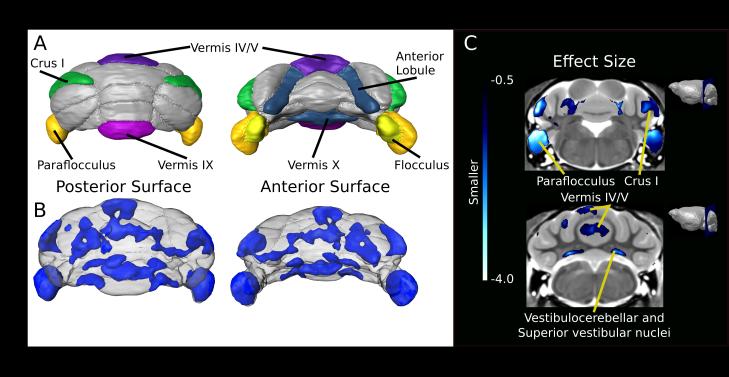
Recurrent deletions at the 22q11.2 locus have been established as a strong genetic risk factor for the development of schizophrenia and cognitive dysfunction. Individuals with 22q11.2 deletions have a range of well-defined volumetric abnormalities in a number of critical brain structures. A mouse model of the 22q11.2 deletion (Df(16)A(+/-)) has previously been utilized to characterize disease-associated abnormalities on synaptic, cellular, neurocircuitry, and behavioral levels. We performed a high-resolution MRI analysis of mutant mice compared with wild-type littermates. Our analysis revealed a striking similarity in the specific volumetric changes of Df(16)A(+/-) mice compared with human 22q11.2 deletion carriers, including in cortico-cerebellar, cortico-striatal and cortico-limbic circuits. In addition, higher resolution magnetic resonance imaging compared with neuroimaging in human subjects allowed the detection of previously unknown subtle local differences. The cerebellar findings in Df(16)A(+/-) mice are particularly instructive as they are localized to specific areas within both the deep cerebellar nuclei and the cerebellar cortex. Our study indicates that the Df(16)A(+/-)mouse model recapitulates most of the hallmark neuroanatomical changes observed in 22q11.2 deletion carriers. Our findings will help guide the design and interpretation of additional complementary studies and thereby advance our understanding of the abnormal brain development underlying the emergence of 22q11.2 deletion-associated psychiatric and cognitive symptoms.
22q11.2位点的反复缺失已被确认为精神分裂症和认知功能障碍发生的一个强大遗传风险因素。患有22q11.2缺失的个体在一些关键脑结构中存在一系列明确的体积异常。先前已利用22q11.2缺失的小鼠模型(Df(16)A(+/-))在突触、细胞、神经回路和行为水平上表征与疾病相关的异常。我们对突变小鼠与野生型同窝小鼠进行了高分辨率MRI分析。我们的分析显示,与人类22q11.2缺失携带者相比,Df(16)A(+/-)小鼠的特定体积变化具有惊人的相似性,包括在皮质 - 小脑、皮质 - 纹状体和皮质 - 边缘回路中。此外,与人类受试者的神经成像相比,更高分辨率的磁共振成像能够检测到以前未知的细微局部差异。Df(16)A(+/-)小鼠的小脑发现特别具有启发性,因为它们定位于小脑深部核团和小脑皮质内的特定区域。我们的研究表明,Df(16)A(+/-)小鼠模型概括了在22q11.2缺失携带者中观察到的大多数标志性神经解剖学变化。我们的发现将有助于指导其他补充研究的设计和解释,从而推动我们对22q11.2缺失相关精神和认知症状出现背后异常脑发育的理解。