Department of Biomedicinal Science & Biotechnology, Pai-Chai University, Daejon 302-735, Republic of Korea ; School of Biological Sciences and Technology, Chonnam National University, Gwangju 500-757, Republic of Korea.
Biomol Ther (Seoul). 2012 Sep;20(5):492-8. doi: 10.4062/biomolther.2012.20.5.492.
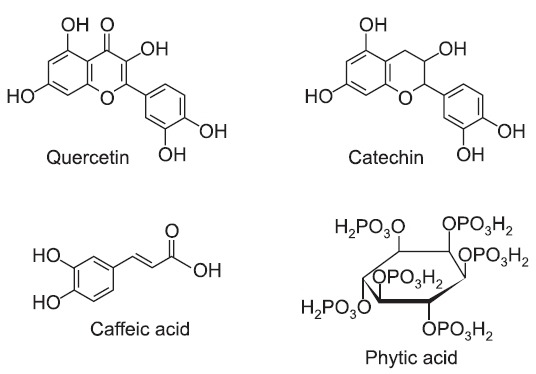
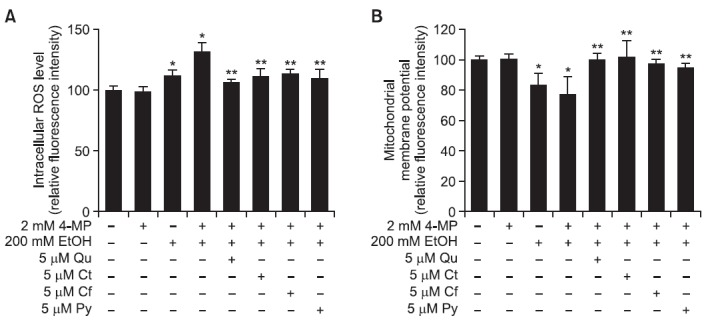
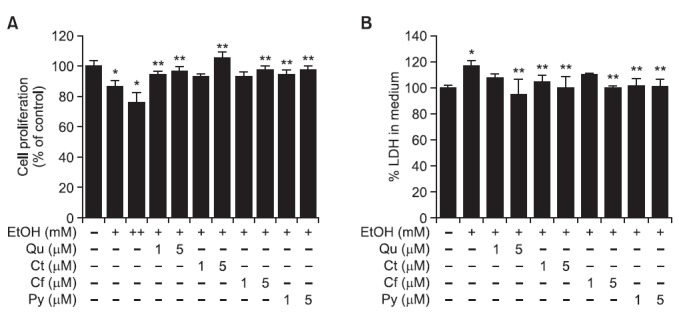
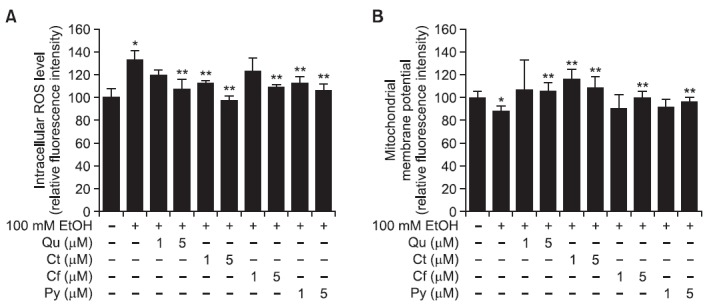
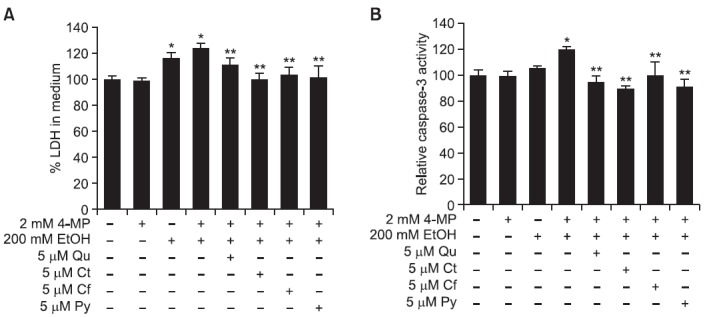
Phytochemicals have been known to exhibit potent antioxidant activity. This study examined cytoprotective effects of phytochemicals including quercetin, catechin, caffeic acid, and phytic acid against oxidative damage in SK-Hep-1 cells induced by the oxidative and non-oxidative metabolism of ethanol. Exposure of the cells to excess ethanol resulted in a significant increase in cytotoxicity, reactive oxygen species (ROS) production, lipid hydroperoxide (LPO), and antioxidant enzyme activity. Excess ethanol also caused a reduction in mitochondrial membrane potential (MMP) and the quantity of reduced glutathione (GSH). Co-treatment of cells with ethanol and quercetin, catechin, caffeic acid and phytic acid significantly inhibited oxidative ethanol metabolism-induced cytotoxicity by blocking ROS production. When the cells were treated with ethanol after pretreatment of 4-methylpyrazole (4-MP), increased cytotoxicity, ROS production, antioxidant enzyme activity, and loss of MMP were observed. The addition of quercetin, catechin, caffeic acid and phytic acid to these cells showed suppression of non-oxidative ethanol metabolism-induced cytotoxicity, similar to oxidative ethanol metabolism. These results suggest that quercetin, catechin, caffeic acid and phytic acid have protective effects against ethanol metabolism-induced oxidative insult in SK-Hep-1 cells by blocking ROS production and elevating antioxidant potentials.
植物化学物质已被证实具有很强的抗氧化活性。本研究考察了植物化学物质(包括槲皮素、儿茶素、咖啡酸和植酸)对乙醇氧化和非氧化代谢诱导的 SK-Hep-1 细胞氧化损伤的细胞保护作用。细胞暴露于过量乙醇会导致细胞毒性、活性氧(ROS)产生、脂质过氧化物(LPO)和抗氧化酶活性显著增加。过量乙醇还会导致线粒体膜电位(MMP)和还原型谷胱甘肽(GSH)含量降低。细胞与乙醇和槲皮素、儿茶素、咖啡酸和植酸共同处理可通过阻断 ROS 产生来抑制氧化乙醇代谢诱导的细胞毒性。当用 4-甲基吡唑(4-MP)预处理细胞后再用乙醇处理时,观察到细胞毒性、ROS 产生、抗氧化酶活性和 MMP 丧失增加。向这些细胞中添加槲皮素、儿茶素、咖啡酸和植酸可抑制非氧化乙醇代谢诱导的细胞毒性,类似于氧化乙醇代谢。这些结果表明,槲皮素、儿茶素、咖啡酸和植酸通过阻断 ROS 产生和提高抗氧化能力对乙醇代谢诱导的 SK-Hep-1 细胞氧化损伤具有保护作用。