Yoo Yeon-Jee, Lee Woocheol, Kim Hyeon-Cheol, Shon Won-Jun, Baek Seung-Ho
Department of Conservative Dentistry, Seoul National University School of Dentistry and Dental Research Institute, Seoul, Korea.
Restor Dent Endod. 2013 Aug;38(3):154-9. doi: 10.5395/rde.2013.38.3.154. Epub 2013 Aug 23.
The aim of this study was to compare the cleaning efficacy of different final irrigation regimens in canal and isthmus of mandibular molars, and to evaluate the influence of related variables on cleaning efficacy of the irrigation systems.
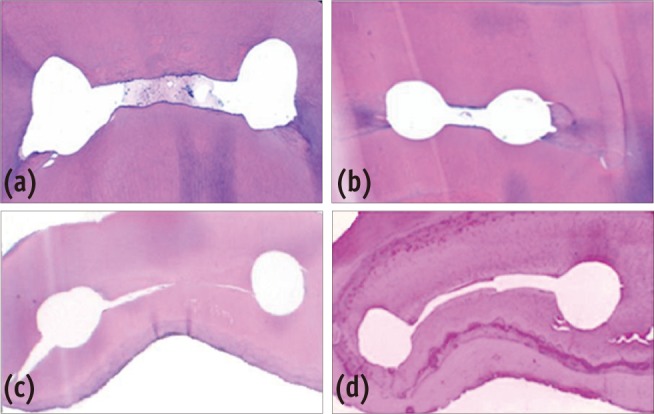
Mesial root canals from 60 mandibular molars were prepared and divided into 4 experimental groups according to the final irrigation technique: Group C, syringe irrigation; Group U, ultrasonics activation; Group SC, VPro StreamClean irrigation; Group EV, EndoVac irrigation. Cross-sections at 1, 3 and 5 mm levels from the apex were examined to calculate remaining debris area in the canal and isthmus spaces. Statistical analysis was completed by using Kruskal-Wallis test and Mann-Whitney U test for comparison among groups, and multivariate linear analysis to identify the significant variables (regular replenishment of irrigant, vapor lock management, and ultrasonic activation of irrigant) affecting the cleaning efficacy of the experimental groups.
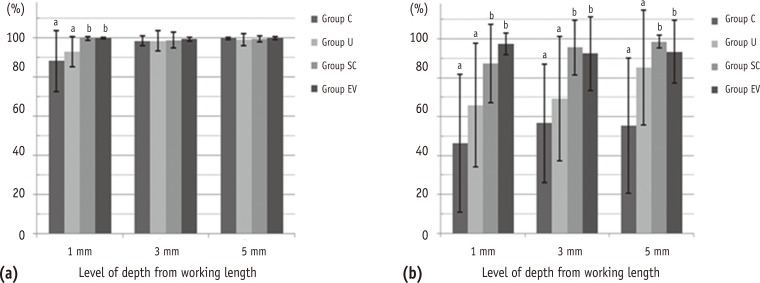
Group SC and EV showed significantly higher canal cleanliness values than group C and U at 1 mm level (p < 0.05), and higher isthmus cleanliness values than group U at 3 mm and all levels of group C (p < 0.05). Multivariate linear regression analysis demonstrated that all variables had independent positive correlation at 1 mm level of canal and at all levels of isthmus with statistical significances.
Both VPro StreamClean and EndoVac system showed favorable result as final irrigation regimens for cleaning debris in the complicated root canal system having curved canal and/or isthmus. The debridement of the isthmi significantly depends on the variables rather than the canals.
本研究旨在比较不同最终冲洗方案在下颌磨牙根管和峡部的清洁效果,并评估相关变量对冲洗系统清洁效果的影响。
制备60颗下颌磨牙的近中根管,并根据最终冲洗技术分为4个实验组:C组,注射器冲洗;U组,超声激活冲洗;SC组,VPro StreamClean冲洗;EV组,EndoVac冲洗。检查根尖1、3和5mm水平的横截面,以计算根管和峡部空间中残留碎屑面积。采用Kruskal-Wallis检验和Mann-Whitney U检验进行组间比较,并进行多变量线性分析以确定影响实验组清洁效果的显著变量(冲洗液的定期补充、气锁管理和冲洗液的超声激活)。
在1mm水平时,SC组和EV组的根管清洁度值显著高于C组和U组(p<0.05),在3mm水平时,SC组和EV组的峡部清洁度值高于U组,且在C组的所有水平上均高于C组(p<0.05)。多变量线性回归分析表明,所有变量在根管1mm水平和峡部的所有水平上均具有独立的正相关关系,且具有统计学意义。
VPro StreamClean系统和EndoVac系统作为最终冲洗方案在清洁具有弯曲根管和/或峡部的复杂根管系统中的碎屑方面均显示出良好效果。峡部的清创显著取决于变量而非根管。