Centers for Disease Control, Department of Health, Taipei, Taiwan ; Ph.D. Program, School of Public Health, Taipei Medical University, Taipei, Taiwan ; Division of Infectious Diseases, Department of Internal Medicine, Taipei Medical University Hospital, Taipei Medical University, Taipei, Taiwan.
PLoS One. 2013 Aug 27;8(8):e73069. doi: 10.1371/journal.pone.0073069. eCollection 2013.
To evaluate the T-SPOT.TB interferon-γ releasing assay and the tuberculin skin test (TST), for the diagnosis of latent tuberculosis infection(LTBI) and the development of subsequent active tuberculosis, in BCG-vaccinated HIV-infected individuals.
HIV-infected individuals without clinical suspicion of active TB or a past history of TB were enrolled from 1 January 2008 to 30 November 2010. Both T-SPOT.TB test and TST were offered to the participants whom were followed up prospectively until April 30, 2012 for development of TB.
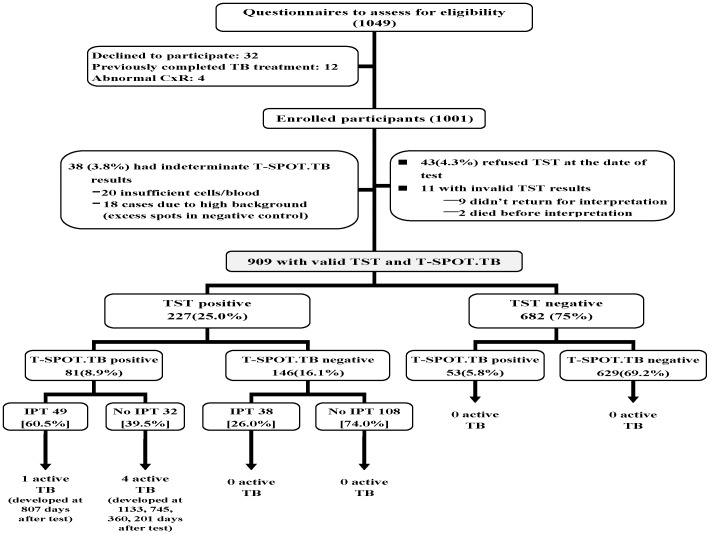
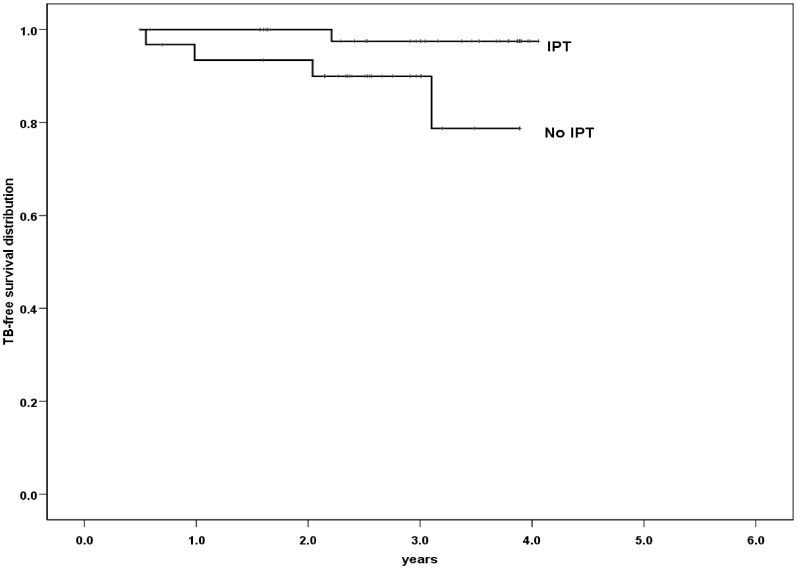
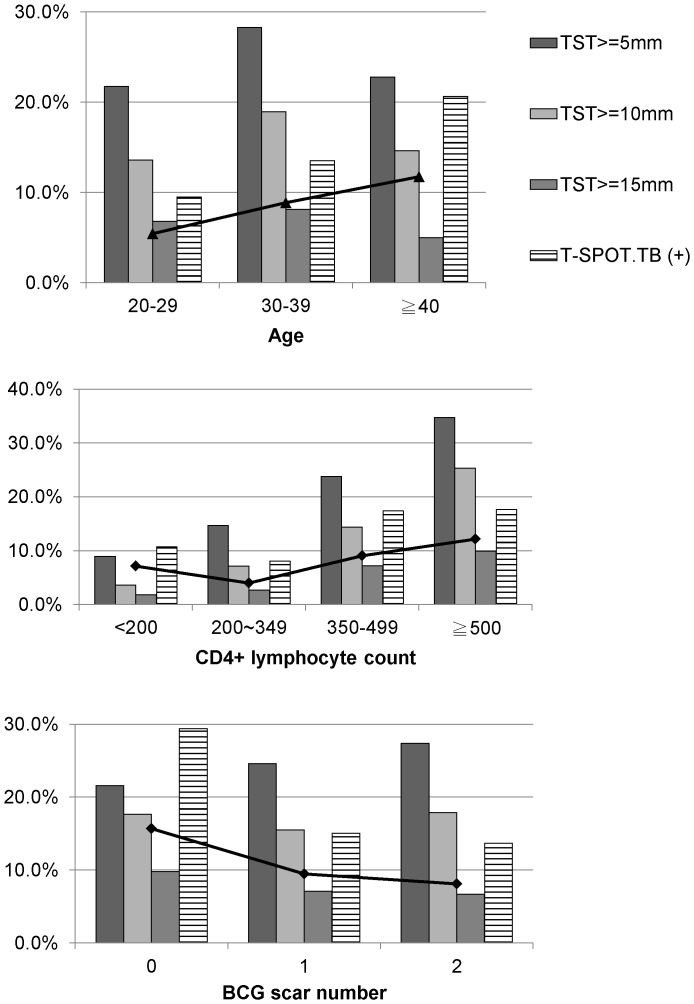
Among the 909 participants, 25% had positive TST reactions with cut-off point of 5 mm and 15% had positive T-SPOT.TB results. After a median follow-up of 2.97 years, there were 5 cases developed culture-confirmed active TB (all had dual positive TST and T-SPOT.TB results), and the incidence was 0.17 per 100 person-years. The relative risks (RRs) for subsequent active TB in HIV-infected individuals with positive TST results, positive T-SPOT.TB results and dual positive results compared with the risk for individuals with negative results were 40.6 (95% CI 2.1-767.9), 73.9 (95% CI 3.9-1397.7) and 226.5 (95% CI 12.0-4284), respectively. The number needed to treat to prevent one subsequent TB case among patients with a positive TST, a positive T-SPOT.TB and dual positive results was 35, 22 and 8 respectively.
Adopting positive results of the TST and T-SPOT.TB to screen LTBI among BCG-vaccinated HIV-infected individuals might be feasible. Number needed to treat for isoniazid preventive therapy could be reduced significantly by using dual positive strategy.
评估 T-SPOT.TB 干扰素释放试验和结核菌素皮肤试验(TST)在卡介苗(BCG)接种的 HIV 感染者中诊断潜伏性结核感染(LTBI)和随后发生活动性结核的价值。
2008 年 1 月 1 日至 2010 年 11 月 30 日,招募无活动性结核临床疑似症状或既往结核病史的 HIV 感染者。所有参与者均接受 T-SPOT.TB 检测和 TST,前瞻性随访至 2012 年 4 月 30 日,以明确结核发病情况。
909 例参与者中,25%的 TST 反应阳性(截断值为 5mm),15%的 T-SPOT.TB 结果阳性。中位随访 2.97 年后,有 5 例培养确诊的活动性结核(均为 TST 和 T-SPOT.TB 双重阳性),发病率为 0.17 例/100 人年。与 TST 和 T-SPOT.TB 结果均阴性的参与者相比,TST 阳性、T-SPOT.TB 阳性和双重阳性的 HIV 感染者发生后续活动性结核的相对风险(RR)分别为 40.6(95%CI 2.1-767.9)、73.9(95%CI 3.9-1397.7)和 226.5(95%CI 12.0-4284)。TST、T-SPOT.TB 和双重阳性检测结果阳性者中,每治疗 35、22 和 8 例可预防 1 例后续结核发病。
在 BCG 接种的 HIV 感染者中,采用 TST 和 T-SPOT.TB 检测阳性结果筛查 LTBI 可能是可行的。采用双重阳性策略可显著减少异烟肼预防治疗的治疗人数。