School of Biological Sciences, Nanyang Technological University, Singapore, Singapore.
PLoS One. 2013 Aug 27;8(8):e73344. doi: 10.1371/journal.pone.0073344. eCollection 2013.
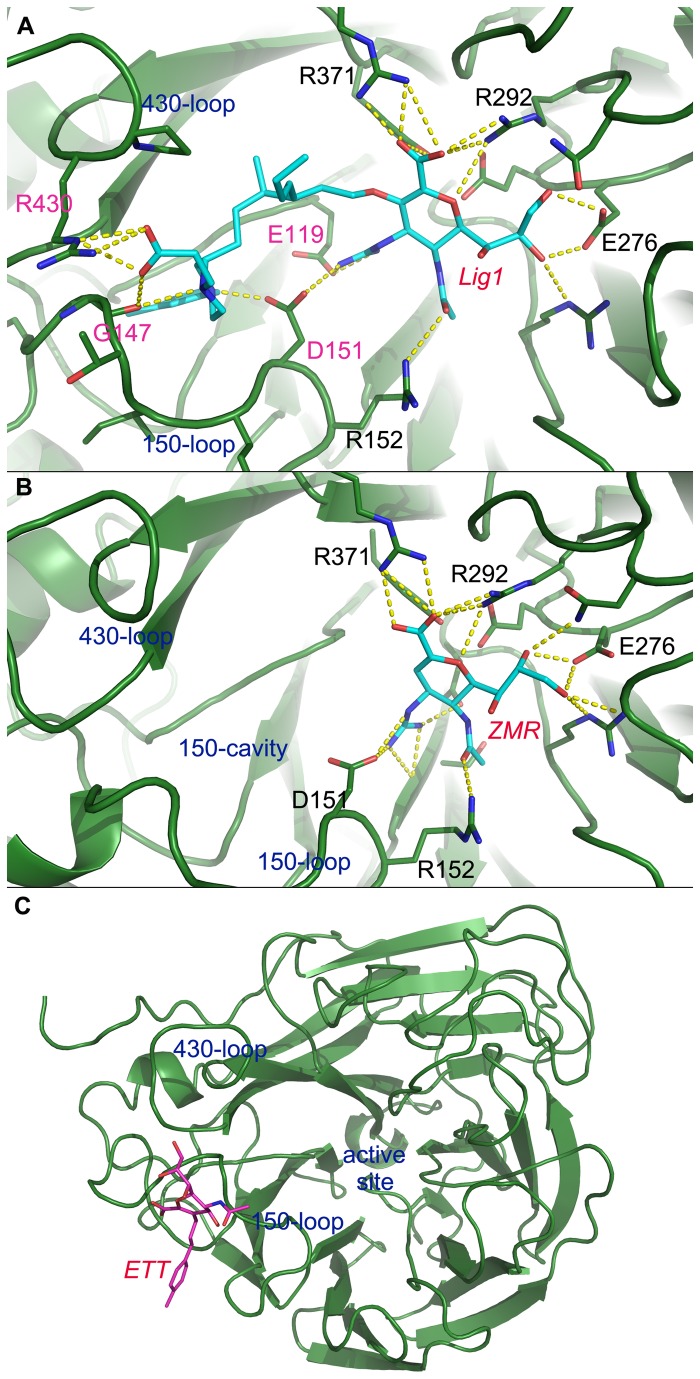
Neuraminidase (NA) of influenza is a key target for virus infection control and the recently discovered open 150-cavity in group-1 NA provides new opportunity for novel inhibitors design. In this study, we used a combination of theoretical methods including fragment docking, molecular linking and molecular dynamics simulations to design ligands that specifically target at the 150-cavity. Through in silico screening of a fragment compound library on the open 150-cavity of NA, a few best scored fragment compounds were selected to link with Zanamivir, one NA-targeting drug. The resultant new ligands may bind both the active site and the 150-cavity of NA simultaneously. Extensive molecular dynamics simulations in explicit solvent were applied to validate the binding between NA and the designed ligands. Moreover, two control systems, a positive control using Zanamivir and a negative control using a low-affinity ligand 3-(p-tolyl) allyl-Neu5Ac2en (ETT, abbreviation reported in the PDB) found in a recent experimental work, were employed to calibrate the simulation method. During the simulations, ETT was observed to detach from NA, on the contrary, both Zanamivir and our designed ligand bind NA firmly. Our study provides a prospective way to design novel inhibitors for controlling the spread of influenza virus.
流感神经氨酸酶(NA)是病毒感染控制的关键靶点,最近发现的 1 型 NA 的开放 150 腔为新型抑制剂的设计提供了新的机会。在这项研究中,我们使用了包括片段对接、分子连接和分子动力学模拟在内的理论方法的组合,来设计专门针对 150 腔的配体。通过对 NA 的开放 150 腔的片段化合物库进行计算机筛选,选择了几个得分最高的片段化合物与 NA 靶向药物扎那米韦进行连接。所得的新配体可能同时结合 NA 的活性位点和 150 腔。在明确定义的溶剂中进行了广泛的分子动力学模拟,以验证 NA 与设计配体之间的结合。此外,还使用了两个对照体系,一个使用扎那米韦的阳性对照和一个在最近的实验工作中发现的低亲和力配体 3-(对甲苯基)烯丙基-Neu5Ac2en(ETT,在 PDB 中报告的缩写)的阴性对照,来校准模拟方法。在模拟过程中,观察到 ETT 从 NA 上脱离,相反,扎那米韦和我们设计的配体都与 NA 牢固结合。我们的研究为设计新型抑制剂以控制流感病毒的传播提供了一种有前景的方法。